The Speedmaster got the Moon. Gagarin, Schirra, White, Swigert, Scott, Pogue and Furrer packed other watches: a Sturmanskie, a GMT-Master, a yellow Seiko in a pocket, and a Sinn that Sinn still talks about.
Yuri Gagarin wore a Sturmanskie on Vostok 1 in April 1961. John Glenn took a Heuer 2915A stopwatch around the Earth in February 1962, Scott Carpenter followed with a 24-hour Navitimer Cosmonaute 809, and Wally Schirra wore his own Speedmaster CK2998 in October. NASA had not yet qualified a wrist chronograph.
Alexei Leonov left Voskhod 2 in March with a Strela 3017 on his sleeve, the first watch worn outside a spacecraft. NASA had a qualified Speedmaster on the Gemini 3 crew the same month. Pete Conrad wore a Glycine Airman on Gemini 5 that August, the first automatic wristwatch in space.
1970-1972
Personal Apollo
Jack Swigert flew Apollo 13 with a personal GMT-Master under the suit. Edgar Mitchell suited up for Apollo 14 with a pair of 1675s; whether they reached the lunar surface is unfilmed. Dave Scott wore a prototype Bulova on Apollo 15 after his Speedmaster crystal popped off. Ron Evans sent a GMT-Master to Taurus-Littrow in a personal kit on Apollo 17.
William Pogue smuggled a yellow Seiko 6139 onto Skylab 4 and wore it for 84 days, Seiko on the left wrist and Speedmaster on the right. Gerald Carr brought a Movado Datachron, another automatic chronograph, on the same flight. Neither watch was NASA issue.
Reinhard Furrer wore a Sinn 140 S on Spacelab D1 in 1985. Fortis became Roscosmos kit in 1994 with the Official Cosmonauts Chronograph, flown on Mir and later the ISS until the B-42 replaced it in 2003. NASA added quartz options for the Shuttle cabin, including a G-Shock DW-5600C.
Omega released the analogue-digital Speedmaster Professional X-33 in 1998. The later titanium 3290.50.00 ran from 2001 to 2007 with quartz calibre 1666. The Skywalker X-33 added a hybrid LCD that NASA and the Smithsonian treat as crew equipment. For spacewalking, the mechanical Speedmaster remains the qualified watch.
Ask a collector which watch went to space and they will say Speedmaster, then they will say the Moon. NASA qualified it in 1965, Ed White wore a 105.003 over a Gemini 4 suit, and later Professional generations such as the 145.012 and 145.022 kept the issued line in production. Those Apollo Speedmasters have their own history. The rest of the luggage is stranger: a Heuer stopwatch on a glove strap, Soviet kit, a yellow Seiko in a pocket, a Rolex under a suit, and the quartz instruments NASA later allowed inside the orbiter.
Space agencies like issued instruments because they can test them. Astronauts like the watch they already know how to read. The gap between those two instincts is most of this list: smuggled pieces, base-exchange bargains, a Fortis qualified by Roscosmos, a G-Shock approved for the Shuttle cabin. It was never the EVA watch.
On 12 April 1961 Yuri Gagarin left Baikonur in Vostok 1 and came back after one orbit. The watch on his wrist was a Sturmanskie from the First Moscow Watch Factory, the sort issued to Soviet air-force graduates, not a shop watch. Which exact model is still argued: Type 1 or Type 2, whether it was the piece he received at Orenburg in 1957. Two days later he showed Komsomolskaya Pravda an ordinary navigator's watch and said it still kept time. He later gave the watch to Marshal Vershinin; it is now in the Cosmonaut Training Centre museum. Collectors treat the Sturmanskie as the first watch a human wore in space, while allowing that a test flight in March may have sent a Pobeda 34-K up with a dog named Chernushka and a life-sized mannequin, the watch strapped to the animal's leg for the whole orbit.
Open space was a different job. On 18 March 1965 Alexei Leonov left Voskhod 2 on the first EVA, a white-dial Strela chronograph on his sleeve, calibre 3017. The First Moscow Watch Factory had been making that chronograph, based on a Swiss Venus, for Soviet air-force staff since 1959. It became the first watch worn outside a spacecraft. Ed White's American spacewalk was still three months away. The Strela stayed standard cosmonaut kit into the 1970s.
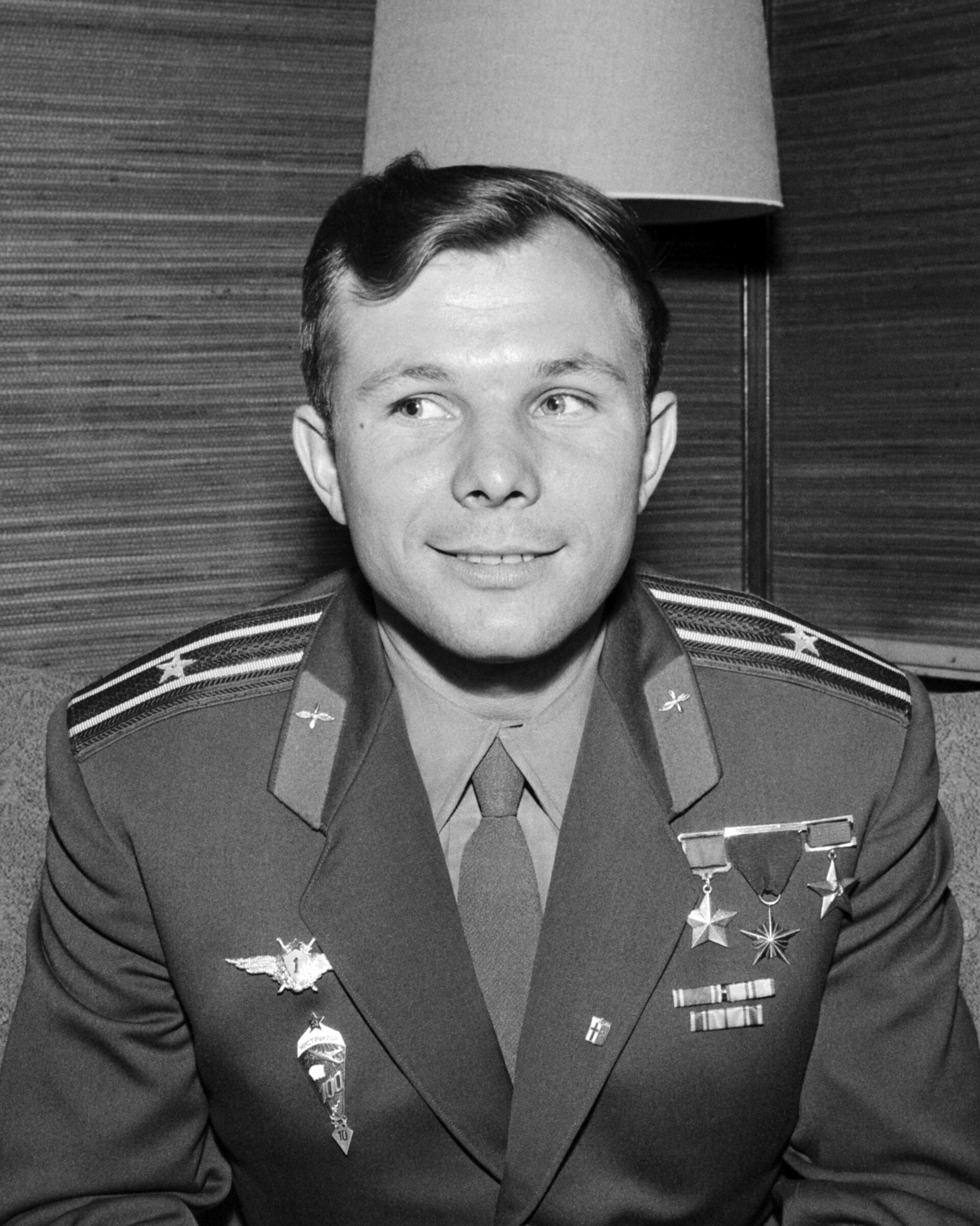
Yuri Gagarin in 1961. The Sturmanskie he wore on Vostok 1 was air-force issue, not a shop watch, and collectors still argue about which type it was, though never about who went first. Arto Jousi / /Suomen valokuvataiteen museo / Alma Media / Uuden Suomen kokoelma; Restored by Adam Cuerden / Wikimedia Commons - Public domain
1962
Mercury, when NASA still said no
John Glenn became the first American to orbit Earth on 20 February 1962, Friendship 7, with a Heuer 2915A Long Range stopwatch on an elastic strap over his glove. It was not a wristwatch. Heuer had built a handheld 1/5-second timer with a large onion crown at twelve o'clock, and NASA modified it so Glenn could wear it over the pressure-suit gloves. The first Swiss-made timekeeper in space lived on the suit, not on a wrist. Heuer still describes itself as the first Swiss watchmaker in space. The Smithsonian has the stopwatch now, in the same building as the Speedmasters that arrived later.
Three months later Scott Carpenter flew Aurora 7 with a 24-hour Breitling Navitimer Cosmonaute 809, the first Swiss wristwatch in orbit. Wally Schirra bought his own Speedmaster and wore it on Sigma 7 on 3 October 1962; Omega still calls that the first Omega in space. NASA had not qualified a wrist chronograph. The issued Moonwatch was still three years off, and Mercury crews were still packing whatever they already trusted.
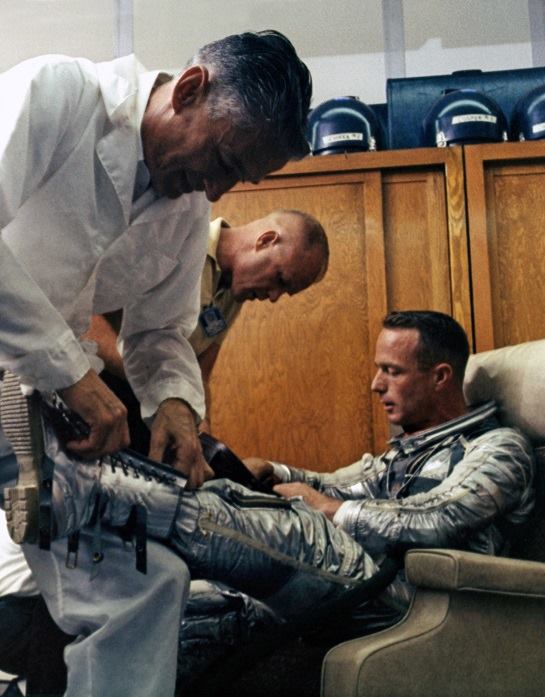
Scott Carpenter being dressed for Mercury-Atlas 7 in May 1962. The 24-hour Navitimer Cosmonaute he wore was the first Swiss wristwatch in orbit. The Navitimer story tells that one properly; here it gets a sentence. NASA / Wikimedia Commons - Public domain
NASA had a qualified chronograph on the Gemini 3 crew by 23 March 1965. Three months later the public photograph was still a Speedmaster, because that is what the agency issued. The watches that were not issued are the rest of this list.
The Smithsonian now holds 63 flown Speedmasters, most of them transferred after Apollo-Soyuz, because NASA treated issued watches as government property. Personal watches were a different argument, and they kept turning up in suit pockets and under cuffs: a GMT-Master, a prototype Bulova, a yellow Seiko, a Movado nobody asked for. Those went home in a kit bag, and they are the rest of this list.
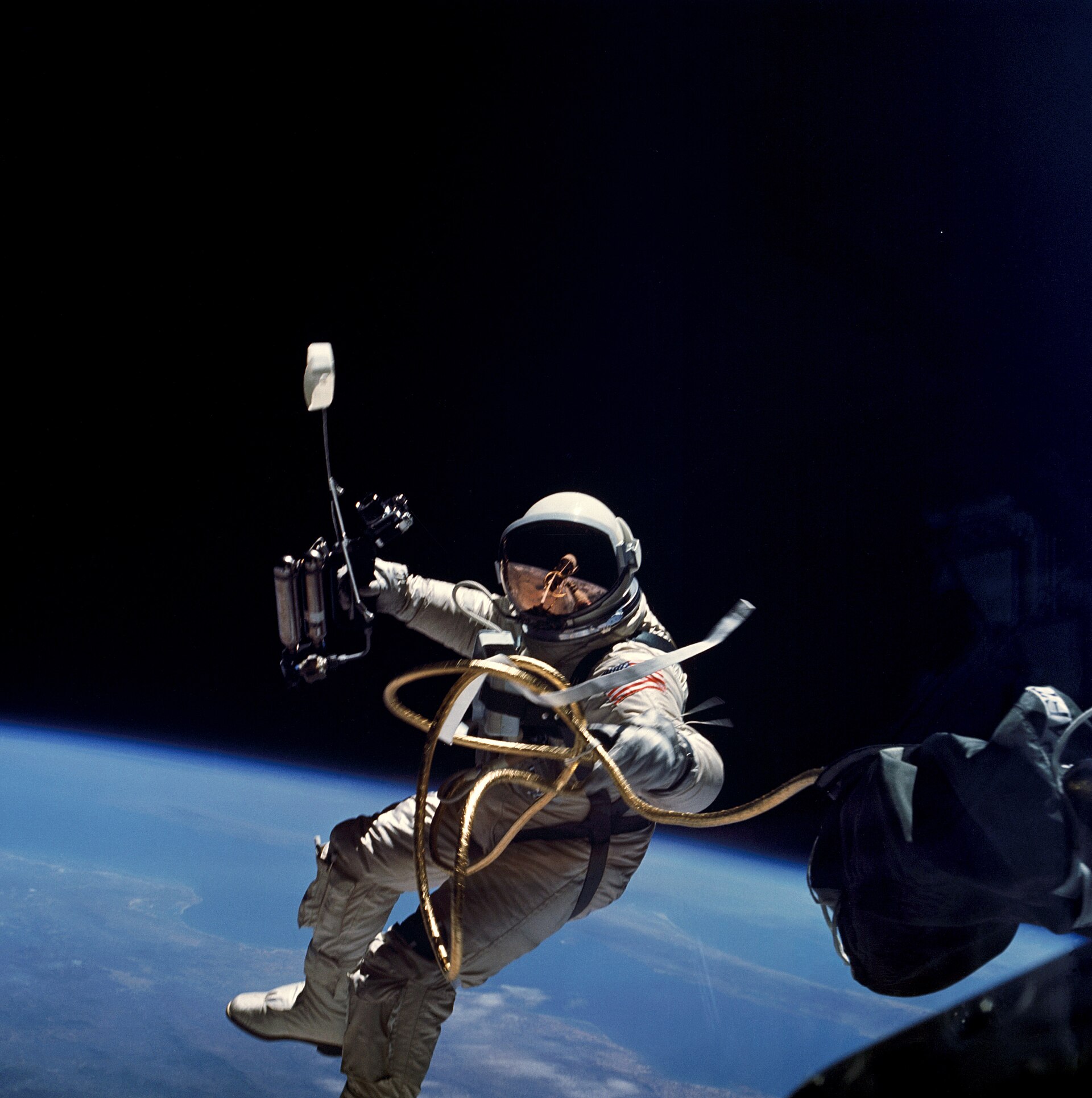
The photograph that turned a racing chronograph into a space watch. The Speedmaster 105.003 is on the long strap over White's suit sleeve, and it is the strap, as much as the movement, that made the picture. NASA / Wikimedia Commons - Public domain
Apollo 13 to 17
Swigert's GMT, Scott's spare, and a kit bag on the Moon
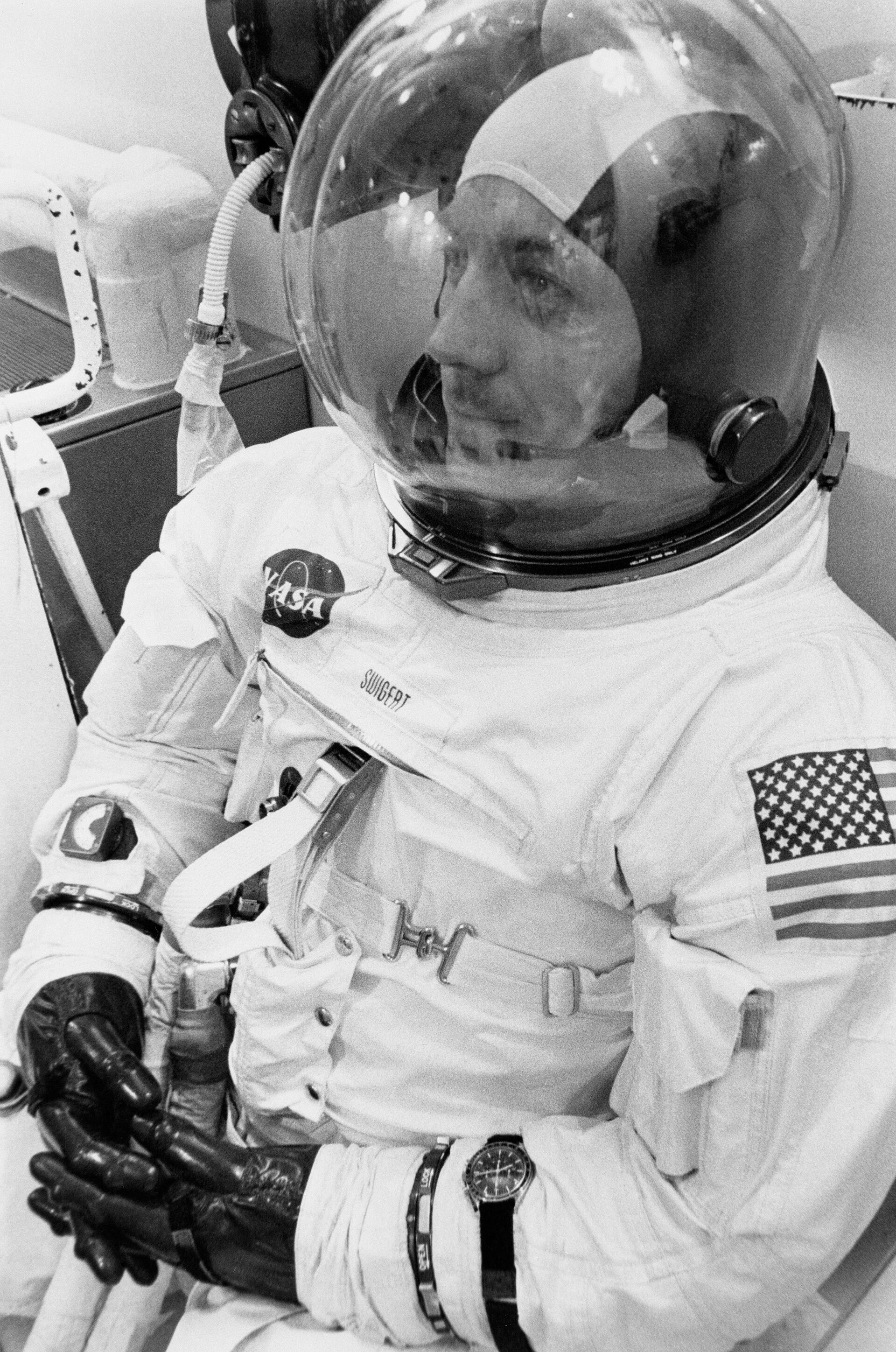
Jack Swigert replaced Ken Mattingly on Apollo 13 about 72 hours before launch. Suit-up photographs show a Rolex GMT-Master on his left wrist, under the suit. After splashdown he gave the watch to Rolex. Collectors read the Pepsi bezel as a 1675. Apollo 13 looped the Moon and never landed; the issued Speedmasters timed the burn that got them home, and that is the Moonwatch's story.
Edgar Mitchell suited up for Apollo 14 on 31 January 1971 with a pair of GMT-Master 1675s tucked under the inner cuffs of his A7L suit, one on each wrist. Command module pilot Stuart Roosa was wearing a GMT-Master that morning too. Mitchell wore the pair in command module Kitty Hawk. There is no footage of either watch aboard lunar module Antares, and none on the surface. Some accounts still call Mitchell's 1675 the first Rolex on the lunar surface. The suit-up is photographed; the walk is not.
On Apollo 17, command module pilot Ron Evans sent a private GMT-Master down to Taurus-Littrow in a personal-preference kit while he stayed in lunar orbit. The watch spent about 75 hours on the surface without walking. Dave Scott, commanding Apollo 15, had a more practical problem. He was the seventh person on the Moon and the first to drive the Lunar Rover, and during the second EVA the Hesalite crystal of his issued Speedmaster popped off. For the third, on 2 August 1971, he wore a prototype Bulova chronograph, model 88510/01, that the company had asked him to evaluate about four months before launch. RR Auction sold that watch in 2015 for $1,625,000, the only privately owned watch known to have been worn on the lunar surface. The 96B251 Lunar Pilot that Bulova sells now is the 2016 reissue: quartz at 262 kHz, 45 millimetres, a nylon strap marked 08021971.
Jack Swigert during Apollo 13 suit-up in April 1970. The watch on his left wrist is his own Rolex GMT-Master, worn under the suit alongside the issued Speedmaster that later timed the burn home. Ed Hengeveld / Wikimedia Commons - Public domain
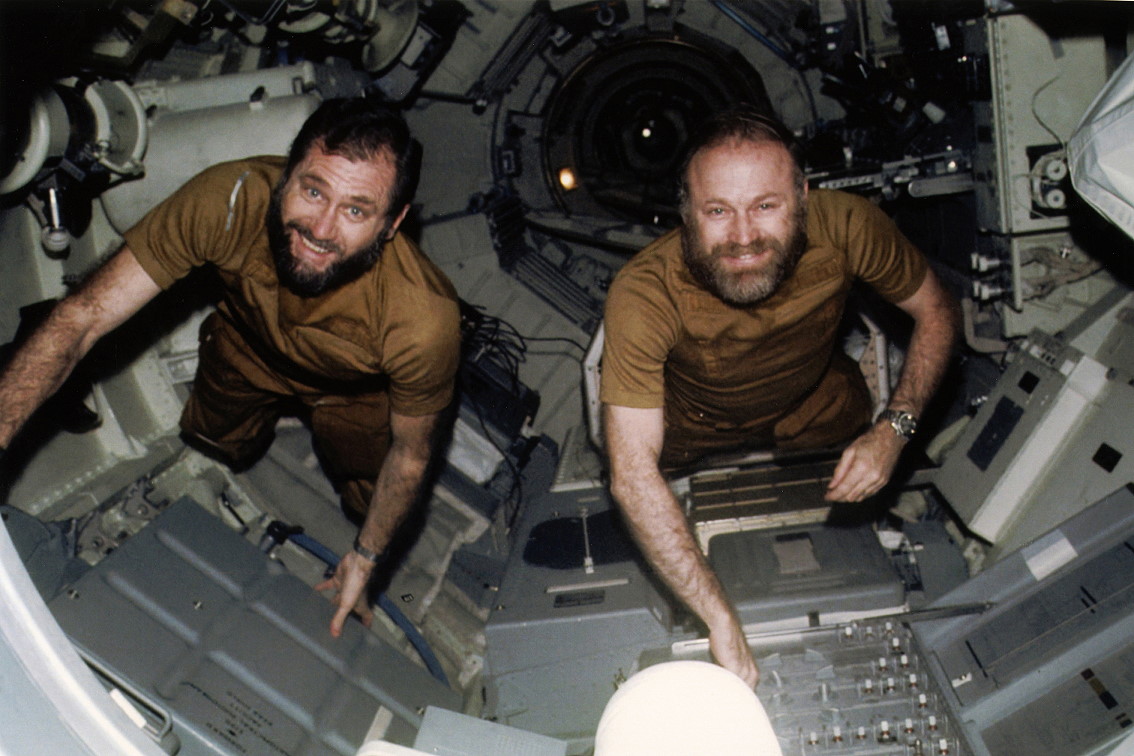
Colonel William Pogue bought a yellow 6139 at the Ellington AFB exchange in 1972. Revolution has him paying $71 on 13 June; a later collector reconstruction has a 6005 on layaway in September for $64. Either way it went into a suit-leg pocket at launch on 16 November 1973, without asking. NASA had not issued Speedmasters in time for his Skylab training, so he timed burns on the Seiko for more than six months and then took the watch he already knew. On the station he also became the first astronaut to go on strike, asking for less work and more time to look out of the window. For 84 days on Skylab 4 he wore the Seiko on one wrist and the issued Speedmaster on the other. He later confirmed that the automatic winding worked in zero-G.
The left wrist was the Seiko, the right wrist the Speedmaster. He kept the issued chronograph for EVAs, because that one was certified. The rotating inner bezel on the 6139 was what he used to time thruster burns, the same job it had done in the simulator. The Seiko's magic-lever winding, he told collector David Bruno who wrote to him in 2006, worked perfectly without gravity. Collectors call the yellow-dial, Pepsi-bezel 6139 the Pogue, usually under the 6139-6002 code. The US-market case is more likely a 6005: AUTOMATIC alone under the logo, rather than AUTOMATIC CHRONOGRAPH. The nickname stuck to 6002 anyway.
Commander Gerald Carr brought a Movado Datachron HS 360 on the same flight, another automatic chronograph, this one with an El Primero inside, and equally unauthorised. Two automatic chronographs spent the winter on Skylab, neither of them on the packing list. For a long time the Sinn 140 S that Reinhard Furrer wore on Spacelab D1 in 1985 was treated as the first automatic chronograph in space. Pogue and Carr had already run the experiment, twelve years earlier. Some lists also give Pete Conrad's Glycine Airman, worn on Gemini 5 in August 1965, as the first automatic wristwatch in space, a different claim from first automatic chronograph.
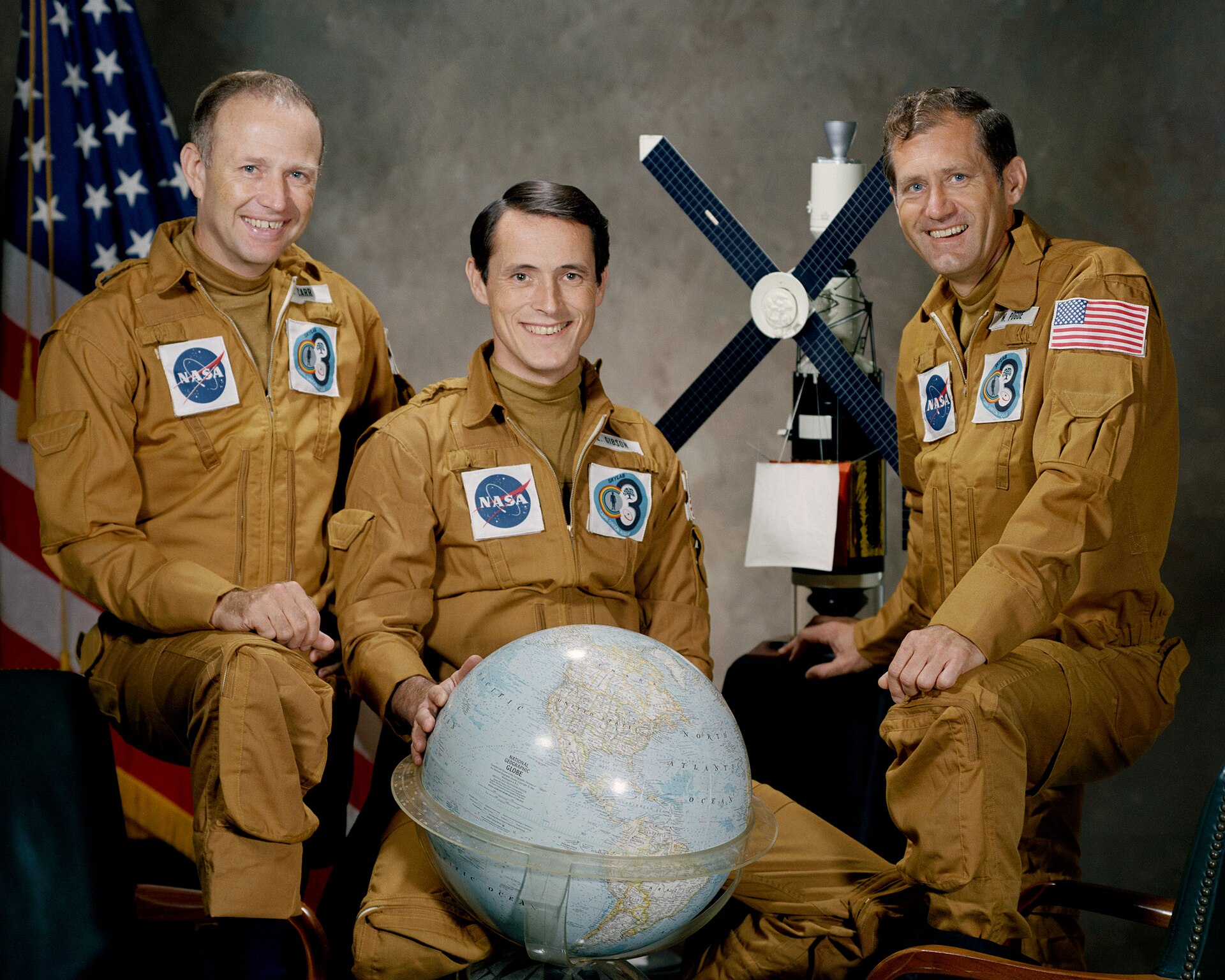
William Pogue and Gerald Carr inside Skylab in late 1973. Pogue's Seiko 6139 rode up in a suit-leg pocket; Carr's Movado automatic came along the same way. Between them they proved a rotor winds in zero gravity a dozen years before anyone advertised it. NASA / Wikimedia Commons - Public domain
A Sinn on Spacelab, then Fortis and a square Casio
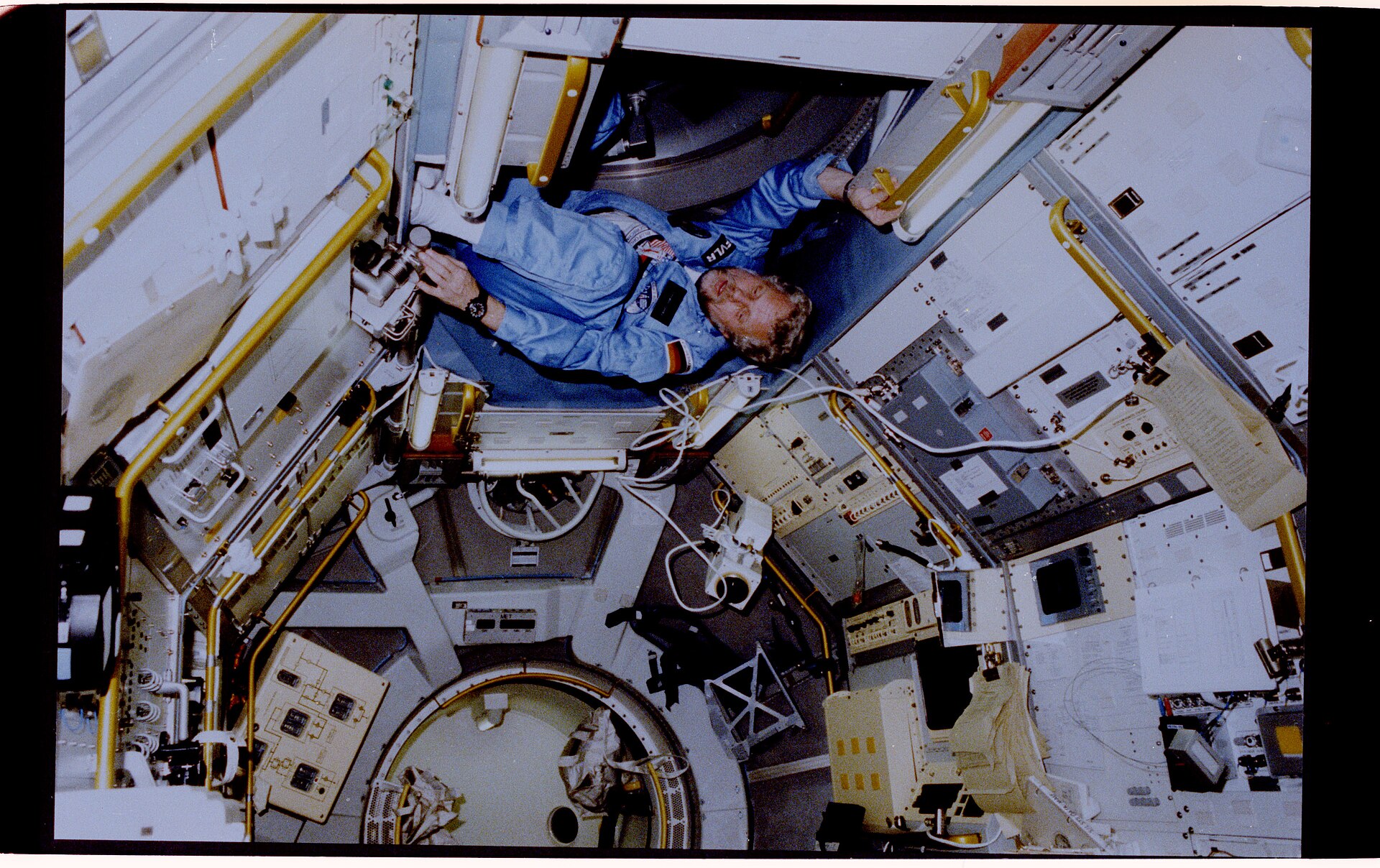
Reinhard Furrer bought a Sinn 140 S with a Lemania 5100 shortly before STS-61-A, the German D1 Spacelab mission, launched 30 October 1985. He wore it in orbit. The flight carried eight people, a Shuttle record from launch to landing, and it was Challenger's last successful mission. The current 140 is a later watch with Sinn's own SZ01 movement. Furrer's 140 S is the flown one. Klaus-Dietrich Flade later took a 142 S to Mir in 1992.
In 1994 Fortis issued the Official Cosmonauts Chronograph for Roscosmos: Lemania 5100, 38 millimetres. Cosmonauts wore it from Soyuz TM-19 onward, on Mir and the ISS, until the B-42 with a Valjoux 7750 replaced it in 2003. One ISS story has a cosmonaut using a Fortis as a hammer on a loose rivet. NASA, for the Shuttle and the station, added quartz options inside the orbiter. The Speedmaster remained the EVA watch. A Casio G-Shock DW-5600C sat on the approved list with a Timex Ironman and a few others. The Smithsonian's shuttle gallery still describes the square G-Shock as one of the era's popular crew watches.
Reinhard Furrer floating in the Spacelab D1 module during STS-61-A, October 1985, with a watch on his wrist. Sinn still prints that his 140 S showed an automatic could wind without gravity. National Aeronautics and Space Administration. Lyndon B. Johnson Space Center. 2/17/1973 / Wikimedia Commons - Public domain
The instrument they asked astronauts to help design
Omega released the analogue-digital Speedmaster Professional X-33 in 1998, a 42 millimetre titanium watch some listings still tag as 3290.50, and designed with astronauts in the specification. The later production instrument collectors meet as 3290.50.00 ran from 2001 to 2007, quartz calibre 1666, still titanium. Alarm, chronograph, countdown and a mission timer sit in the same case as the analogue hands.
The Skywalker X-33 that followed, 318.90.45.79.01.001, is the hybrid the Smithsonian describes: LCD windows that die in the cold of a spacewalk, analogue hands that keep moving outside, more functions once you are back inside. NASA transferred one to the museum in 2022. Quartz watches had been allowed inside the orbiter since the Shuttle programme; for EVA, the mechanical Speedmaster is still the only NASA-qualified option, so a yellow Seiko and a square G-Shock keep turning up in the cabin photographs and never outside.