Turtle, Tuna, Sumo: the Zoo Seiko Started Printing
Seiko still engraves 6309-7040 and SBDC001 on the caseback. Collectors asked for a Turtle or a Sumo instead, and some of the factory's own shops now sell the zoo under those names.
Seiko's first diver's watch, the 6217-8000, arrived in 1965. Collectors call it the 62MAS. The 6105 series followed at the end of the decade and set the four o'clock crown and cushion case that later nicknames would hang off.
The Professional 600-metre 6159-7010 of 1975 wrapped a titanium case in a ceramic-coated shroud and became the Grandfather Tuna. In 1976 Ikuo Tokunaga's 6306-7001 for Japan, and the 6309-7040 and 6309-7049, grew the cushion case that collectors still call Turtle.
The H558-5000 put an analogue-digital movement in a shrouded 150-metre case in 1982. Collectors named it the Arnie after the films; that story sits elsewhere.
The SKX779 and orange SKX781 of 2000 became the Monster. The green SARB017 of 2006 became the Alpinist people still mean. Collectors date the black SBDC001 of 2007 as the first Sumo; listed production runs from 2010 to 2018. Those forum names are still the ones dealers use.
Seiko put the Turtle back into Prospex in 2016 with the SRP777K1, revived the Samurai on the SRPB51J1, brought the Arnie back as the solar SNJ025P1, and recast the 62MAS as the SPB143J1. Official shops now file several of these under the collectors' names.
Ask a Seiko collector for a 6309-7040 and you will get a blank look, then a Turtle. Ask for an SBDC001 and they will say Sumo. The factory still engraves the codes. The people who wear the watches have been running a second language for half a century, and most of it is animals.
The official language is a pile of calibre numbers bolted to case codes, then a later alphabet of SRP, SBDC, SPB and SLA, with a K1 or J1 hanging off the end to mark the market. A single watch can carry three factory names before anyone has nicknamed it. Rolex collectors did Pepsi and Batman. Seiko collectors had more to work with: cushion cases, tuna-can shrouds, twelve o'clock markers that look like a wrestler's topknot, bezels with teeth. They named what they saw. Some of the brand's own shops now sell collections labelled Turtle, Tuna Can, Sumo, Samurai and Monster.
Before the zoo, there was an acronym. In 1965 Seiko put Japan's first diver's watch on sale, the 6217-8000, and collectors later squeezed autoMAtic Selfdater into 62MAS. Seiko itself now describes that watch as "known to fans as the iconic 62MAS". It is the grandfather of the line and it looks nothing like a turtle: 37 millimetres of steel, a crown at three, a bidirectional bezel, 150 metres, and a push-pull crown that had not yet learned to screw down.
The 6217-8001 followed with a larger crown. Collectors wanted a name short enough to shout across a table, because 6217-8000 is a mouthful and "Japan's first professional diver" is a sentence. 62MAS stuck. In 2017 Seiko made a careful recreation as the SLA017. In 2020 the more wearable SPB143J1 took the same silhouette, grey dial and all, and put a 6R35 inside it.
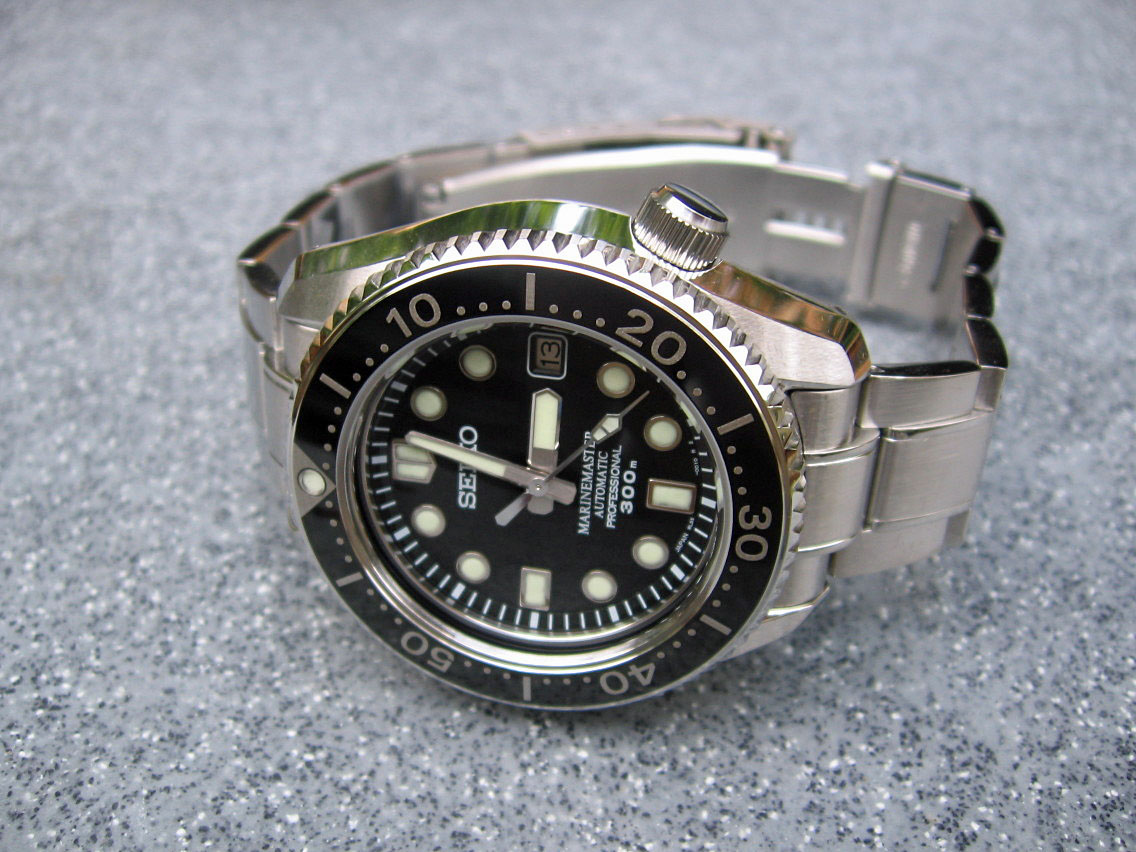
Marinemaster is the name Seiko did print, for the flagship divers that sit above the zoo. The SBDX001 is a 300-metre mechanical from the early 2000s. The SBDX011 is the 1,000-metre professional Marinemaster. Those are official words. The animals came later, for the watches people actually wore into the shops.
A Marinemaster 300 SBDX001, the flagship mechanical diver that sits above the nicknamed watches. Marinemaster was an official word on the dial; the animals came later, for the watches people actually wore into the shops. Francis Flinch / Wikimedia Commons - CC BY-SA 3.0
The Turtle starts in 1976 as a Japan-only 6306-7000, soon the 6306-7001, designed by Ikuo Tokunaga as a rounder take on the 6105 that came before it. Same four o'clock crown, now screwed down, and a cushion case about 45 millimetres across whose sloping flanks, seen from above, look like a turtle's shell. It was a 150-metre recreational diver with day and date under a Hardlex crystal, which was plenty for anyone who was not going down in a bell.
The rest of the world usually got the 6309-7040 the same year, with the 6309-7049 reserved for North America. Seventeen jewels instead of twenty-one, no hacking seconds, and many more of them made. The 6309 stayed in production until 1988 and turned up on military PX counters, on Mick Jagger's wrist, and on Ed Harris in The Abyss. Collectors still argue about whether 7040 or 7049 is the one to want. Both are Turtles.
Seiko put the shape back into the Prospex line in 2016. The SRP777K1 is the black one that looks most like the old 6309, now to 200 metres, with a 4R36 that hacks and hand-winds. King Turtle arrived around 2020 on the SRPE03K1: same cushion, sapphire, a cyclops. Mini Turtle, the SRPC35K1 and its siblings from 2017, shrank the case to about 42 millimetres and moved the crown back to three. Save the Ocean Turtles such as the SRPD11K1 put a wave on the dial and a conservation line on the hangtag.
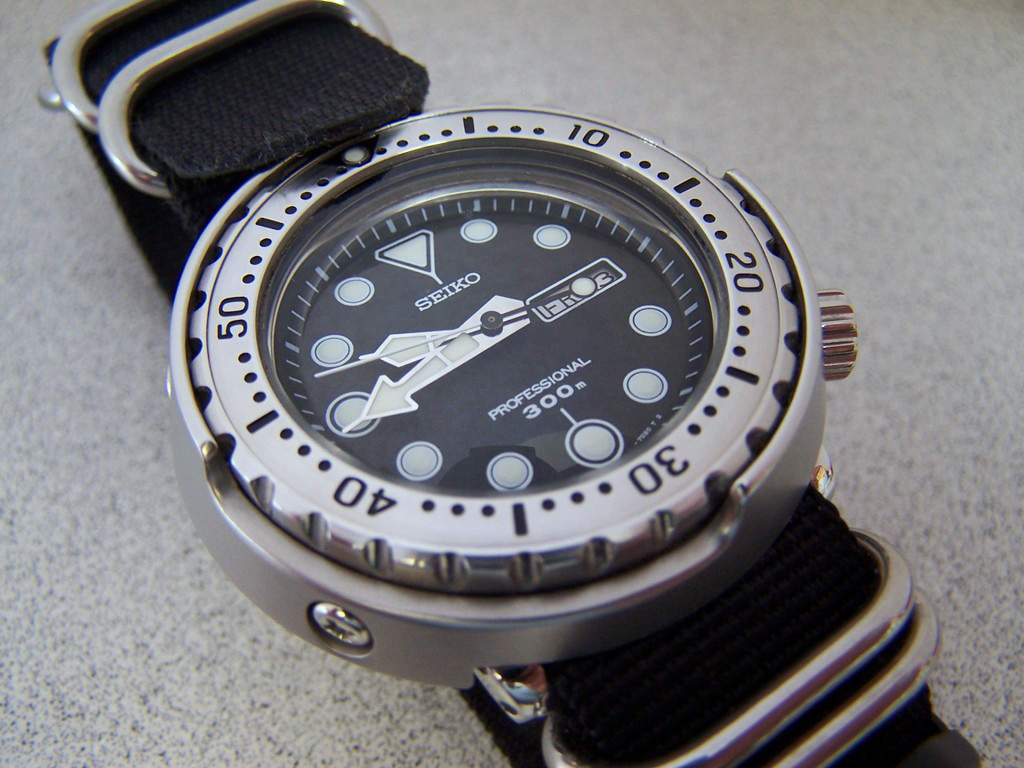
Saturation divers wanted more than a recreational case. In 1975 Seiko answered with the 6159-7010, a Professional 600-metre watch in titanium, wrapped in a ceramic-coated shroud that screws over the monocoque like the lid of a tin. Collectors took one look at the proportions and said Tuna. Grandfather Tuna, once the children arrived. The shroud is the whole visual joke: it protects the bezel, it adds bulk, and it makes a dive watch look like something you would open with a tin opener.
The children came quickly, smaller cans and later quartz professionals among them. The black SBBN013 is the one collectors still discuss as Darth Tuna. Phillips, selling a later Emperor Tuna, put the nickname in the lot essay and blamed the oversized case.
Seiko tested the architecture for real. In May 1983 two Professional 600-metre watches rode JAMSTEC's Shinkai 2000 to 1,062 metres and came back readable. In 2014 a quartz SBBN013 on the hull of the KAIKO 7000II stopped at 3,284 metres; a mechanical SBDX011 stopped at 4,299.
Collectors date the black SBDC001 Sumo to 2007; listed production is 2010 to 2018. Either way it is the 45-millimetre Prospex whose shoulders and short lugs reminded people of a rikishi. The twelve o'clock marker, a broad applied block, is the other origin story: some see a mawashi, some a topknot. Seiko's Philippine shop goes with the topknot. Blue Sumos picked up Blumo among the people who cannot leave a colour unnamed.
Samurai is the sharp one. The original run, from 2004, is the watch people still hunt as SBDA001, and it is easier to describe than to find. What survived into the 2017 revival, the SRPB51J1 and later the SRPE33K1, is a case with edges that look sliced, sword-shaped hands, and a bezel whose knurling has been compared to the wrap on a tsuka. Seiko's copy now says the edges look "as if someone had sliced them off with a razor-sharp sword." That is the collectors' line with a press-office polish.
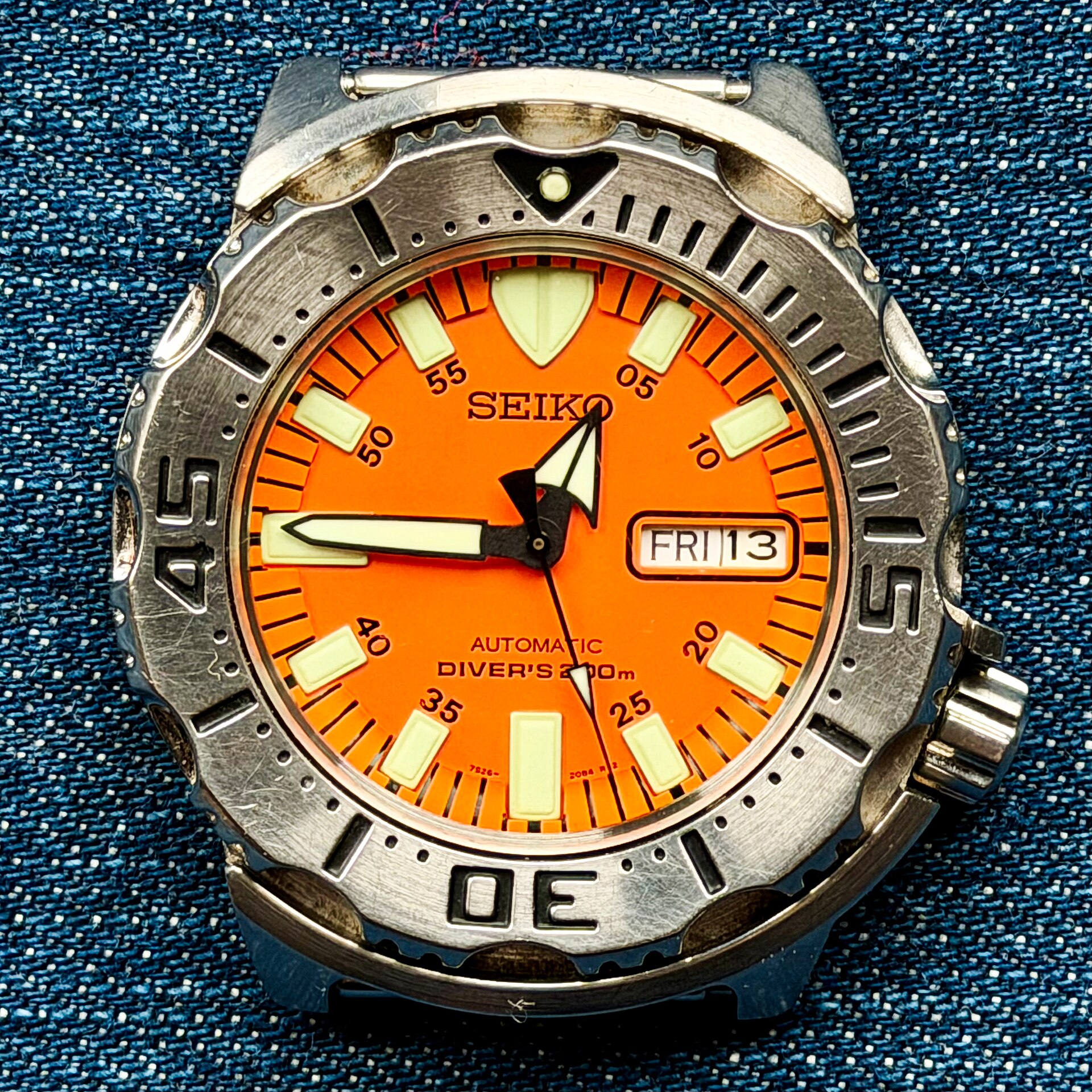
Monster arrived first of these three, in 2000, as the SKX779 and the orange SKX781, with a toothy bezel, huge lume plots and guards that make the head look recessed. Seiko's shop text talks about fangs and a mouth opening wide. The Orange Monster is the one that still gets a greeting in a pub. None of these three names were on a dial, and all three now have collection pages.
A well-worn SKX781 Orange Monster: the toothy bezel, the huge lume plots and the recessed crown that made the nickname obvious in 2000. It is still the Seiko most likely to get a greeting in a pub. Olgierd Rudak / Wikimedia Commons - CC BY-SA 4.0
Collectors call the 6105-8110 the Captain Willard after the Apocalypse Now character; the film watch is told properly elsewhere. The nickname is the claim this zoo has on it. Seiko's later SPB151 keeps the cushion and the four o'clock crown without restaging the river.
Collectors call the H558-5000 the Arnie after the analogue-digital diver Arnold Schwarzenegger wore on screen; that story is told elsewhere. Seiko brought the silhouette back as a solar watch, the SNJ025P1, in 2019.
Collectors also say Pogue for a yellow 6139, after William Pogue's Skylab 4 watch. That flight, and the 1969 automatic-chronograph argument, are told properly elsewhere; the name is the only claim this zoo has on it.
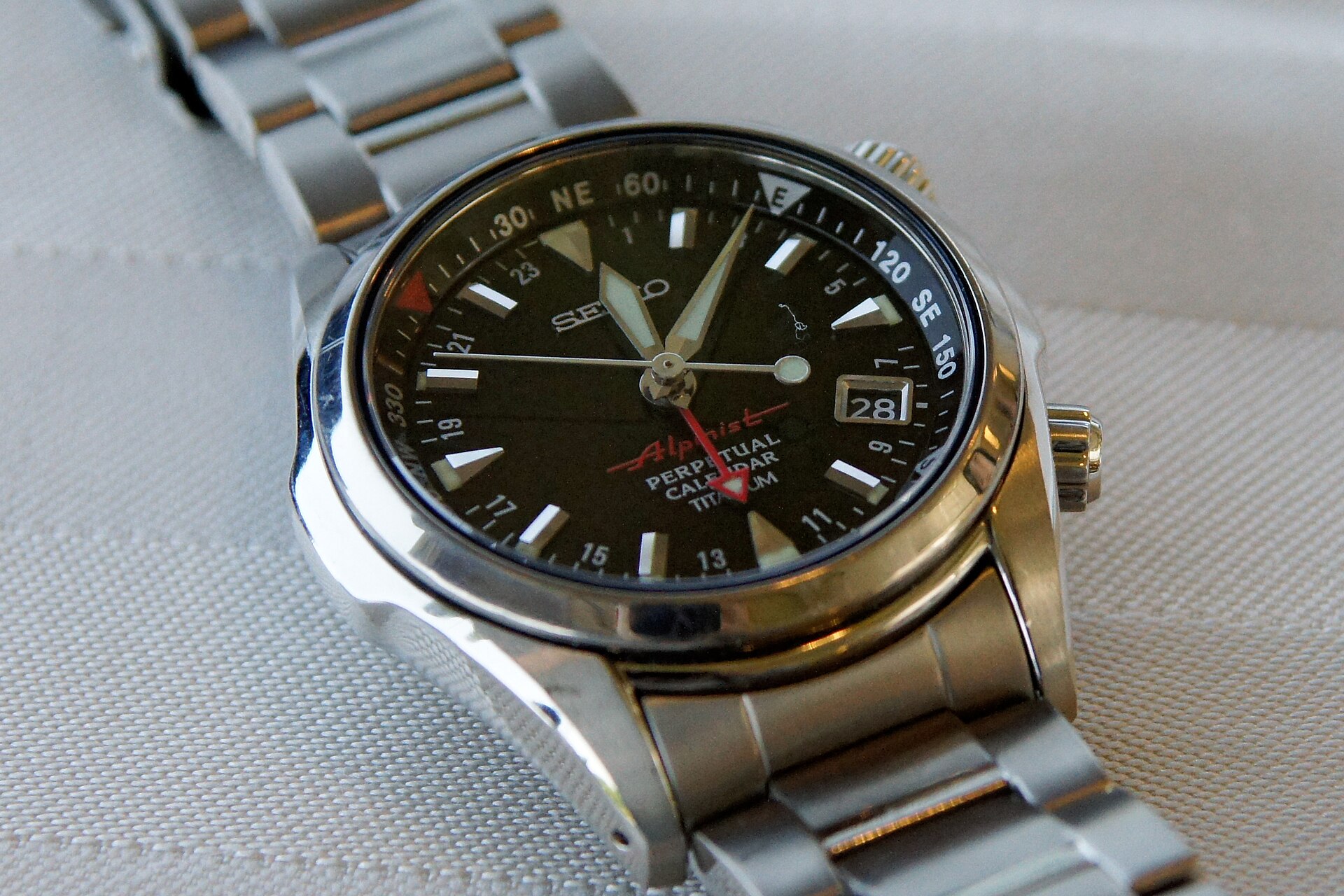
Alpinist is the cheat in this zoo, because Seiko used the word itself. The green SARB017 of 2006, with a second crown driving an internal compass ring, is the one people mean: gold hands on a textured green dial, about 39 millimetres, 200 metres. The SPB121 of 2020 took the job in a slightly larger case.
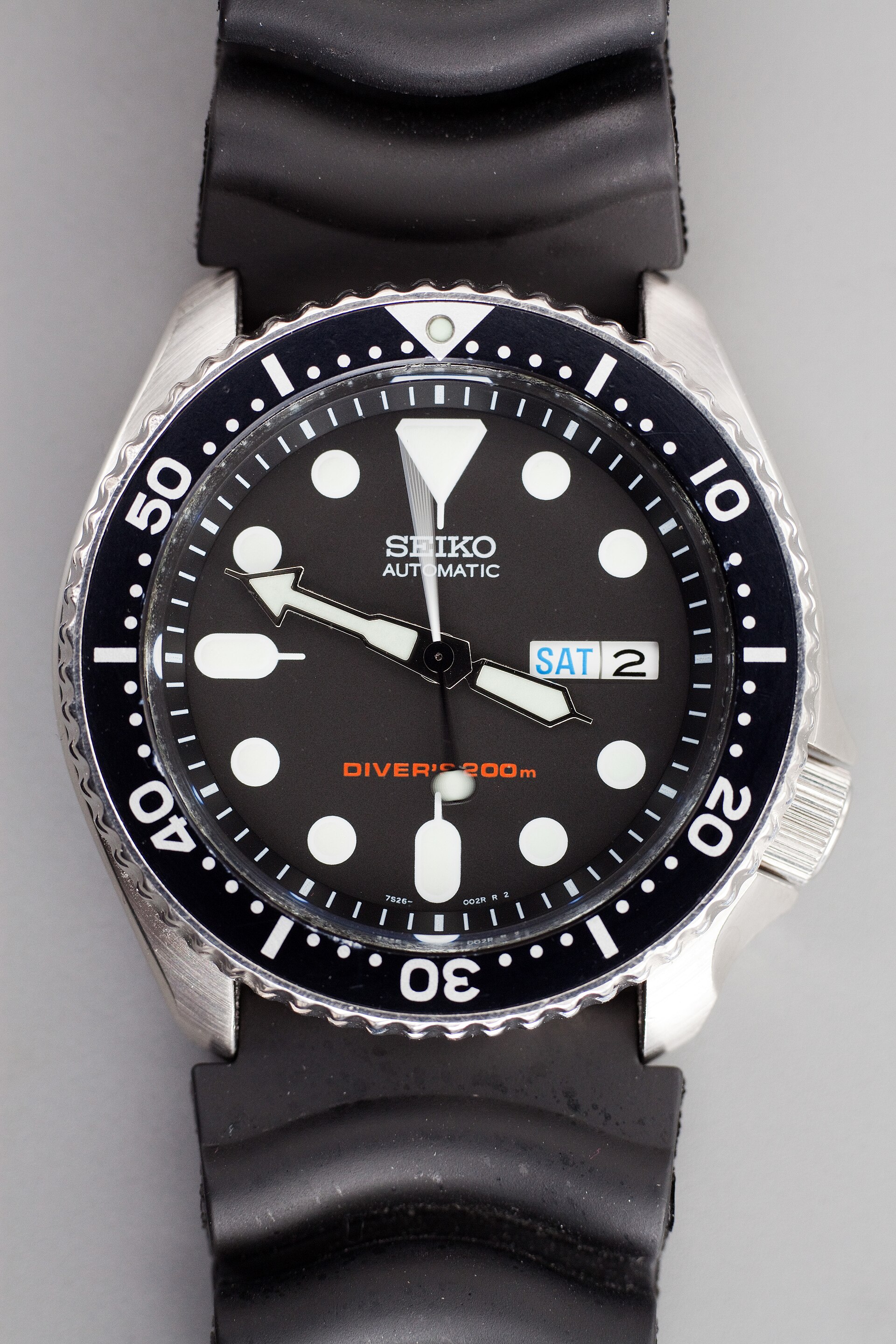
The SKX007 never needed an animal. From 1996 until Seiko stopped it in the late 2010s it was the SKX, full stop, the affordable 200-metre diver whose code was short enough to be the nickname. After it went, the 5 Sports SRPD55 picked up 5KX from people who wanted the look with a 4R movement, at 100 metres rather than a diver's 200. Collectors call a Seiko 5 diver with long minute marks a Sea Urchin, if you squint; even the people who use the name will admit it is a reach.
Shogun, on watches such as the SPB189, takes the habit off the animals and onto armour. Once Turtle, Tuna, Sumo, Samurai and Monster already exist, a shogun's breastplate is simply the next object in the room.
An SKX007 on its rubber strap. From 1996 until 2019 this was the affordable 200-metre diver whose reference number never needed an animal; people just said SKX. Ashley Pomeroy / Wikimedia Commons - CC BY-SA 4.0A titanium perpetual-calendar Alpinist, an older cousin of the green SARB017, with the internal compass ring driven by the second crown at four. Alpinist is the cheat in this zoo: Seiko printed the mountain name itself. 663highland / Wikimedia Commons - CC BY 2.5
Seiko's Philippine boutique now walks through Tuna Can, Turtle, Sumo, Samurai, Monster and Shogun as if they were model names, then adds Arnie, Willard, King Turtle and Alpinist for anyone who arrived late. The casebacks still carry the codes. The shop language has moved.
An alphanumeric system that dense was always going to grow nicknames. The manufacturer has started putting some of those words on its own pages. You can still ask for a 6309-7040. Almost nobody does. They ask for a Turtle, and on a growing number of official pages Seiko asks for one too.