1969: Three Finish Lines for the First Automatic Chronograph
Zenith named it El Primero, a Swiss consortium put the crown on the left, and Seiko sold a 6139 in Japan while the others were still pouring coffee for journalists. Collectors have been picking a winner ever since.
Zenith started work on an integrated high-beat automatic chronograph in 1962, hoping to have it ready for the manufacture's centenary in 1965, and missed that date. In February 1966 Heuer, Breitling, Büren and Dubois-Dépraz signed a consortium agreement, code-named Project 99, to put a chronograph module on a thin micro-rotor automatic. Seiko's Suwa factory was developing calibre 6139 on a third track, with a vertical clutch and almost no publicity.
January 1969
El Primero goes public
On 10 January 1969 Zenith presented calibre 3019 PHC, an integrated automatic chronograph beating at 36,000 vibrations an hour, and named it El Primero. Jack Heuer read the news over breakfast and nearly dropped his coffee. His consortium already had 3 March booked for its own unveiling and decided to keep the date.
On 3 March 1969 the consortium presented Calibre 11, the Chrono-Matic, at 5 p.m. in Geneva and 11 a.m. in New York. Heuer showed it in the Carrera, the Autavia and a new square Monaco. Breitling put it in Chrono-Matic cases with the crown on the left. Hamilton, which had bought Büren during the project, cased its share as the Fontainebleau. A month later the same watches appeared at the Basel fair.
Seiko put the 61 Speed-Timer, powered by calibre 6139, on sale in Japan on 21 May 1969. Chrono-Matic watches, including Breitling's Navitimer 1806 and the oversized 7651, were in Western shops by August. Zenith's El Primero watches followed in October. Who reached a counter first depends on which country you were standing in.
Calibre 11 became the faster Calibre 12 in 1971, and Heuer was still using versions of that family in Autavias such as the 11630 into the mid-1970s. El Primero paused in the quartz years, came back, and from 1988 powered Rolex's first automatic Daytona, the 16520. Seiko's 6139 kept going through the 1970s in a pile of case codes and colours. Of the three 1969 movements, only El Primero is still being made.
In January 1969, Zenith invited journalists to look at a high-beat automatic chronograph it had already named El Primero, Spanish for "the first", while two other teams were still working. Jack Heuer, whose company had spent three years on a secret automatic chronograph of its own, read the news over breakfast and nearly dropped his coffee. His group already had 3 March in the diary and, after a hurried meeting, kept it.
That group was Heuer, Breitling, Büren (by then inside Hamilton) and the module specialists Dubois-Dépraz, working under the unromantic code name Project 99. They showed Calibre 11, sold as the Chrono-Matic, at simultaneous press conferences in Geneva and New York, then again at the Basel fair a month later. Seiko, which had not bothered with a telegram, put its 6139 Speed-Timer on sale in Japan in May.
The scoreboard changes with the event you choose. Zenith announced first, on 10 January. Seiko had watches in Japanese shops by 21 May. The consortium's Chrono-Matic pieces were on Western counters by August, with El Primero following in October. Anyone who wants a single winner has to pick a definition and live with the other two people at the table.
The crown ended up on the left because the rotor was in the way
An automatic chronograph was supposed to be too much mechanism for a wrist-sized case. Start the chronograph and it drinks power; stack a full rotor on top of the gear train and the sandwich becomes a doorstop. Gérald Dubois at Dépraz thought Büren's thin micro-rotor automatic might leave enough room for a chronograph module on the back. He recruited Jack Heuer, then Willy Breitling. They signed the consortium agreement on 2 February 1966, and spent the next three years pretending, even inside their own factories, that nothing was happening.
Calibre 11 is a 17-jewel sandwich about 31 mm across and 7.7 mm thick. Büren's micro-rotor movement, beating at 19,800 vibrations an hour with about 42 hours of reserve, keeps time. Dubois-Dépraz's cam-and-lever chronograph module bolts onto the back with three screws. The layout is bi-compax: 30 minutes at 3, 12 hours at 9, date at 6, and no running seconds at all. Because the micro-rotor and the module took the usual stem's real estate, the winding crown had to sit at 9 o'clock, opposite the pushers.
Jack Heuer later said a crown on the left looked weird at first, then decided that was the joke worth keeping. The line they sold it with was simple: this chronograph does not need winding. About a hundred pre-production movements were ready by the end of 1968. They stuck to 3 March even after Zenith's January announcement. Gérald Bauer of the Swiss watch industry federation opened the Geneva event at 5 p.m. New York started at 11 a.m. the same morning, so the consortium could claim the whole afternoon.
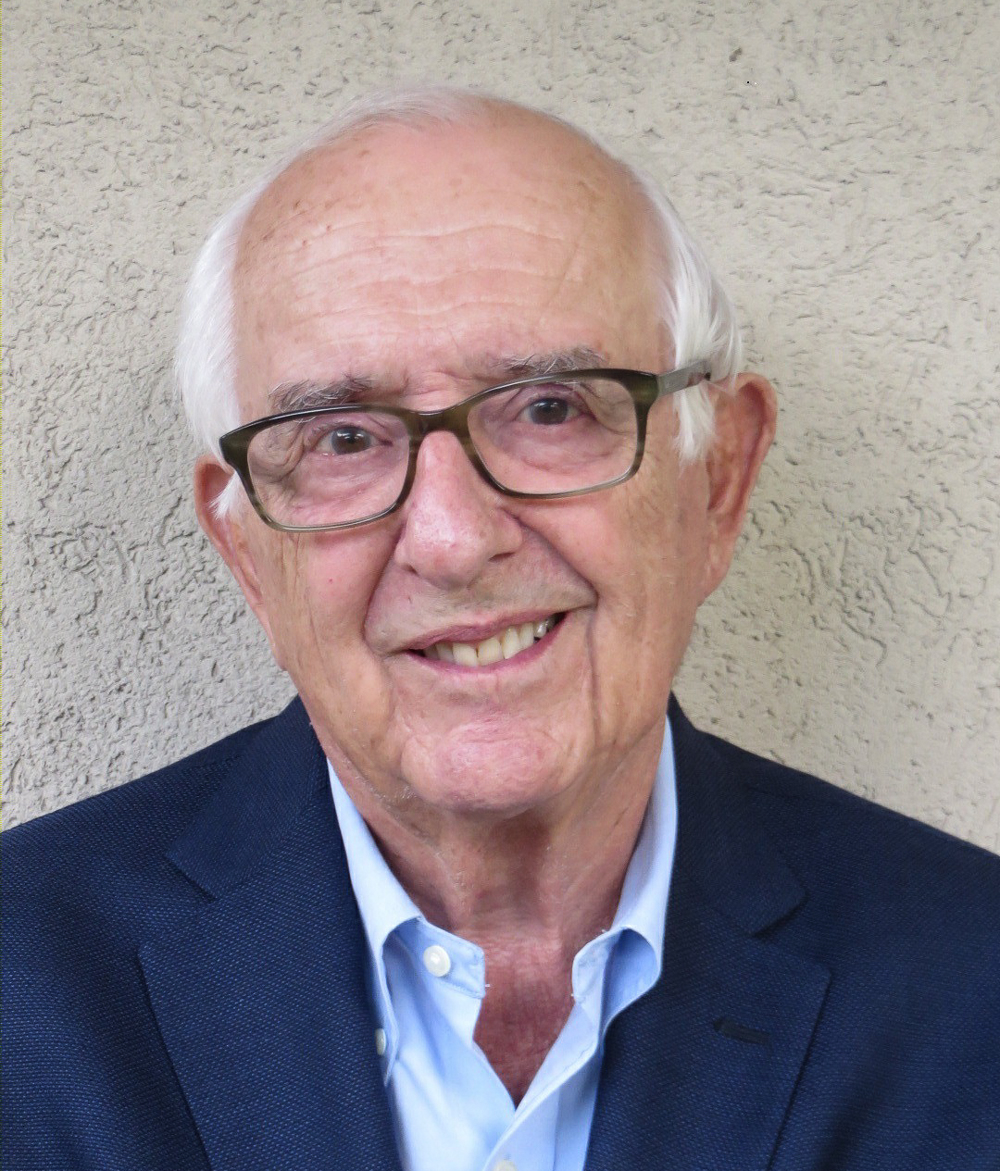
Jack Heuer in 2017. He read Zenith's January announcement over breakfast, held a hurried meeting, and kept the 3 March press conferences anyway. The left-hand crown was his team's joke, and he decided it was worth keeping. BBCLCD / Wikimedia Commons - CC BY-SA 4.0
If the winding crown is on the left, you are looking at Chrono-Matic
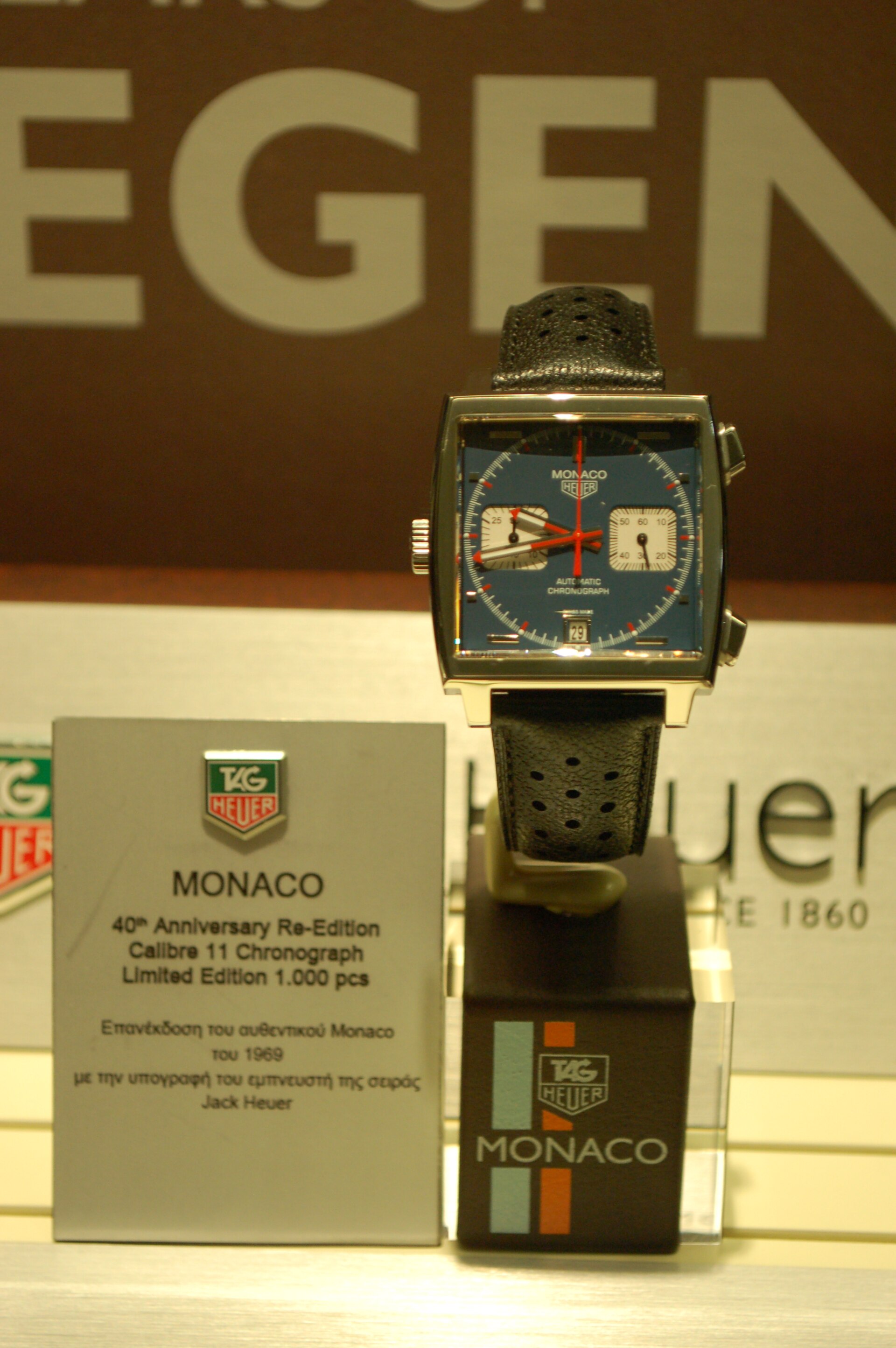
Each partner put the new movement into watches it already knew how to sell, and Heuer added a square one. The Monaco 1133 is the original: midnight-blue dial, white registers, crown at 9, introduced with the movement on 3 March 1969. Piquerez had finally made a waterproof square case, which Jack Heuer took exclusively, and the result still reads as 1969 from across a room. The automatic Carrera is the cushion-cased 1153, and the black-dial 1153N, same left-hand crown, same Chronomatic architecture.
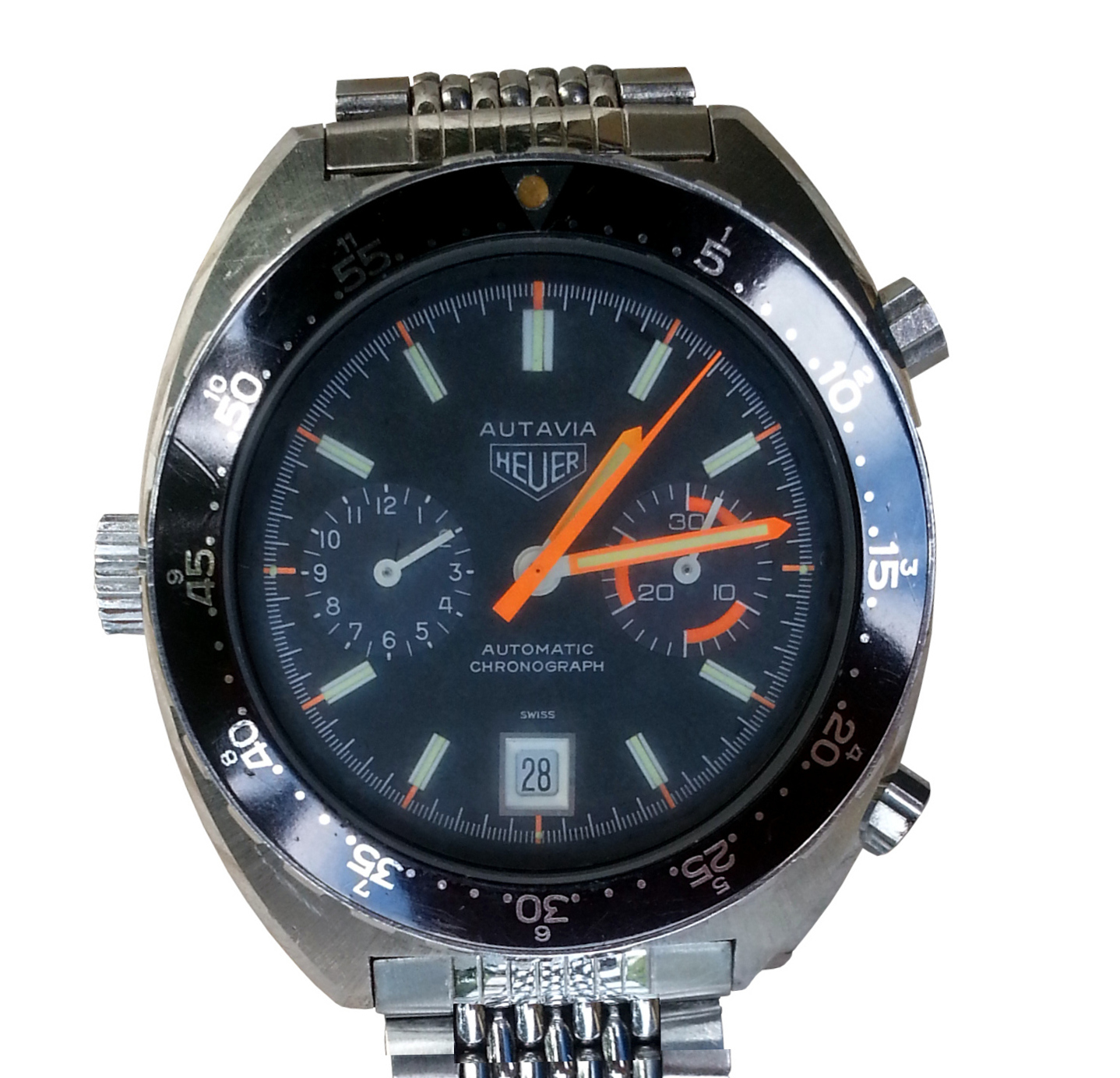
The early automatic Autavia was the 1163, a reference collectors talk about constantly and then lose in a list of later codes. The 11630, from 1973 to 1975, is the one that is simple to point at: a 42 mm Autavia on Calibre 12, the 21,600-vph successor that became the family's main product from 1971. Breitling called the movement Chrono-Matic and put it in the restrained round 2110, about 38 mm with an external rotating bezel, and in the almost-square 2111, which wears a pulsometer and a surfboard-shaped subdial field that could only have been drawn in 1969.
Late in the year the 7651 arrived as a 48 mm statement, still with the crown at 9 and the date at 6. The Navitimer Chrono-Matic 1806 is the slide-rule Navitimer wearing the same movement, a left-crown giant the Navitimer story already covers, so we can leave it there. Hamilton, allocated a smaller share of the movements after buying Büren, cased them as the Fontainebleau Chrono-matic, reference 11001-3. Büren-signed watches exist too, and they turn up less often, so the fourth name on the consortium letterhead reads like a rumour at the table.
The Autavia 11630 on Calibre 12, crown at nine, pushers at two and four. If the winding crown is on the wrong side of a 1970s Heuer, you are looking at the consortium's movement. File:Heuer Autavia 11630 Orange.jpg : Alex Peters alias Benutzer:ape10000 derivative work: Pittigrilli / Wikimedia Commons - CC BY-SA 3.0A 2009 40th-anniversary Monaco re-edition on a shop stand, not a 1969 1133, but the same square case, blue dial and left-hand crown that Piquerez and Heuer put on sale with Calibre 11 in March 1969. Ferengi / Wikimedia Commons - CC BY-SA 3.0
Zenith named it El Primero and dared the rest of the room
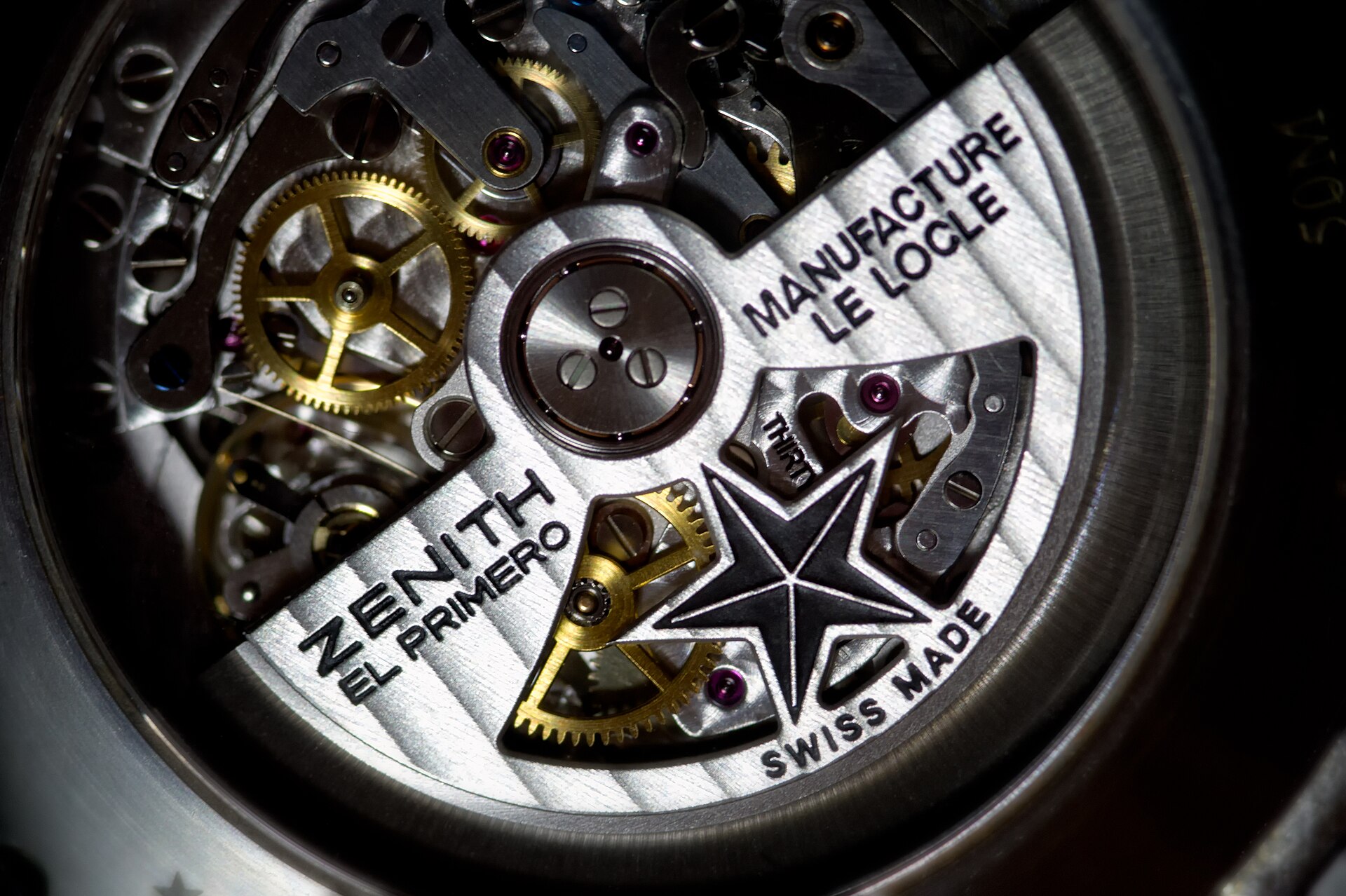
The manufacture had wanted an automatic chronograph ready for its 1965 centenary and missed that date by four years. What finally appeared on 10 January 1969, calibre 3019 PHC, was an integrated construction: a central rotor on ball bearings, a column wheel, 36,000 vibrations an hour, a 50-hour reserve and a date, all in 6.5 mm. It could time to a tenth of a second. Movado, in the same industrial group that year, sold the same architecture as the Datron HS 360.
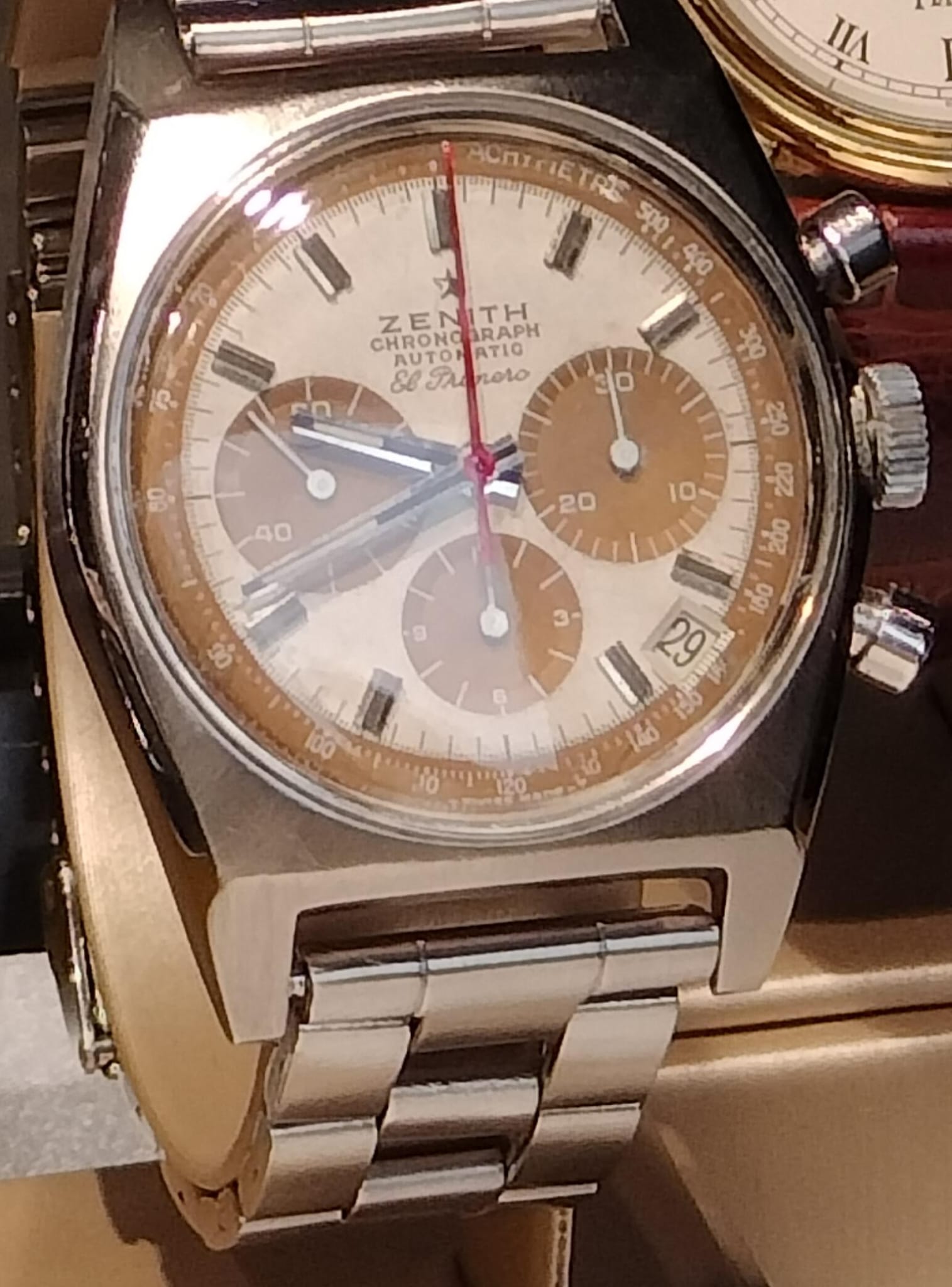
The first steel watches were the A384, A385 and A386, and Phillips dates the A386 to 1969. El Primero is still in production. Calibre 11 and the 6139 are not. A later 42 mm El Primero 36'000 VpH, reference 03.2040.400/69.C494, still uses those overlapping blue, anthracite and grey registers. Rolex borrowed a heavily reworked version, slowed to 28,800 vibrations an hour, as calibre 4030 in the Daytona 16520 from 1988. The Daytona history covers that generation. Zenith's movement outlived the argument about who got there first.
A Zenith El Primero A384, the angular tonneau of the 1969 launch trio, photographed in a display case. The silver dial and dark registers are the shy sibling of the tri-colour A386 everyone pictures. EMore98 / Wikimedia Commons - CC BY-SA 4.0
Suwa Seikosha finished calibre 6139 in 1969 with a Magic Lever automatic, a column wheel and a vertical clutch, the combination Seiko still describes as a first. Toshihiko Ohki designed the clutch after the stacked wheels of the 61-series base left no room for a conventional horizontal one. The watch that went on sale in Japan on 21 May 1969 was the 61 Speed-Timer: one 30-minute register at 6, day-date at 3, no running seconds, and a price that was meant to be ordinary. Seiko was, at the same time, busy finishing the quartz Astron, which may explain the missing fanfare.
An advertisement had already run in February, and surviving watches show 6139 production in January. There was no Geneva press conference. At the Basel fair that spring, Seiko's president congratulated Jack Heuer on the first automatic chronograph without mentioning that Seiko was showing its own 6139 at the same event. Heuer took the compliment. Japanese shops had the watch that May.
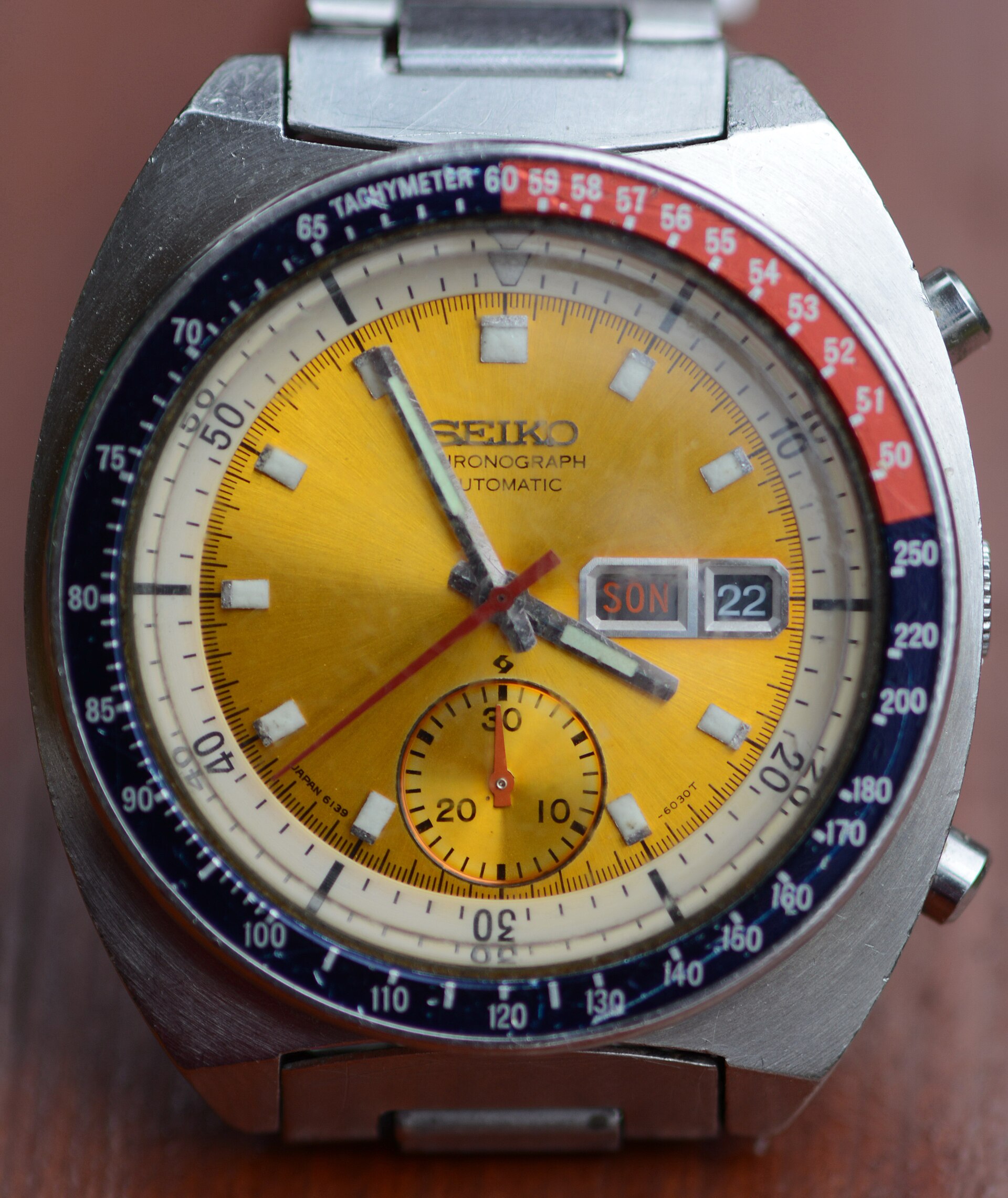
The yellow 6139-6002 is the one people call a Pogue, though Colonel William Pogue's Skylab 4 watch was the North American 6139-6005. The 6139-6000 sits in the same family. The 6139-7002 is a later single-register export Speedtimer. They share the architecture: integrated, column wheel, vertical clutch, 21,600 vibrations an hour. Pogue wore his in 1973, which belongs to a different story. In 1969 the 6139 was already a production watch while the Swiss were still counting prototypes.
Seiko's 6139 with the yellow dial and Pepsi bezel. Column wheel, vertical clutch and Magic Lever winding, the calibre Japanese shops were selling from May 1969; this export-dial version followed a little later. Dnalor 01 / Wikimedia Commons - CC BY-SA 3.0 at
First to announce, first in the shops, first still ticking
The winner changes if you change the verb: announced, sold, still made. The engineering is a cleaner contest than the publicity. Calibre 11 is a module on a micro-rotor, quick to assemble, thick, left-crowned, switched by cams. El Primero is integrated, high-beat, column-wheeled and thin, and it needed a dry lubricant because oil at 5 Hz tends to fly off the balance. The 6139 is integrated too, with a vertical clutch that later became the fashionable way to build a chronograph, and it was designed to be punched out on a press for series production. All three solved the same problem with three different machines.
Watchmakers still argue because the word "first" is doing too much work. Announced, delivered, sold, patented, still made: those are different races that happened to share a calendar year. 1969 was also the year of a moon landing and, later that year, Seiko's quartz Astron. The automatic chronograph arrived just as another kind of watch was about to make the whole argument feel slightly antique.
What the three lines did after the year of the argument
Calibre 11 became Calibre 12 in 1971, the same sandwich running at 21,600 vibrations an hour. Heuer kept versions of it going into the 1980s. The Monaco kept the square case long after the original movement left. That silhouette is Calibre 11's real afterlife: it still looks like 1969 even when something else is ticking inside. Breitling's Chrono-Matic watches kept the left crown as a period signature and then moved on.
El Primero paused in the quartz years and came back. Rolex used a modified version in the Daytona 16520 from 1988 until the in-house calibre 4130 arrived in 2000. The 6139 ran through the 1970s in a pile of case codes and colours, then left the line in the late 1970s. You can still buy a new El Primero. You cannot buy a new Calibre 11 or a new 6139.
The useful way to look at 1969 is as a year when three different ideas of an automatic chronograph reached the public at once. A left-hand crown, a tri-colour register set and a yellow 6139 are all finish lines from the same year.