A Hundred Years of the Oyster, and Tudor Turns 100 Too
In 1926 Hans Wilsdorf sealed a watch like a shell and registered a second name for customers who couldn't quite stretch to the first. A hundred years on, Rolex and Tudor are both still throwing parties for the same year.
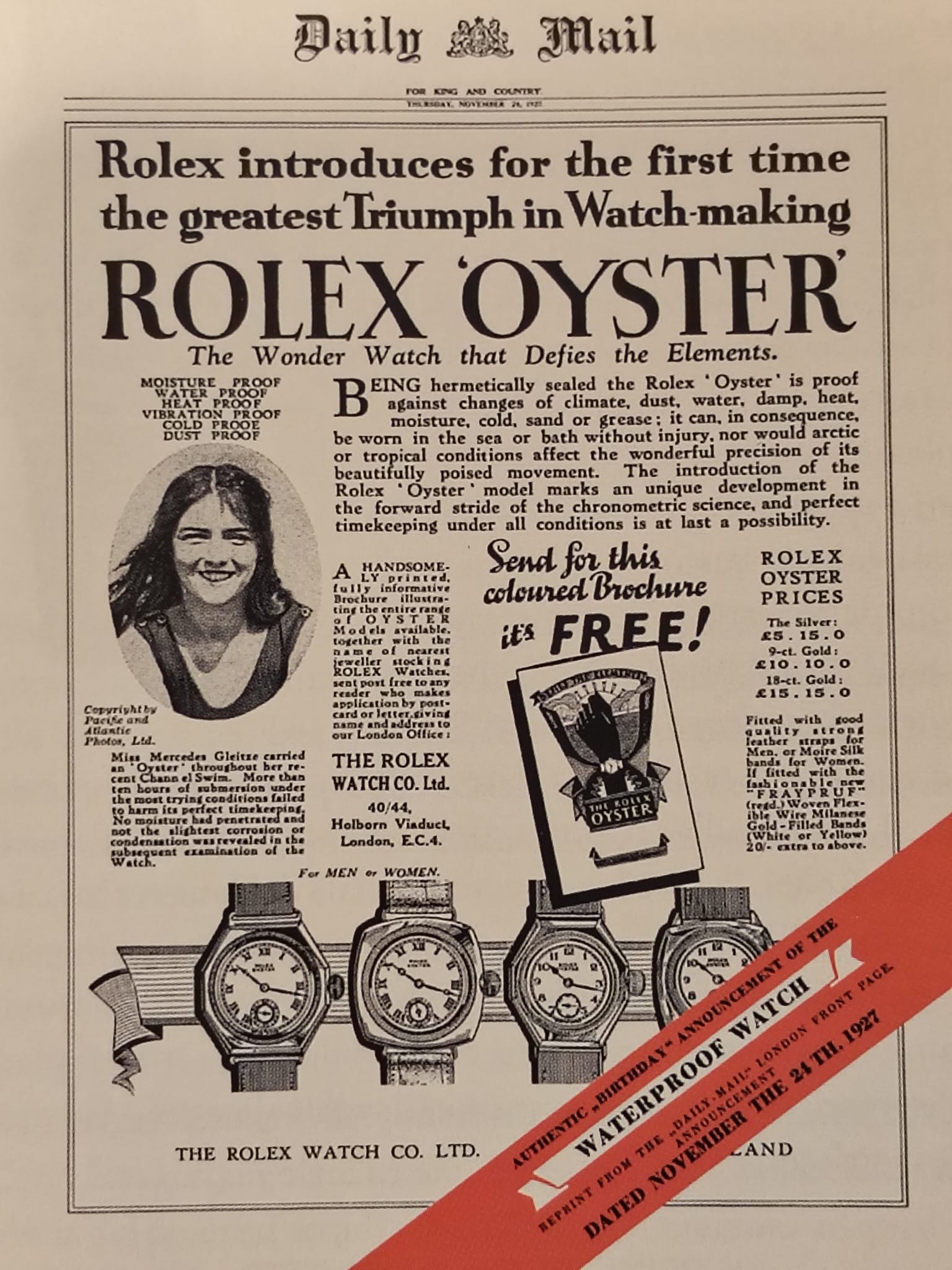
Rolex patented the hermetically sealed Oyster case in 1926, and the same year the trademark "The Tudor" was registered in Geneva on Hans Wilsdorf's behalf. A year later Mercedes Gleitze's Channel swim and a full page in the Daily Mail turned waterproofness into a story Rolex has been retelling ever since.
1931-1953
The rotor finds a case
Rolex patented the Perpetual rotor in 1931 and squeezed it into the Oyster case, and the Bubbleback got its hump. By the early 1950s the same case was carrying moonphases, dates and the first professional bezels, while the ordinary Oyster Perpetual gradually flattened out.
Montres Tudor S.A. was formed on 6 March 1946, twenty years after the name was registered. The Oyster Prince of 1952 borrowed Rolex's waterproof case and self-winding rotor, went to Greenland with a scientific expedition, and made the value argument in steel.
Tudor's first Submariner, the 7922, arrived in 1954. Crown guards, bigger crowns and eventually snowflake hands followed, many of them on watches issued to and marked by the French Marine Nationale. This is the archive the Black Bay later quoted from at length.
Tudor rebuilt itself around the Black Bay, Rolex carried on selling the plain Oyster Perpetual in ever louder colours, and 2026 asked both brands to celebrate the same year. One did it with "100 Years" on a slate dial. The other dated the party to a 1926 trademark and kept insisting the story was still being written.
Most years invent one thing at most. 1926 managed two
1926 produced two inventions that have shared a birthday ever since. Hans Wilsdorf, already the man behind Rolex, patented a wristwatch case that screwed shut like a shell, and in the same year quietly had a second name registered for watches his agents could sell to people who liked the idea of a Rolex but not the invoice. The case was the Oyster and the name was Tudor, and a century later both brands still hang their identities off that one year, which is either an impressively tidy piece of corporate housekeeping or the longest shared-custody arrangement in watchmaking.
The expensive watch and the more modest one have been explaining themselves to each other ever since. Rolex will tell you that waterproofness is the whole plot, and that every Submariner, GMT-Master and Datejust since is a footnote to a 1926 patent. Tudor will tell you it was born in 1926 too, which is true of the trademark and rather less true of the company. Collectors, who enjoy a family argument as much as anyone, get to spend 2026 watching the two of them blow out the same candles.
The Submariner, the Black Bay and the Datejust all have their own histories here, so this is a birthday story instead, about a case and a name that have refused for a hundred years to live in different years, told through the watches that make the double life visible.
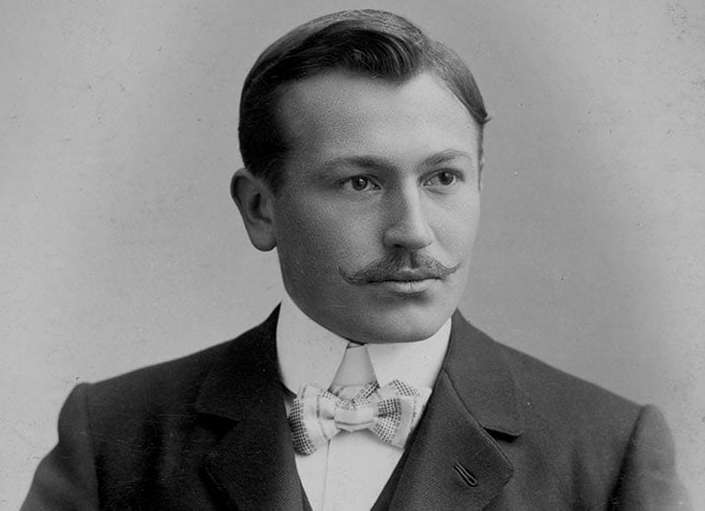
Wilsdorf patented the Oyster case and had the Tudor name registered in the same year. One was engineering and the other was pricing, and he appears to have known exactly what he was doing with both. Unknown author Unknown author / Wikimedia Commons - Public domain
The watch that went swimming, and the one that actually crossed
The Oyster was a case rather than a model. Bezel, case back and winding crown all screwed down against the middle, making it hermetically sealed, dustproof if you believed the brochure, and waterproof if you were willing to find out for yourself. Wilsdorf liked the name because, like an oyster, the watch could sit underwater indefinitely without coming to harm. Rolex had tried a clumsier version of the idea in 1922, a "Submarine" whose outer case had to be opened before you could wind it, so 1926 was really the first version you could leave on while washing your hands.
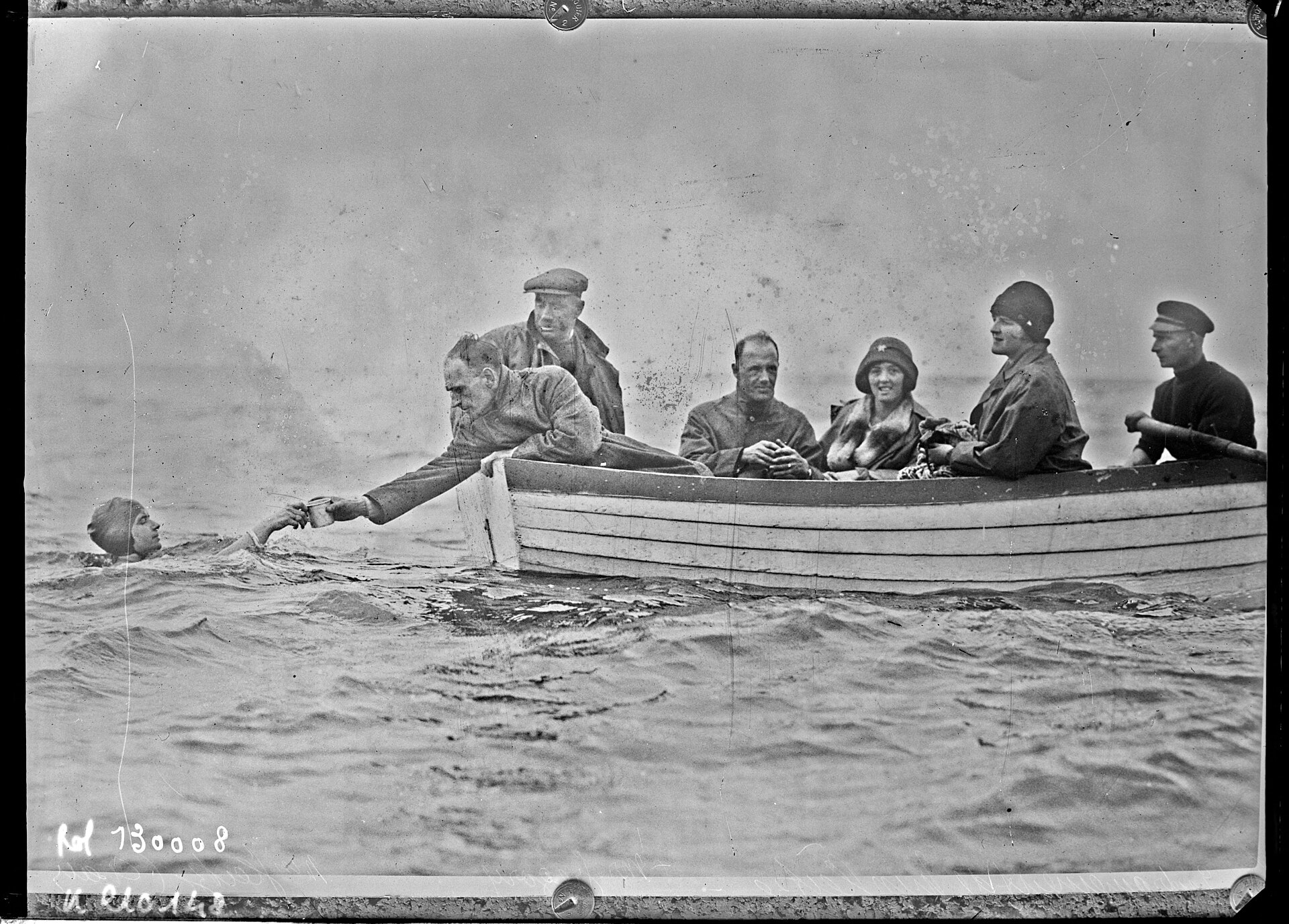
Proving it took a Channel, and this is where the story splits in two. Rolex's own history still says that Mercedes Gleitze, a young English swimmer, crossed in 1927 wearing an Oyster for more than ten hours, after which the watch was found to be in perfect order. The auction record is fussier about the details and, frankly, more fun. On 7 October 1927 Gleitze did become the first British woman to swim the Channel, in 15 hours and 15 minutes, but the Oyster wasn't with her. It went into the water two weeks later, on 21 October, for a "Vindication Swim" she attempted after a hoax claim had cast doubt on her record. The conditions were dreadful and she came out after 10 hours and 24 minutes without reaching the other side, with the small gold Oyster, worn on a ribbon around her neck rather than on her wrist, still ticking.
Wilsdorf then took out a full page in the Daily Mail on 24 November 1927 and called it "the watch that defied the Channel", and that advertisement is the reason we are still talking about a typist from Brighton a hundred years later. The whole Testimonee idea starts here: find somebody doing something faintly mad, put a watch on them, and buy the page. The very earliest cushion-case Oysters from 1926 and 1927 rarely turn up with a reference number collectors can agree on, but the idea outlasted the first cases, which is what a patent is for.
A press-agency photograph of Mercedes Gleitze in training, taking a drink from a rowing boat. Channel swimming in the 1920s was cold, slow and very public, and a watch that survived it made a very good advertisement. Agence Rol. Agence photographique (commanditaire) Central News (Agence photographique). Agence photographique pour le document reproduit (commanditaire) / Wikimedia Commons - Public domainA typist from Brighton who became the first British woman to swim the Channel, and then the first person Rolex ever built an advertisement around. She wore the Oyster on a ribbon rather than her wrist. Unknown author Unknown author / Wikimedia Commons - Public domain
1931 and the Bubblebacks
Then they put a rotor in it, and the back blew out
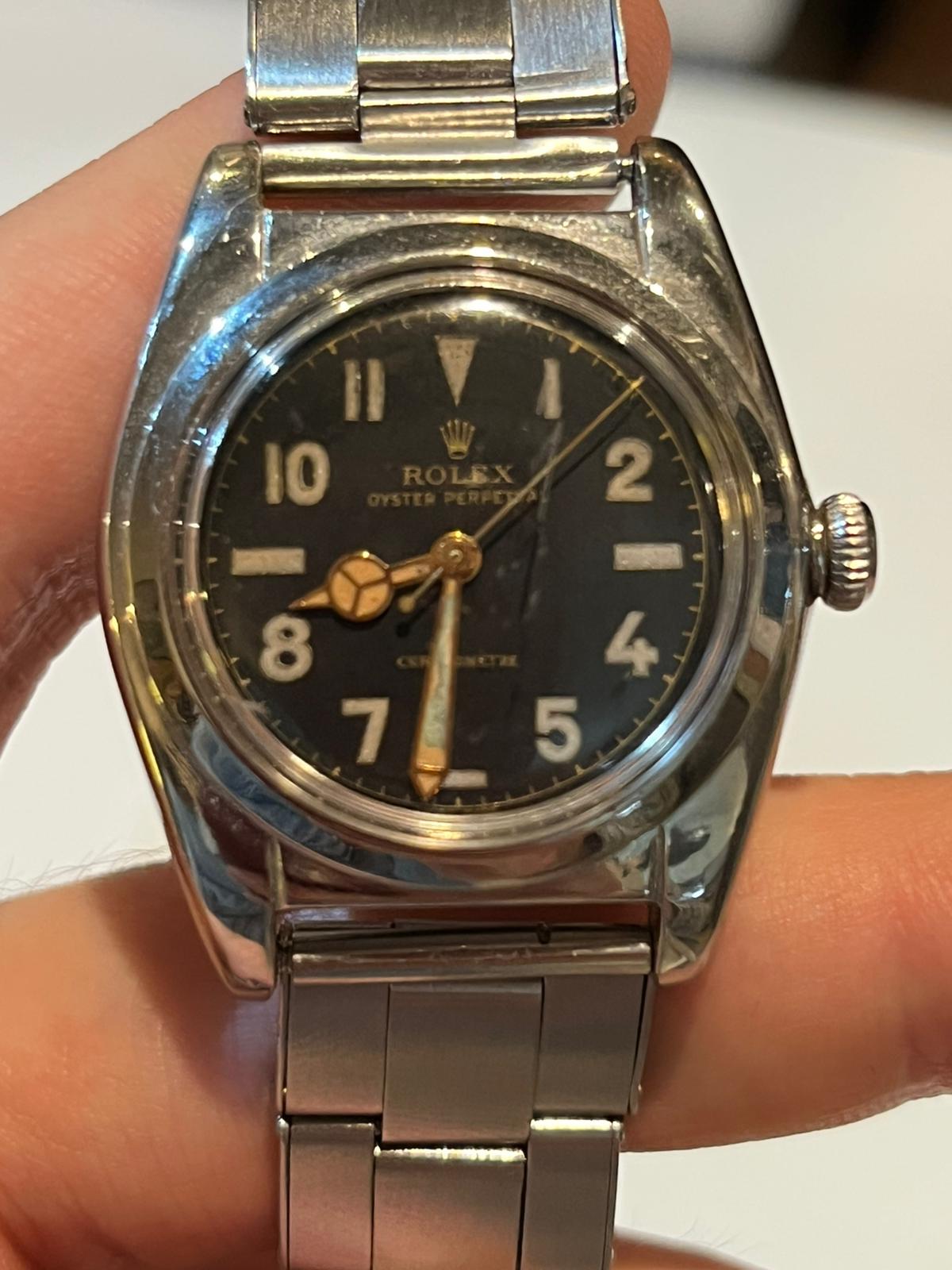
Waterproof, it turned out, was only half a watch. In 1931 Rolex patented a self-winding rotor that swung a full 360 degrees on a central pivot and called it the Perpetual. Sit that rotor on top of an existing movement, screw an Oyster case around the lot, and the case back has to dome outwards to make room. Collectors, who cannot leave a lump unnamed, called the result a Bubbleback. It's a faintly comic silhouette, and it is also the first Oyster Perpetual, the two words that still sit on the dial of every steel Rolex that doesn't have a job.
The family is a thicket of small steel and gold references. The 2940, 3372 and 5015 are the sort of compact, slightly swollen automatics that make the nickname obvious the moment you turn one over. By the mid-1950s the case was flattening out, and a watch like the 6564 is one of the in-between 34 mm Oysters that no longer needs the bubble but isn't yet the modern Oyster Perpetual either. The case had already gone off to work by then: the first Submariner, the 6204, is an Oyster with a timing bezel, and the first GMT-Master, the 6542, is an Oyster with an extra hand. Both have their own stories, so we'll leave them there beyond noting the case they share.
Around 1950 Rolex even managed to fit a triple calendar and a moonphase inside an Oyster. That reference, the 6062, later became famous as the Bao Dai watch after Vietnam's last emperor, on a stroll through Geneva, decided he wanted the rarest Rolex in the shop and was duly sold it. A waterproof moonphase is a slightly ridiculous object, and collectors have never quite forgiven themselves for wanting one. The Datejust, launched in 1945, had meanwhile put a date window in the same case and quietly turned into the watch most people mean when they say Rolex. By then the Oyster had stopped being a model in its own right and become the building everything else lived in.
A 1940s Bubbleback in the hand: a small Oyster with a domed back to make room for the Perpetual rotor. The silhouette is faintly comic, and it belongs to the first watches to carry the two words that still sit on every Rolex dial. EMore98 / Wikimedia Commons - CC BY-SA 4.0
The other 1926 was a name, and the company came later
In February 1926, the same year as the Oyster patent, a Geneva watch dealer trading as Veuve de Philippe Hüther registered "The Tudor" on Wilsdorf's behalf. Wilsdorf took the trademark back into his own hands on 15 October 1936, around the time a Tudor rose in a shield began appearing on dials, but Montres Tudor S.A. didn't exist as a company until 6 March 1946, a detail the centenary copy tends to skate over. So the birthday belongs to the name and the company is twenty years younger, and of those two true facts only one fits on a banner.
Wilsdorf's brief wasn't subtle. He wanted a watch his agents could sell at a more modest price than a Rolex without giving up the dependability Rolex was already known for, so Rolex would guarantee the technical side, the distribution and the after-sales, and Tudor would get the Oyster case and, from 1952, the Prince, Tudor's word for the self-winding rotor Rolex called Perpetual. Twenty-six Oyster Princes went to Greenland with a British scientific expedition that year. The 7809 is the sort of compact 34 mm automatic that made the trip, and the 7965 still wears Rolex-signed hardware, like a younger sibling in borrowed shoes.
Around them sit the quiet Tudors nobody puts on a poster: the 7802 with its waffle dial, the 7904 with a honeycomb dial it wore for a single year, and the 7957, the Air-Tiger, which is oddly rectangular and slightly stubborn about it. Princes like the hand-wound 7934 and the 7950 kept the 34 mm Oyster idea going with no professional excuse whatsoever. They were the argument made in steel: if the Oyster was a patent, Tudor was a price, and for a long time that was enough.
In 1954 Tudor took the Oyster Prince underwater with its first Submariner, the 7922, alongside a manual-wind sister reference, the 7923, that appears in every decent history and almost no modern inventory. The French navy's underwater research group in Toulon, the G.E.R.S., began testing them in 1956, and the feedback shaped everything that followed: crown guards on the 7928, then snowflake hands and square markers on the 7016 in 1969, because the French divers had asked for something they could read in murky water, with a date version in the 7021. The later snowflakes, the 9411 and the no-date 9401, carried the idea on with more stable dials, and the casebacks engraved M.N. with a two-digit year are the receipts. In effect the navy did the product testing and Tudor took notes.
The Black Bay later quoted from all of this freely: the 7922 for the first dive, the 7928 for the guards, the 7016 for the hands. Rolex, busy being Rolex, let the sister brand go to sea.
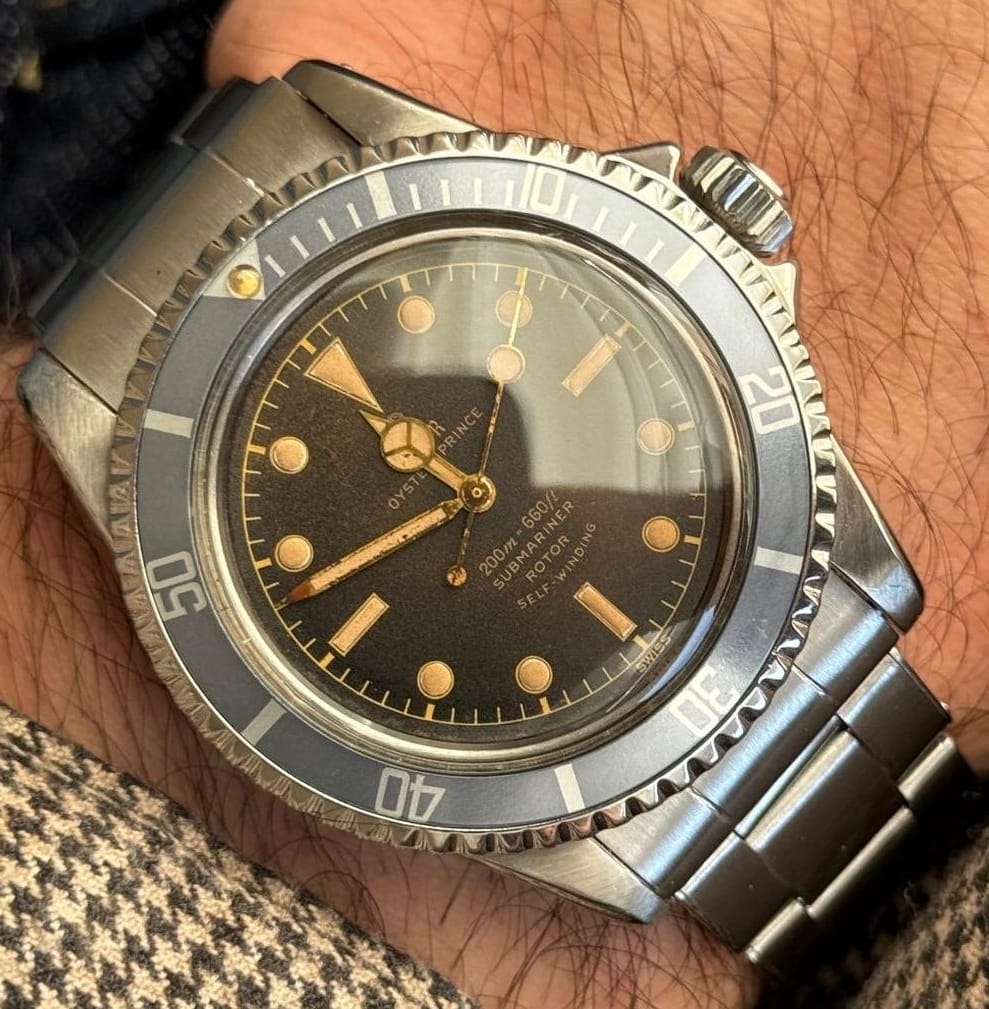
Oyster Prince, Submariner, Rotor, Self-Winding: a vintage Tudor dial reads like an inventory of everything it borrowed from the parent company. The gilt print, the Rolex-signed crown and the faded bezel are the look the Black Bay later quoted. EMore98 / Wikimedia Commons - CC BY-SA 4.0
The plain Oyster Perpetual gets the cake, and a Jubilee motif
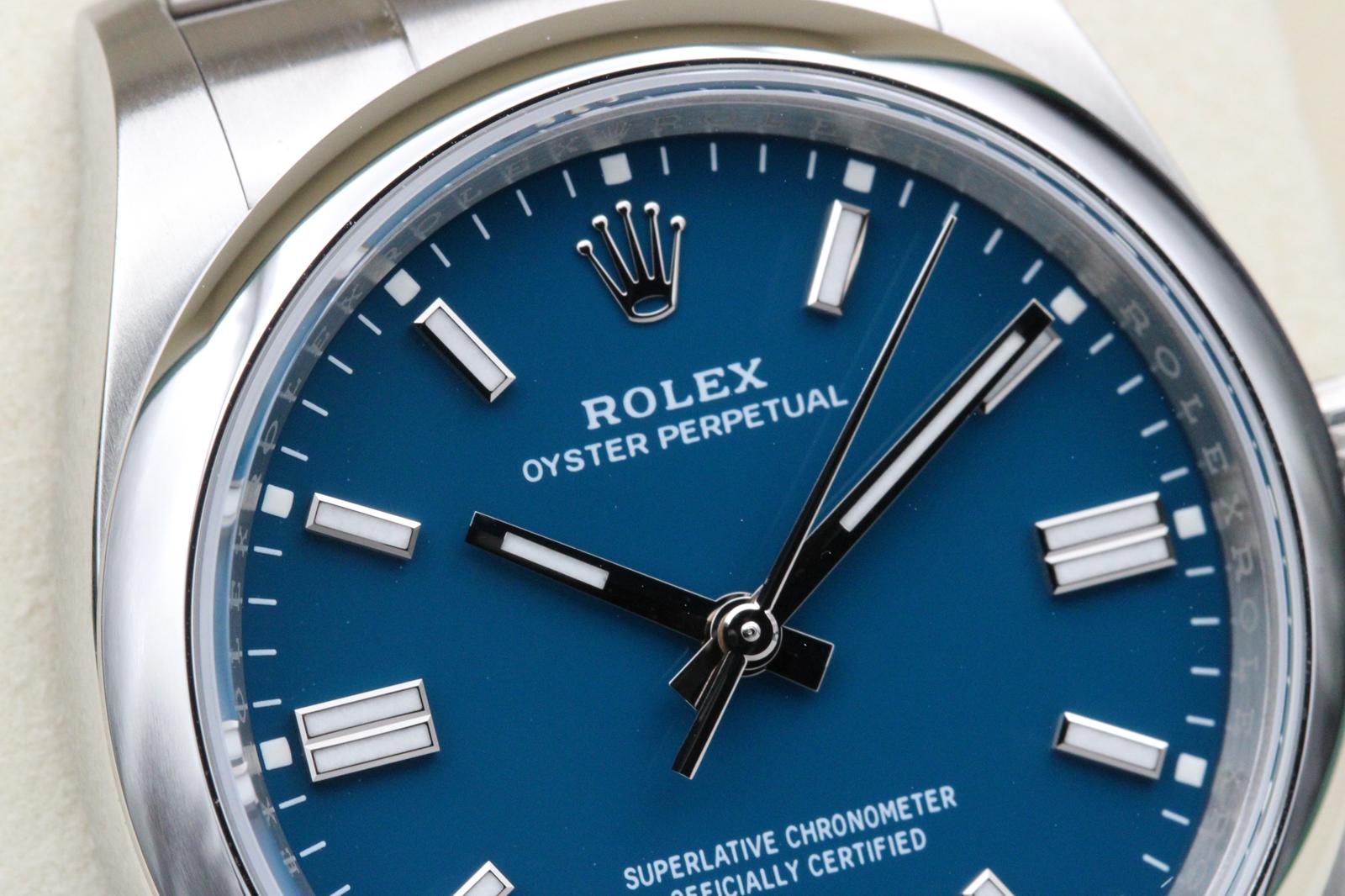
The modern Oyster Perpetual is the least theatrical watch Rolex makes. That is a slightly unhinged thing to say about a steel watch with a bright blue dial, but there it is. The 126000 is the 36 mm one. The 124300 was the first 41, from 2020, and the 134300 is the 41 that replaced it in 2025. There's no date, no bezel to argue about and no professional excuse for any of it, just the case Wilsdorf patented, the rotor he added five years later, and a dial in a colour your authorised dealer will describe, with a straight face, as fun.
For the hundredth year Rolex allowed itself a couple of jokes. One is a two-tone Oyster Perpetual on a steel bracelet with a slate dial and "100 Years" printed at six o'clock, where Swiss Made usually lives, in 31, 36 and 41 mm. The other is a multicolour Jubilee-motif dial across the same three sizes. Rolex calls it a Jubilee motif; collectors already had a name for the older monochrome version, the computer dial, and this is the same repeating ROLEX grid rendered in ten colours. Neither watch needed to exist, and both do because 1926 is the one year Rolex cannot stop talking about.
The Oyster Perpetual has always been the watch you buy when you want a Rolex that still looks like a watch, and in a centenary year that is very nearly a political position. The Submariner and the GMT-Master got the jobs, the Datejust got the date, and the Oyster Perpetual was left holding the original promise: screw it shut, wind it by wearing it, and leave it on in the bath.
An Oyster Perpetual 36, reference 126000, with a bright blue dial. No date, no bezel and no professional excuse: just the 1926 case and the 1931 rotor, wearing a hundred years lightly. EMore98 / Wikimedia Commons - CC BY-SA 4.0
Tudor spent a couple of decades being the brand you'd forgotten was still open. In 2012 it came back with the Heritage Black Bay 79220R, with its burgundy bezel, snowflake hands and an ETA movement wearing a rose on the dial, and the rest of that rebuild is a story already told. The same Basel show had also produced the titanium Pelagos 25500TN, in case anyone thought the comeback was pure nostalgia. What matters here is the birthday and the watches that still wear it: the 79230N with Tudor's own movement inside, the Fifty-Eight 79030N, and the 37 mm Black Bay 54, the 79000N.
2026 is Tudor's hundredth as well, dated from that February 1926 registration, and the brand has spent the year insisting that its story is still being written. The 1926 collection already wears the year on the dial, the 91450 being the 36 mm steel version, and whether that is elegant or a bit on the nose depends on your mood. There's a new Monarch, more Black Bay, and the usual grumbling about whether a centenary deserved a bigger gesture. Tudor didn't really become a company until 1946, and Rolex didn't really become Rolex until the Oyster, and both are celebrating 1926 regardless.
A hundred years is a long time to share a birthday. The Oyster is still the case everything else gets built inside, and Tudor is still the sensible-money bet, except on the days when the waiting list decides otherwise. Wilsdorf's two wagers are both still on the table, one of them a patent and the other just a name, and the rest of us have spent a century arguing about which was the cleverer move.
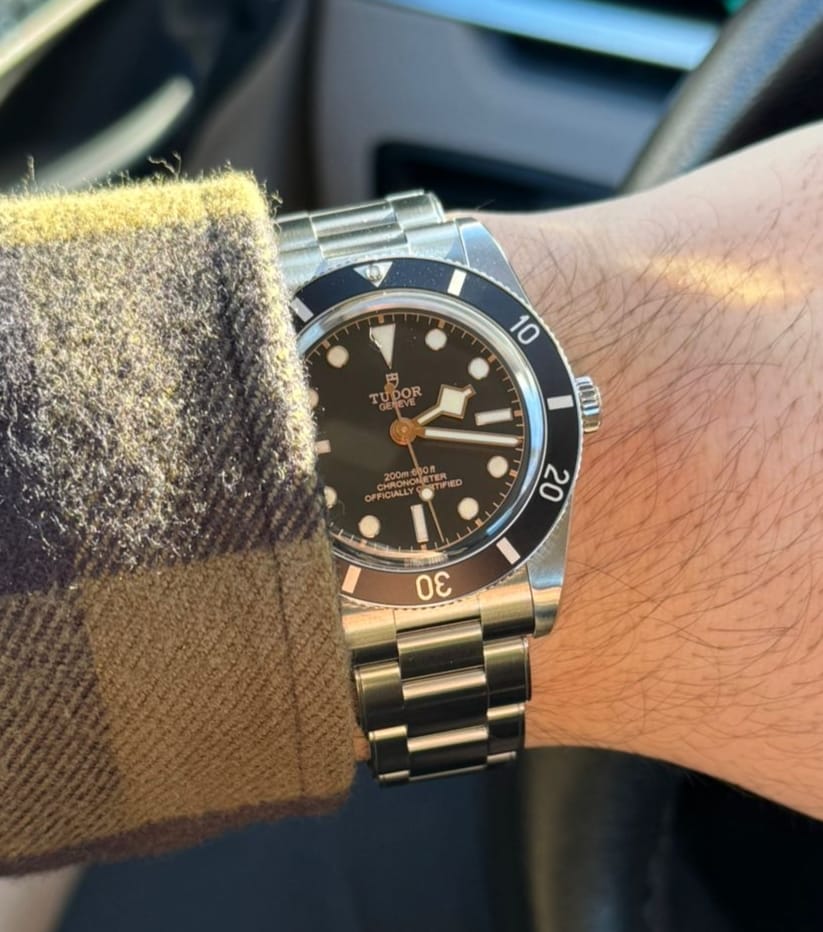
Tudor's 37 mm Black Bay 54 on the wrist. It has the case size of the 1954 Submariner 7922 and the snowflake hands of the 1969 French-navy watches, which is Tudor's way of celebrating a birthday: quote the archive and let the wearer do the arithmetic. EMore98 / Wikimedia Commons - CC BY-SA 4.0