Genta drew two of them. The rest of the 1970s filled in around the Royal Oak: Vacheron's 222, Girard-Perregaux's Laureato, Piaget's gold Polo and Rolex's forgotten Oysterquartz.
Gérald Genta's Royal Oak of 1972 made an expensive steel sports watch with an integrated bracelet look like a serious idea. Baume & Mercier answered a year later with the Riviera, a dodecagonal steel watch drawn by Jean-Claude Gueit. The current 39 mm Riviera 10715 is the shape he left behind.
Girard-Perregaux launched its Quartz Chronometer in 1975, with an octagonal bezel on a circular plinth, a tonneau case and an integrated bracelet, all designed in-house. Italians nicknamed it il Laureato. The house only put that name on the dial as an official title in 1995, when the line finally got a mechanical movement.
1976-1977
Hysek, Blum and Rolex's angles
Patek Philippe's Nautilus arrived in 1976. The next year Vacheron Constantin marked its 222nd anniversary with Jörg Hysek's 222, Ebel put the Sport Classic and its Wave bracelet on sale, and Rolex introduced the Datejust Oysterquartz 17000 and the Day-Date Oysterquartz 19018. IWC's Ingenieur SL, a Genta watch, belongs in that designer's own story.
Yves Piaget launched the Polo in 1979 as a gold bracelet-watch, gadroons running from the links onto the dial, with no steel version at all. Karl-Friedrich Scheufele talked Chopard into its first steel sports watch in 1980 and named it St. Moritz. Omega's Constellation Manhattan, drawn by Carol Didisheim in 1982, closed the class with four claws and an integrated bracelet. Rolex's gold Beta 21 5100, nicknamed the Texan, had already shown the angular integrated case in 1970.
Girard-Perregaux put a limited Laureato into Basel in 2016 for its 225th anniversary, then launched a full collection in 2017. Vacheron Constantin reissued the 37 mm 222 in yellow gold in 2022 as the Historiques 4200H/222J-B935. Piaget's Polo 79 followed in 2024, first in yellow gold as G0A49150. Baume & Mercier's Riviera has been a collection again since the early 2020s, and Chopard's Alpine Eagle is the St. Moritz under a new name.
Gérald Genta's Royal Oak of 1972 made an expensive stainless-steel sports watch with an integrated bracelet look like a serious idea. Four years later Patek Philippe's Nautilus proved the idea could travel. Those two watches have their own histories. What followed was a scramble: every house that wanted to look current spent the rest of the decade inventing its own expensive bracelet watch, and most of the people who actually drew them were not Genta.
The formula was easy to recognise and hard to get right: a case that grew out of its bracelet, a geometric bezel, and finishing that treated steel as if it were gold. The price made the material itself feel like a private joke. Quartz was chewing through the Swiss industry at the same time, so some of these watches hid batteries and some hid ultra-thin automatics. Either way the bracelet was the argument.
By 1982 the class had a full bench. Vacheron Constantin had the 222, Girard-Perregaux had the Laureato, Piaget had a gold Polo that ignored the steel rule on purpose, Rolex had an angular quartz Datejust almost nobody now remembers, and Baume & Mercier, Ebel, Chopard and Omega had all filed their own answers. Then most of them went quiet until the 2010s, when the same shapes came back as if they had been waiting in a drawer.
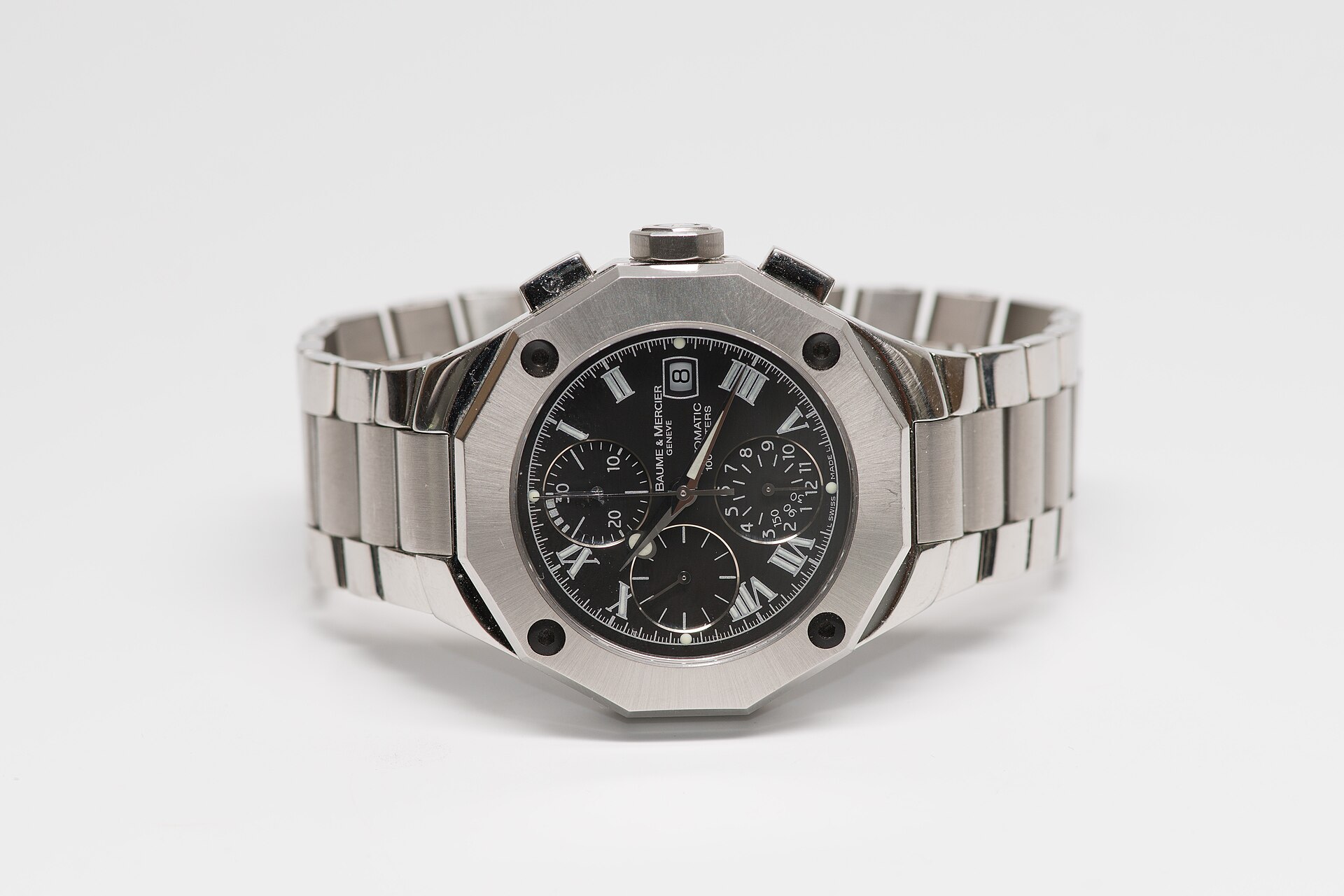
Baume & Mercier got there in 1973. Jean-Claude Gueit drew a dodecagonal steel case with a matching bezel and a flat-link integrated bracelet. The Royal Oak was a year old. Gueit's twelve-sided geometry is its own argument: the hour markers line up with the facets, and the watch wears like a piece of jewellery that happens to go swimming.
The first generation ran on a battery, the obvious move for a Geneva house trying to stay alive in the mid-1970s. Later generations stayed electronic and got thinner. The original 1973 watch is now a collector's footnote. The current Riviera, including the 39 mm automatic 10715, is the shape Gueit left behind, scaled up and given a mechanical heart. For a brand that is often left out of the steel-sports conversation, that is an irritatingly early seat at the table.
A later Riviera chronograph with the dodecagonal bezel Jean-Claude Gueit drew in 1973, a year after the Royal Oak. The hour markers still line up with the facets, and that alignment is the whole idea. Russ / Wikimedia Commons - CC BY 2.0
Girard-Perregaux launched its Quartz Chronometer in 1975, three years after the Royal Oak and a year before the Nautilus. Octagonal bezel on a circular plinth, tonneau case, integrated bracelet, Clous de Paris dial: it looks like a cousin of the Genta watches, so people keep trying to give it a famous father. The manufacture says the design was done in-house. The Milanese architect Adolfo Natalini has been named as the designer in print for years. Girard-Perregaux has said he was not employed by the brand and did not draw the watch. Collectors still prefer the Italian architect.
The nickname is equally messy. In Italy the watch became il Laureato, the graduate. One version of the tale credits Girard-Perregaux's Italian distributor and Mike Nichols's film The Graduate. Another says it was a popular graduation gift. The manufacture has suggested the COSC papers arrived like a diploma. The 1975 watch was sold as a Quartz Chronometer; Girard-Perregaux only put Laureato on the dial as an official name in 1995, when the line finally got a mechanical movement. Until then the precision was the point.
The original 1975 Quartz Chronometer is a collector's object now. What you can buy is the fifth-generation Laureato that returned as a limited 41 mm piece in 2016, reference 81000, and as a full collection in 2017. The 42 mm steel 81010-11-3475-1CM is that collection as Girard-Perregaux sells it today, grey enamel dial and all. It still has the octagon sitting on a circle sitting on a tonneau. That is a lot of geometry for a watch whose designer the factory will not name.
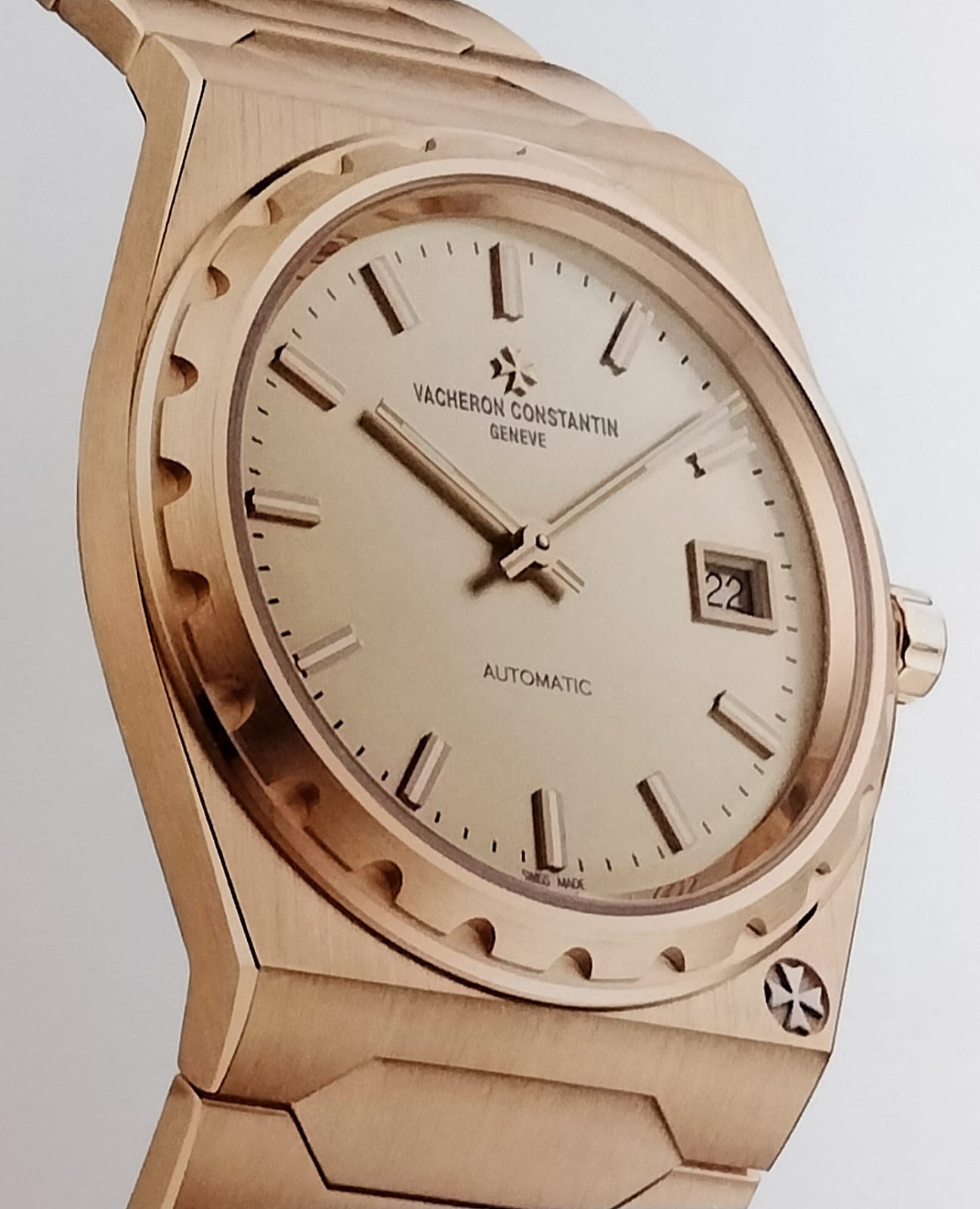
Vacheron Constantin marked its 222nd anniversary in 1977 with a 37 mm integrated-bracelet watch designed by Jörg Hysek, then twenty-four: fluted bezel, monobloc tonneau case water-resistant to 120 metres, a Maltese cross at five o'clock. Collectors still call the full-size 44018 the Jumbo. The 222 line ran until 1985 in 37, 34 and 24 mm, the 34 mm 46003 among them, and later became the Overseas. That is a story of its own.
The same year, Ebel's Pierre-Alain Blum put the Sport Classic on sale with a hexagonal case, a five-screw bezel and the Wave bracelet that still reads as Ebel from across a room. It was quartz, thin, and unlike the octagons everyone else was chasing. IWC's Ingenieur SL, redesigned by Genta in 1976, belongs in that designer's own canon.
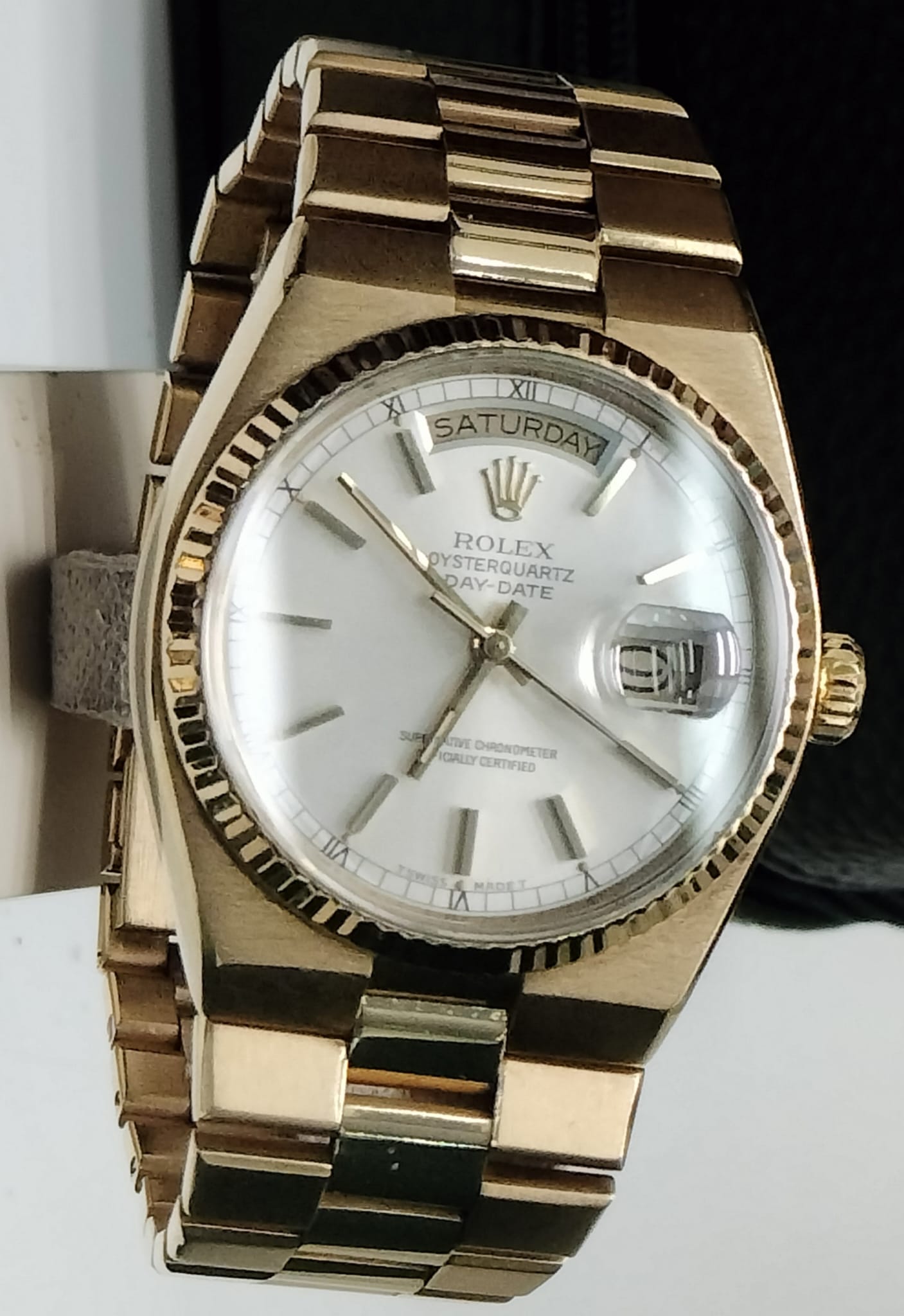
The Datejust and Day-Date already treat the Oysterquartz as a branch. The watch itself is stranger than a footnote. In 1970 Rolex cased the consortium Beta 21 quartz movement in a limited gold watch, reference 5100, about a thousand pieces, with an angular case, an integrated bracelet and the first sapphire crystal the company had used. Italian collectors nicknamed it the Texan. Rolex then left the Centre Electronique Horloger, spent five years on its own quartz calibres, and in 1977 put the Datejust Oysterquartz 17000 on a steel integrated Oyster bracelet, with the 17013 in yellow Rolesor and the 17014 with a white-gold bezel. The Day-Date got the same treatment as the 19018, in yellow gold on an integrated President.
The case is the tell. It is 36 mm, cushioned and faceted, with the bracelet growing out of the lugs the way a 1970s sports watch's does. Early 17000s ran the in-house calibre 5035 without COSC text on the dial; from late 1978 the Mk2 movements were certified and the dials grew the usual Superlative Chronometer line. The Day-Date used calibre 5055. Rolex had already tried the angular integrated case on small automatic runs, the Date 1530 and the Datejust 1630, while the quartz movement was still being finished.
Datejust Oysterquartz production ran into 2001; the Day-Date 19018 a year longer. For a company that treats its own product catalogue as scripture, that is a long time to keep a quartz Datejust that looks like 1977. Collectors who can recite every Submariner bezel still walk past one in a tray, the integrated-bracelet Rolex that never became a waiting-list object.
A yellow-gold Oysterquartz Day-Date with the faceted case and integrated President bracelet Rolex drew in 1977. Collectors who can recite every Submariner bezel still walk past one of these in a tray. Clyde94 / Wikimedia Commons - CC BY-SA 4.0
In 1979, after a conversation with his New York distributor Efraim Grinberg, Yves Piaget launched the Polo as a gold bracelet-watch, gadroons running from the links across the case and onto the dial so the whole object reads as one piece of jewellery. He called it a bracelet watch, meaning the case and the links were the same object. There was no steel Polo that year. Piaget was a gold house, and the watch was built for Palm Beach and nightclubs, shock-resistant and waterproof in the jewellery sense.
The round 761C701 is the version people picture: 34 mm, yellow gold, quartz calibre 7P, the ultra-thin quartz Piaget had introduced in 1976. A 25 mm square Polo, 7131C701, ran alongside it. Ursula Andress wore a Polo. The line faded in the late 1980s. When Piaget wanted a modern sports watch in 2016 it drew a different Polo, cushion-shaped and often in steel: a perfectly reasonable watch and almost nothing like 1979.
The 2024 Polo 79 went back to the gadroons. G0A49150 is the yellow-gold 38 mm reissue with an ultra-thin automatic, calibre 1200P1, in place of quartz. A white-gold version, G0A50150, followed in 2025. That is the exception in this class: everyone else spent the 1970s arguing that steel could be luxurious, and Piaget spent it proving gold could be a sports watch if you rolled it thin enough.
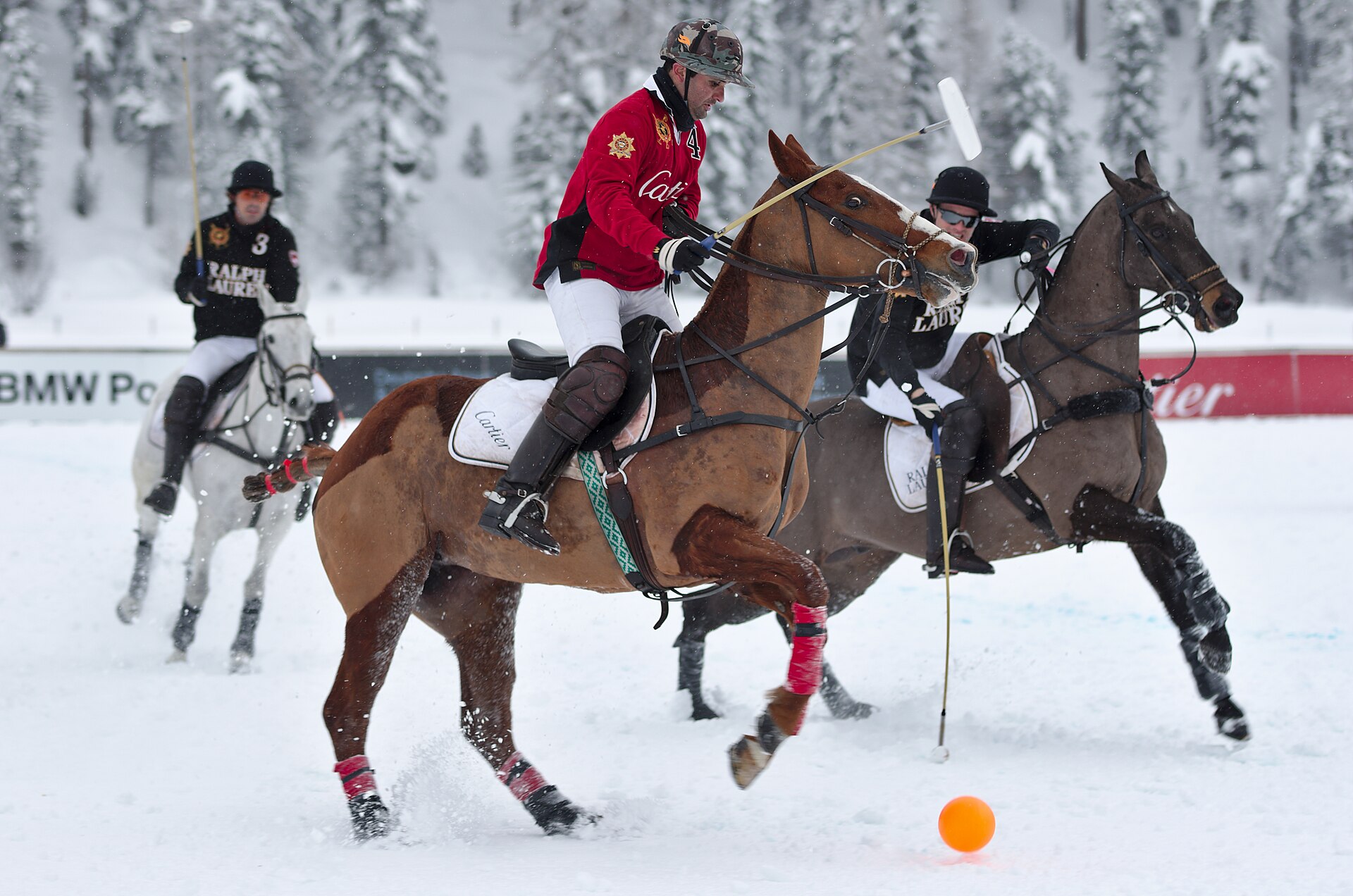
Snow polo on the lake at St. Moritz. Yves Piaget named his 1979 gold bracelet watch after this sport and its crowd, and Karl-Friedrich Scheufele named Chopard's steel one after the town. Clément Bucco-Lechat / Wikimedia Commons - CC BY-SA 3.0
A twenty-two-year-old in St. Moritz, and claws from a bathroom mirror
Chopard still made gold and Happy Diamonds in 1980, so Karl-Friedrich Scheufele, then twenty-two, had a fight on his hands. He wanted a steel sports watch named after St. Moritz, with an uneven octagon, eight visible screws and an integrated bracelet. The watch stayed in the line for years and then went away. In 2019 he brought the idea back as the Alpine Eagle.
Omega's Constellation Manhattan arrived in 1982, drawn by Carol Didisheim, a jewellery designer from La Chaux-de-Fonds, at the age of twenty-six. Four claws at three and nine hold the crystal; the bracelet is integrated; the case is scalloped with half-moon facets. Collectors still credit Genta if they have only ever seen an octagon with screws. They are wrong. She has said the claws came from a colleague's remark about the clasps that hold a frameless bathroom mirror to a wall. She patented the design in 1985. The first Manhattans were quartz, calibre 1422. The claws are still on the Constellation. By then Piaget's gold Polo 761C701 and Rolex's steel Oysterquartz 17000 were already in the shops.
The 1970s drawings come back with better movements
Girard-Perregaux put a limited 41 mm Laureato, reference 81000, into Basel in 2016 for the manufacture's 225th anniversary, then launched a full collection in 2017. Vacheron Constantin reissued the 37 mm 222 in yellow gold in 2022 as the Historiques 4200H/222J-B935, taking Hysek's Jumbo 44018 as the pattern and putting a modern calibre 2455/2 inside. Piaget's Polo 79 followed in 2024. Baume & Mercier's Riviera is a collection again; the 39 mm automatic 10715 arrived in 2023. Ebel brought back its 1911 Chronograph in 2023. Chopard's Alpine Eagle is the St. Moritz with a new name and a new steel.
The market spent forty years treating the Royal Oak and the Nautilus as the entire category, then went looking for every other watch that had been sitting in the same weather. The 222 had already become the Overseas. The Laureato had spent the 2000s as the oversized Evo 3. The Polo had become a cushion. Each revival is a house going back to the 1970s drawing and admitting that the bracelet was the whole point.