Gérald Genta's Canon: How One Freelancer Drew the 1970s
He sold Audemars Piguet a diving helmet, Patek a porthole, IWC five screws and Bulgari a Roman coin. The 1970s copied the homework, and half those copies still get hung on his name.
At twenty-three Genta drew the SAS Polerouter for Universal Genève, a dress watch for polar airline crews with a micro-rotor meant to survive flights over the North Pole. The first pieces went to cabin crew at LAX. He then sold drawings across Geneva, including work the Heritage Association ties to Omega's Constellation refresh, and by the 1960s he was already placing geometrical models with Audemars Piguet. In 1969 he had a secret collection of his own, and Fred in Paris ordered 120 pieces on Christmas Day.
1970-1977
Steel invoices
Georges Golay rang in April 1970 and asked for a steel sports watch that had never been done. The Royal Oak reached Basel in April 1972. Philippe Stern got a porthole in 1976, IWC got five bezel recesses the same year, and Bulgari put the name on the bezel twice in 1977. Four houses, one grammar: integrated bracelet, visible architecture, steel priced like gold.
Vacheron's 222, Girard-Perregaux's Laureato and Piaget's Polo arrived in the same steel-and-gold neighbourhood and still get hung on Genta. He spent the 1980s putting his own name on the dial, taking a Disney licence for gold Mickey watches, and drawing the hexagonal Credor Locomotive for Seiko. The eponymous brand was sold at the end of the 1990s.
Bulgari took over the Genta brand in 2000. IWC wandered off the 1976 drawing in 2005 and only came back to it in 2023. Audemars Piguet's later Jumbo 15202ST kept the 39 mm grammar of the 1972 invoice. Genta died in August 2011 at eighty. In 2022 Sotheby's sold a watercolour of the Royal Oak prototype from his archive for 564,500 Swiss francs.
He sold the same idea to four houses that barely spoke
Gérald Genta was a Geneva goldsmith with a federal diploma and a freelance invoice. Between 1972 and 1977 the same hand sold Audemars Piguet an octagon with eight hexagonal screws, Patek Philippe a ship's porthole, IWC five recesses in a round bezel, and Bulgari a Roman coin with the brand name carved twice around the rim. Collectors now say Genta watch the way they say Newman dial, as if the pieces were cousins. They are four invoices, and the engineering is left on the outside on purpose.
He was born in Geneva on 1 May 1931 to a Swiss mother and an Italian father, and he died in August 2011 at eighty. The Gérald Genta Heritage Association, set up by his widow Evelyne, keeps the drawings and the family version of the stories. The houses keep the watches. The argument, fifty years on, is which of those watches he actually drew.
He earned a Swiss federal diploma as a goldsmith and jeweller in 1951, at twenty, then joined Universal Genève. In 1954, at twenty-three, the firm asked him for a watch to mark SAS polar flights from Copenhagen to Los Angeles via the North Pole. The first Polerouters went to the cabin crew when they landed at LAX. The micro-rotor inside was meant to survive the electromagnetic fields of those polar flights and to keep the automatic thin.
It is a dress watch, sometimes on a black dial. Plenty of others are silver. Universal Genève is no longer around to argue about it. Audemars Piguet's archives already have his name on geometrical models from around 1960, the 5179, the asymmetrical 5182 and the 5199, years before anyone asked him for steel.
The Heritage Association also credits him with Rolex's King Midas in the early 1960s, the lopsided gold brick inspired by the Parthenon. Rolex has never been generous with designer names, so treat that as the family's claim. Omega is messier. The association says he renewed the Constellation in 1959, and that this was the watch that got him called a star designer. Some writers still give him the pie-pan dial. Omega's later Manhattan, the clawed integrated piece from 1982, is Carol Didisheim's, patented in her name.
Royal Oak 1972
Eight hexagonal screws and a steel price that made gold look cheap
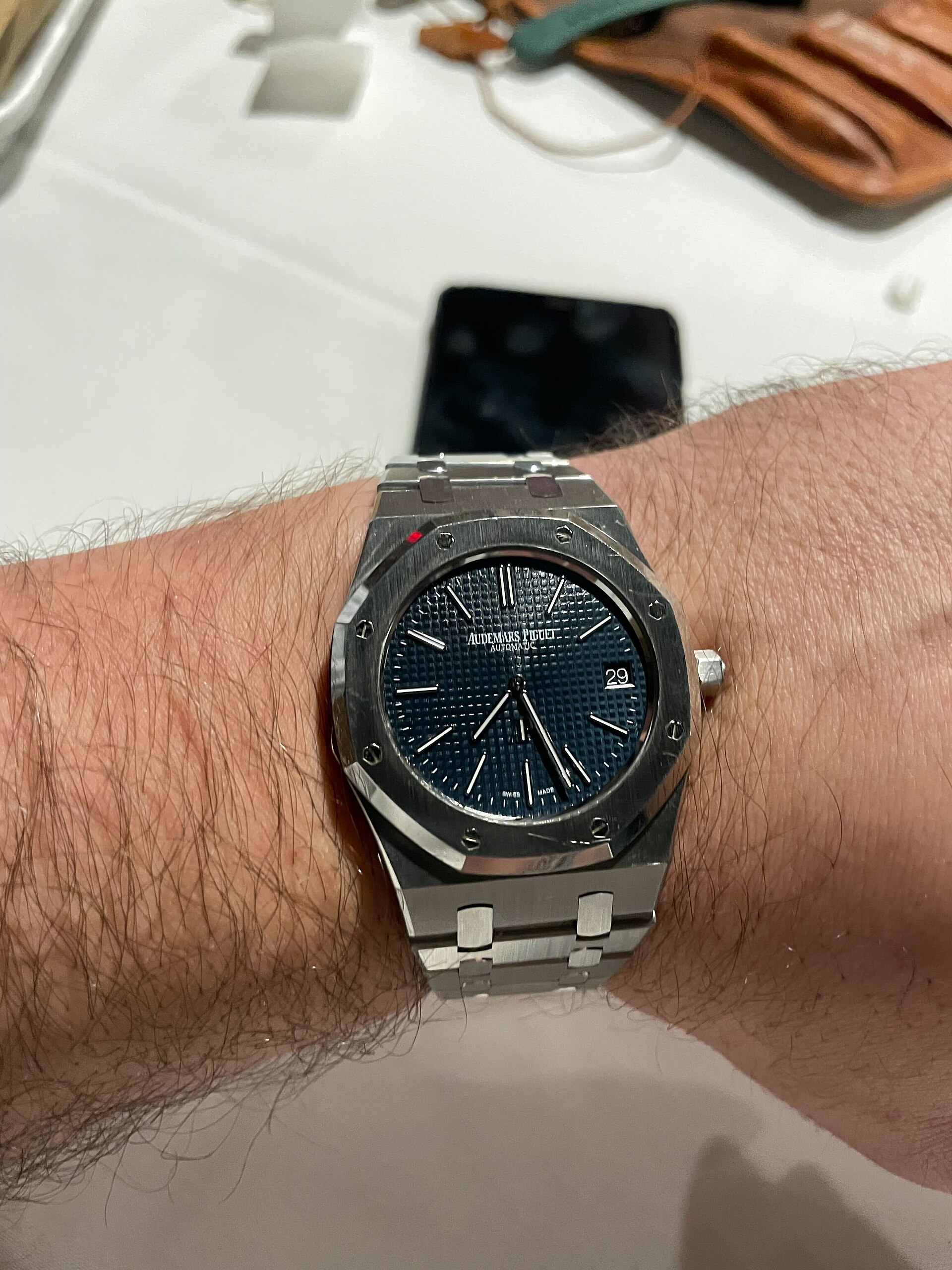
The design idea is the diving helmet he remembered from the Pont de la Machine in Geneva: eight bolts, a fat gasket, the joint left visible. Georges Golay rang him at four in the afternoon in April 1970, asked for a steel sports watch that had never been done, and wanted the sketch by morning. Genta sat down that night and drew the octagon around the eight screws. He later said he had misheard the brief as a new way of making a watch waterproof, so the gasket sits on the outside with the screws.
Audemars Piguet showed the 5402ST at Basel in April 1972 as the most expensive steel watch in the world, listed at 3,300 Swiss francs when the yellow-gold Model 5043 in the same catalogue sat at 2,990. Before the launch, the Italian agent Carlo de Marchi and the Swiss agent Charles Bauty each committed to 400 pieces. The house sold 490 pieces that first year, a record for Le Brassus, and Genta is named as inventor on the water-resistance patent, filed in December 1971 as a water-resistant watch case.
Philippe Stern asked for a sports watch in 1976, and Genta reached for another piece of marine hardware: the porthole on a transatlantic liner, hinges and all. The story he told later is that he sketched it in five minutes on a napkin at lunch during the Basel fair, looking at the Patek table across the room.
The 3700/1 and 3700/1A are that first steel Jumbo: rounded octagon, ears at the sides, horizontally ribbed dial, bracelet growing out of the case. Patek still describes the construction as a ship's porthole. The watch was named after Captain Nemo's submarine. The later steel time-date, of which 5711/1A-010 is the blue-black version people mean when they say Nautilus without a year, is a descendant. The origin stays with the 3700.
IWC got five screws and a nickname it never asked for
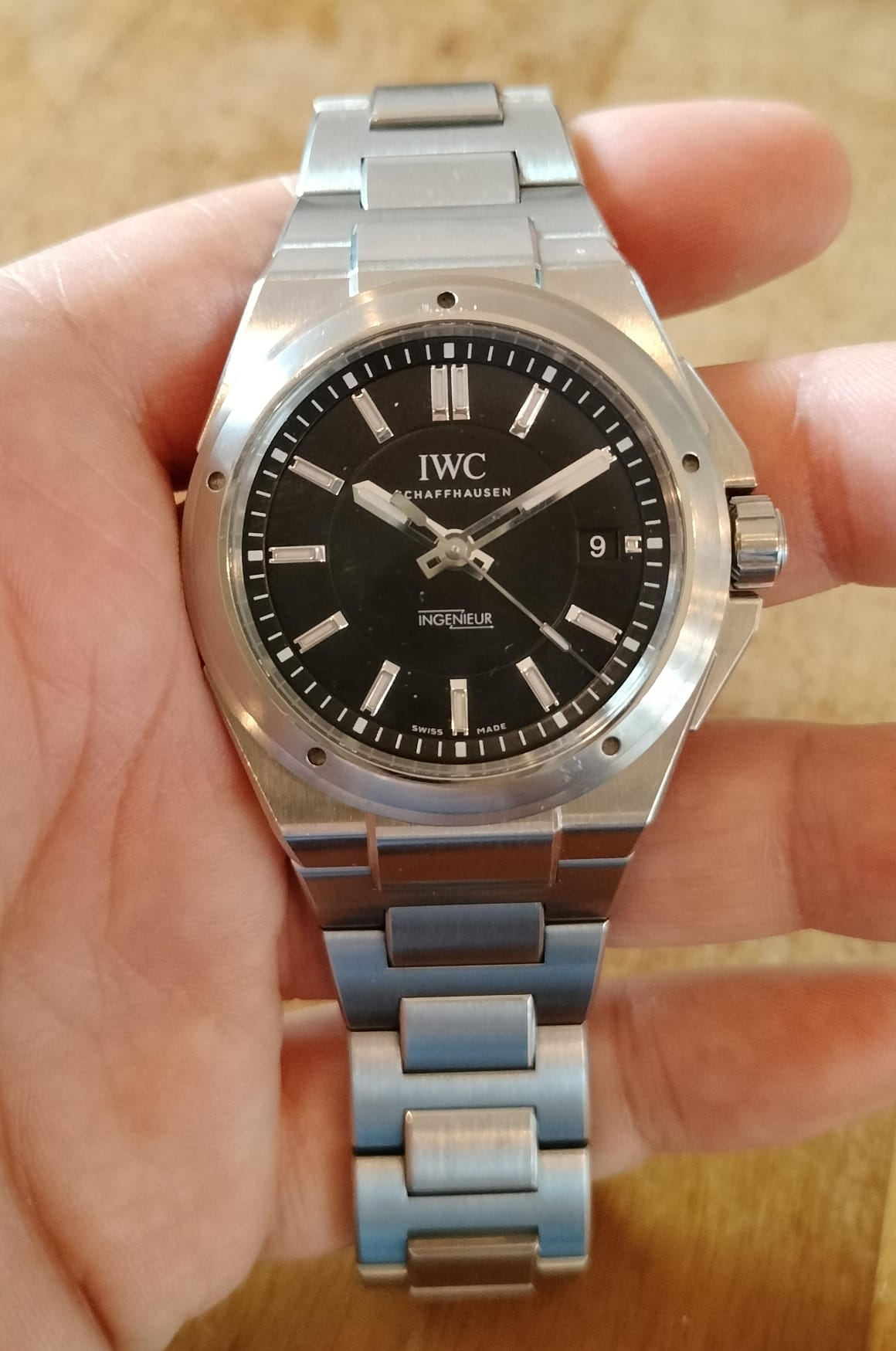
The same year as the Nautilus he gave IWC the Ingenieur SL, reference 1832, a cushioned steel case flowing into an H-link bracelet with five recesses in a screw-on bezel. He had already drawn a steel chronograph for Schaffhausen in 1967 that never went into production, so he was not a stranger when the Ingenieur brief arrived. He delivered the drawings in 1974. The Ingenieur name itself is older, from 1955, and was meant for people who worked near magnets. Genta's 1832 kept the Ingenieur's old brief, a soft-iron cage rated to 80,000 amperes per metre, and put it in a 40 mm steel sports watch. Collectors called it the Jumbo because forty millimetres felt huge in 1976.
IWC launched it at 2,000 Swiss francs as the talking piece of the SL collection of luxury steel sports watches. Inside, automatic calibre 8541 sat on rubber buffers for shock. The watch felt large and heavy on the wrist, and clients then wanted flat quartz. Little more than 1,000 pieces sold between 1976 and 1983. Collectors only really noticed it in the 1990s. For decades it was the Genta sports watch you could actually find. IWC later made a short film with the Genta family and called the 1976 watch the most brilliant failure.
The 2005 3227 put Mercedes-AMG on the dial and wandered into titanium racing-team theatre. The 2013 IW323902 got thinner and kept the name. The 2023 Ingenieur Automatic 40, IW328902, went back to the 1976 drawing and put functional polygonal screws where the old recesses used to land wherever they landed.
The 2013 Ingenieur IW323902 in the hand. The five recesses in the bezel and the H-link bracelet are the 1976 Genta grammar, thinned and updated; the 2023 watch went back to the drawing more faithfully still. EMore98 / Wikimedia Commons - CC BY-SA 4.0
The 1975 original was a gift. Gianni Bulgari had a hundred gold digital watches made with BVLGARI and ROMA on the bezel for the top clients, a slice of column on a cord macramé strap, with a quartz movement inside. Neither the cord nor the quartz matched the jeweller's image, and both were very much 1975. Nobody planned a launch. Clients asked for one, so a small series went into production with a black dial and proper hands. Two years later the commercial watch replaced ROMA with a second BVLGARI. Genta's family, and Genta himself, put his name on that 1977 version: a Roman coin with the inscription running around the rim, a cylindrical case like a temple column.
Bulgari's own English heritage pages talk about coins and columns and stay quiet about the freelancer. The current 103967 is the 2024 automatic with the same double name on the bezel, the living version of that grammar.
The 222, the Laureato and the Polo keep getting hung on him
Jörg Hysek was twenty-four when Vacheron hired him for its 222nd birthday watch in 1977. His name is less famous than Genta's. That is how the 222 spent forty years on the wrong invoice, until Vacheron put Hysek in the second line of the revival press release. Girard-Perregaux's Laureato of 1975 was done in-house. The manufacture has spent years telling people Genta did not draw it, and neither did the Italian architect Adolfo Natalini. Piaget's Polo of 1979 sits in the same steel-and-gold integrated family and is not on Genta's invoice either.
The Golden Ellipse is the other mix-up. Plenty of write-ups still give Genta the 1968 oval. He sat for an interview in 2009 and said Patek made the Ellipse with Rubeli, meaning Jean-Daniel Rubeli, the house's chef de création. Rubeli is even supposed to have said he would never have thought of it if Genta had not existed. That is a compliment. The signature on the idea is still Rubeli's.
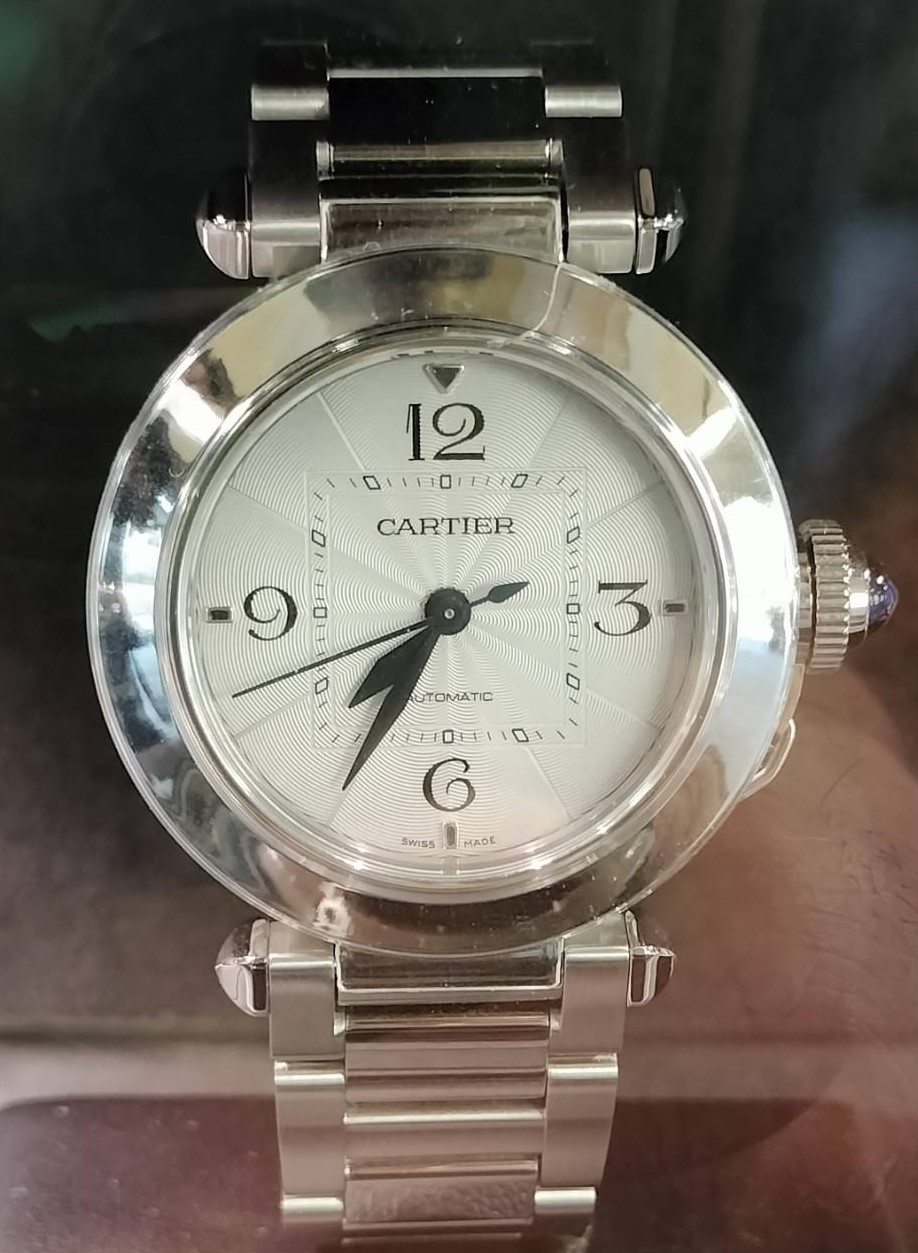
The Pasha is the awkward one. The Heritage Association treats the 1985 round watch as his. Cartier's pages are less eager to print the freelancer. The 1985 redesign is widely attributed. The current WSPA0009 is that round Pasha in steel, and it is the watch people mean when they have that argument.
A round Pasha de Cartier behind glass: Arabic numerals, a square rail on the dial and the capped crown. The 1985 redesign is widely attributed to Genta, and Cartier's own pages are less eager to print the freelancer's name. EMore98 / Wikimedia Commons - CC BY-SA 4.0
Then he put Mickey on a complicated watch and named a Seiko after a locomotive
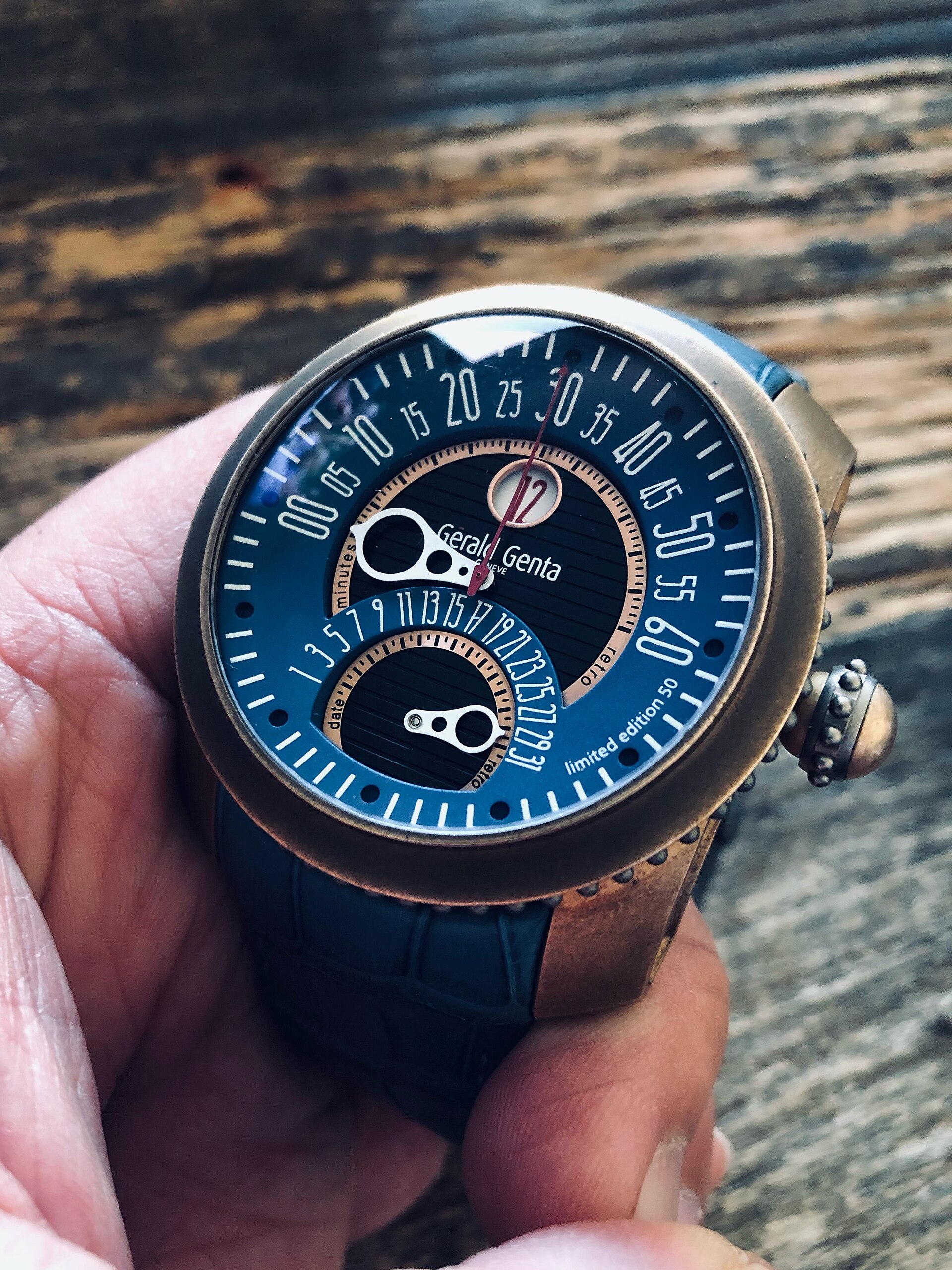
He had been trying to put his own name on a dial since Christmas 1969, when Fred in Paris ordered 120 pieces of a secret collection. By the 1980s Evelyne was running the company while he drew, and they took a Disney licence for gold Mickey and Donald Fantaisie watches with serious movements under the cartoons. The Credor Locomotive of 1979, drawn for Seiko, is the hexagonal cousin of the Oak and the Nautilus. He picked the name himself, he said, in the French sense of a driving force, hoping it would pull Credor forward. In 1984 he also made the bronze Gefica Safari for three hunters, a case that was supposed to look dull in the bush so it would not flash at an animal.
The eponymous brand was sold at the end of the 1990s and passed to Bulgari in 2000. He spent the rest of the time painting. In 2022 Sotheby's sold a hundred of his design drawings, including a Royal Oak prototype watercolour that made 564,500 Swiss francs, with proceeds toward the Heritage Association. The line he liked was that if you are not copied, you are incompetent. He would have enjoyed the 222 argument.
A later Gérald Genta Gefica Safari in bronze, the retrograde descendant of the 1984 watch he built for three hunters so it would not flash at an animal. The one line of watches where the designer's name is the brand. DirtDoog / Wikimedia Commons - CC BY-SA 4.0