Panerai Luminor: The Crown Guard That Became a Culture
A connected history of the Panerai Luminor, from the 1949 Luminor luminous compound and the crown-protecting bridge to the 1993 Pre-Vendome civilian watches, the Stallone/Slytech moment, Richemont-era scale, the Luminor 1950 revival, in-house calibres, and the modern Luminor Marina.
Luminor began as a name for Panerai's low-radiation tritium-based luminous material, registered in 1949. The visual identity collectors now call Luminor arrived as the Ref. 6152/1 evolved: cushion case, sandwich dial, and the lever crown-protecting bridge that locked water resistance into the silhouette.
1993-1994
Military secrecy gives way to civilian scale
In 1993, Officine Panerai brought Luminor and Luminor Marina watches to the civilian market in limited numbered runs. The watches were still huge, direct, and instrument-like, but now they were public objects instead of military equipment.
Sylvester Stallone's discovery of Panerai and the later Slytech watches gave Luminor a strange second ignition: a secretive Italian naval design suddenly became visible as an action-cinema object, and its size became part of its charisma.
After the Vendome/Richemont acquisition, the Luminor and Luminor Marina became internationally distributed luxury-sport watches. Early PAM references kept the formula stark: cushion case, bridge lever, black dial, big numerals, and the feeling that everything unnecessary had been left off.
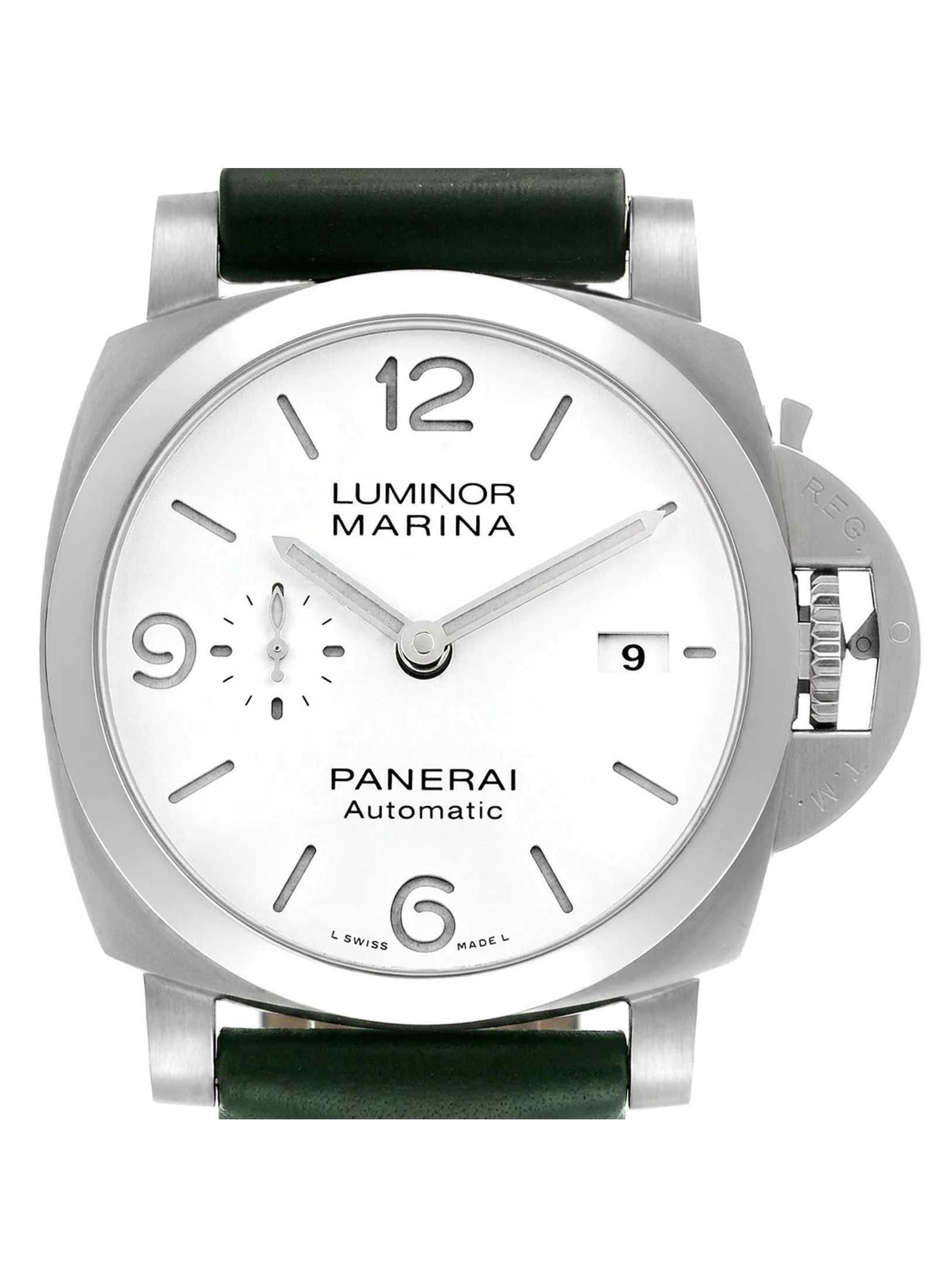
The collector shorthand hardened around Base and Marina. Base meant the dial reduced almost to a logo and hands; Marina added small seconds at 9 o'clock. The difference was tiny, but for Panerai it became a whole language.
The Luminor 1950 line made Panerai's archive feel sculptural again. PAM 127, the 'Fiddy', turned the mid-century case into modern collector mythology, and later 47 mm 1950 references made the domed crystal, vintage dial, and cushion case into a repeatable design system.
The case stays simple while the calibres move in-house
Panerai's manufacture era changed the mechanics without making the watch look busy. Eight-day and three-day calibres, P.5000 and P.6000 descendants, and cleaner Luminor Logo models let the same case architecture carry more of Panerai's own watchmaking.
Modern Luminor Marina references translate the old brief into everyday luxury: automatic P.9010 and newer P.980 movements, 44 mm steel cases, stronger water-resistance ambitions, blue and white dials, and the familiar small seconds/date layout. The 2025 PAM03312/PAM03313/PAM03314/PAM03323 generation keeps the silhouette historical while making the watch more technically current.
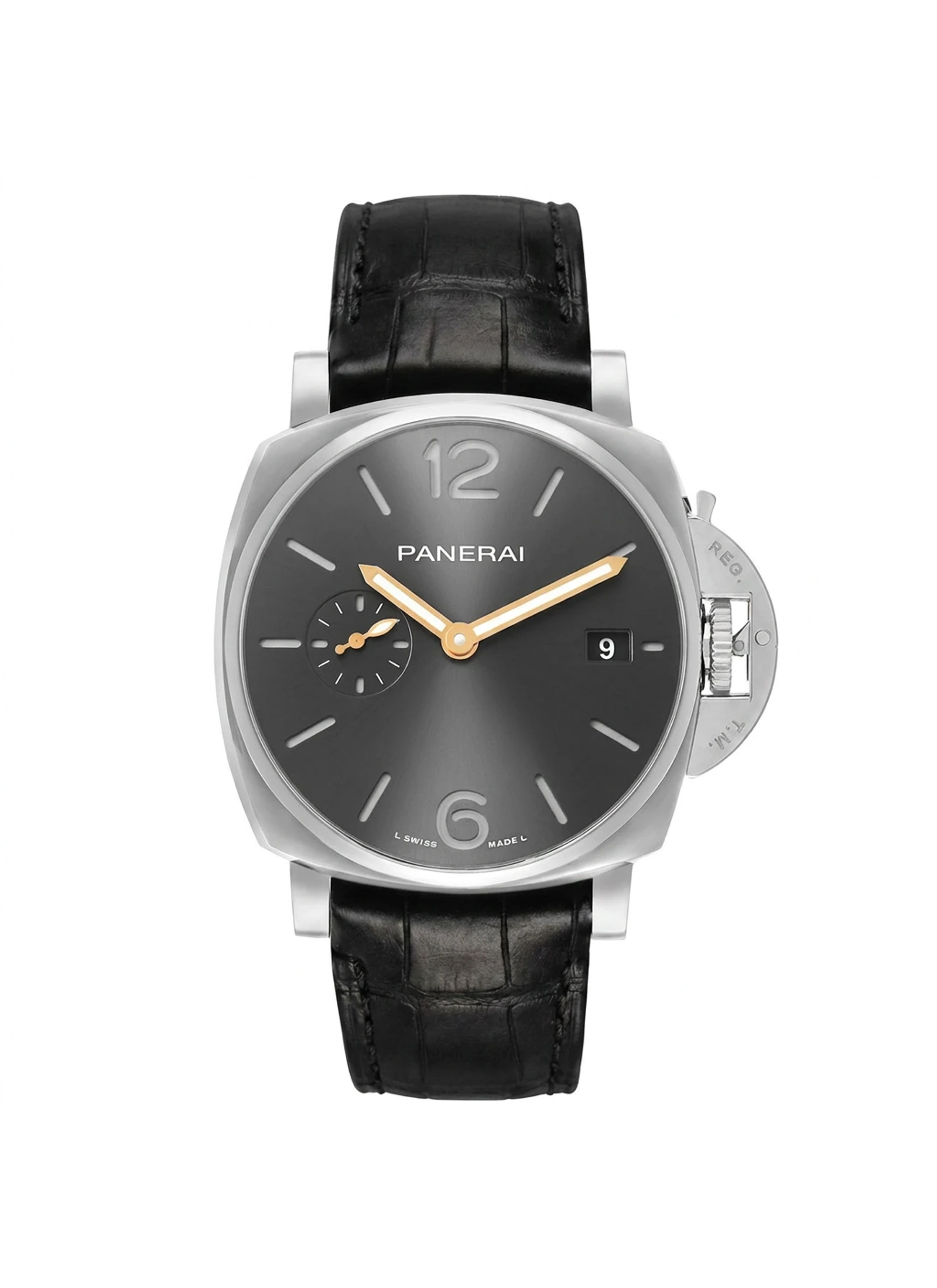
Luminor Due is the family argument in miniature: how far can Panerai thin and polish the Luminor before it stops feeling like a naval instrument? The answer is not a replacement, but a parallel branch where the crown guard becomes style as much as hardware.
The oddity of the Luminor story is that the name and the silhouette were not originally the same thing. Luminor was first a luminous material identity, a safer tritium-era successor to the radioactive Radiomir idea.
The bridge-lever crown protector then gave that technical story a face. Once the Ref. 6152/1 had the cushion case, sandwich dial, and locking crown bridge, Panerai had a watch whose functional logic was visible from across a room.
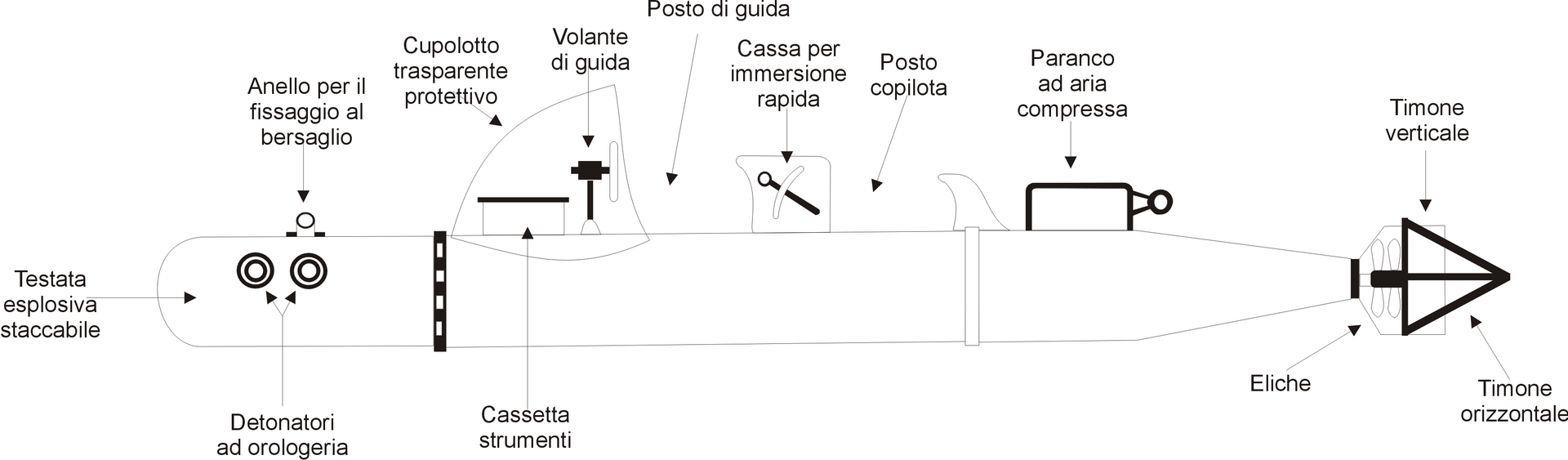
The slow-running human torpedo diagram places Panerai's oversized luminous instruments inside the naval-equipment context that shaped the early watches. Guidomac / Wikimedia Commons - CC BY-SA 3.0
Civilian launch
The Pre-Vendome watches made secrecy collectible
The 1993 civilian launch is the hinge. Panerai took a design language that had lived around military secrecy and offered it as limited civilian watches: Luminor, Luminor Marina, and Mare Nostrum.
The early Luminor references were not trying to be broadly wearable in the conventional 1990s sense. That was the point. The 44 mm case, blunt dial, and crown guard made the watch feel like equipment that had wandered into luxury.
Stallone turned the Luminor into a cultural object
Panerai's official history treats the Stallone episode as a real turning point: the actor noticed the watches, asked for one to wear in Daylight, and the Slytech series followed. The story has been argued over by collectors, but the effect is hard to deny.
The Luminor did not become famous because it disappeared elegantly under a cuff. It became famous because it refused to disappear at all.
The 1997 acquisition and 1998 international launch transformed the Luminor from a cult object into a global collection. What had been eccentric became a product language.
Early PAM references such as PAM00001, PAM00002, and PAM00003 show the brand learning how much it could preserve: the cushion case, the bridge lever, the dial architecture, and the large-wrist stance all survived the move into international retail.
Panerai made minimal differences carry emotional weight. A Luminor Base can feel almost diagrammatic: case, dial, hands, logo. A Luminor Marina adds small seconds at 9 o'clock and immediately feels more animated.
That is why references like PAM00005, PAM00111, and PAM00112 matter. They are not complicated watches. They are vocabulary words.
The Luminor 1950 'Fiddy' did more than revive a case profile. It made Panerai's archival proportions feel like an event: 47 mm, domed crystal, vintage-inflected dial, and a name that turned 1950 into collector slang.
Later Luminor 1950 references such as PAM00372 and PAM00422 stretched that language into an ongoing branch. The family did not simply look back; it learned how to sell the feeling of looking back.
Panerai's in-house era could have made the Luminor more visibly technical. Instead, the brand mostly hid the progress inside: longer reserves, stronger automatic and hand-wound calibres, and models that still looked almost stubbornly simple.
That restraint is important. A Luminor Logo with a P.6000-style manual calibre is modern Panerai watchmaking, but it still reads like the same old instrument at first glance.
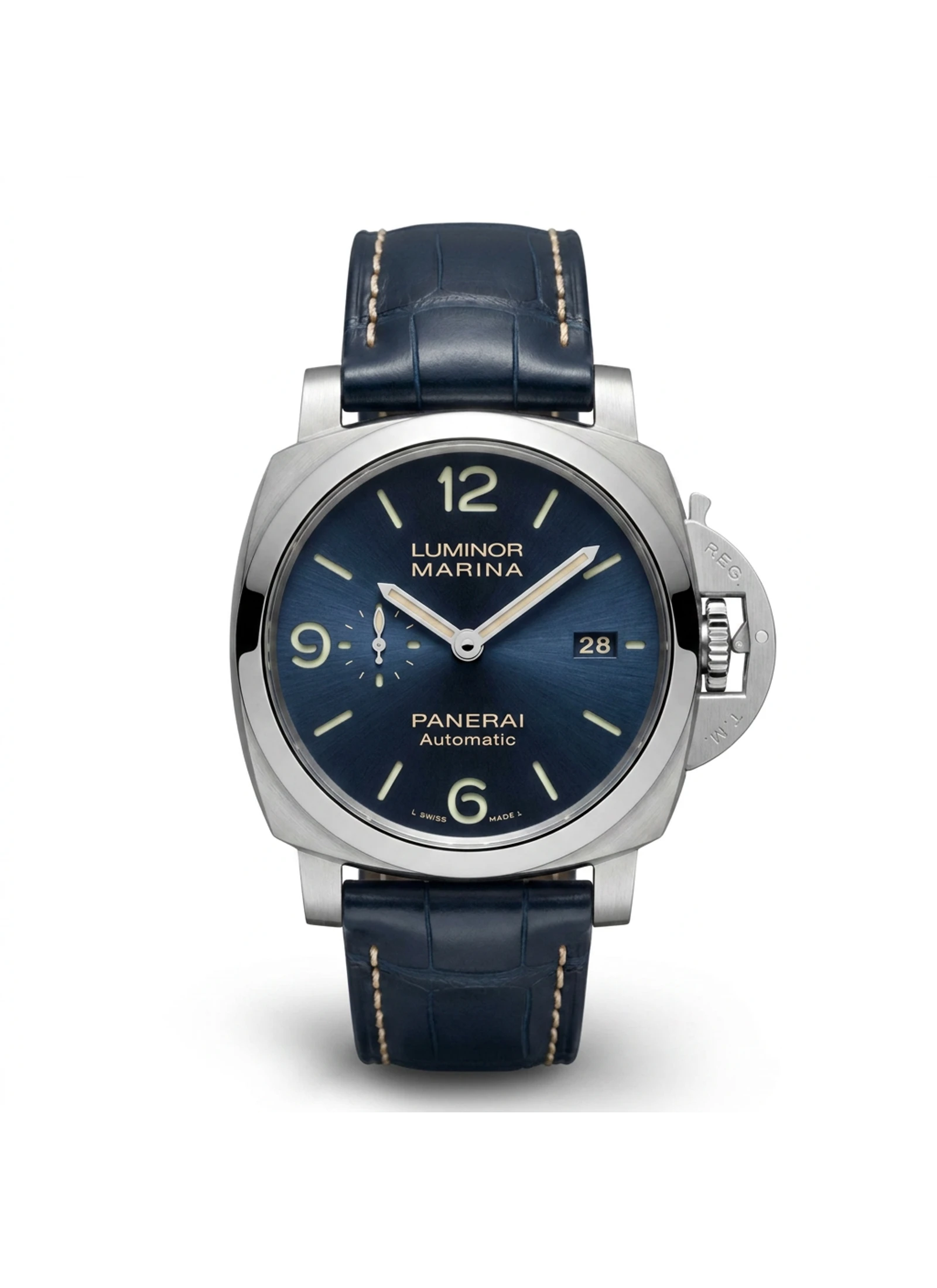
Today, the Luminor Marina is the most immediately legible version of the idea: crown bridge, 44 mm steel case, small seconds, date, modern automatic movement, and enough dial variation to feel current without losing the silhouette.
The P.9010 generation established the everyday modern Marina formula; the P.980 references PAM03312, PAM03313, PAM03314, and PAM03323 push that formula further with 50 bar water resistance, Grade X2 Super-LumiNova dials, quick-change strap or bracelet hardware, and the same unmistakable lever at 3 o'clock.
A cleared catalog visual of Luminor Marina anchors this chapter to a specific watch reference.
Luminor Due is not the purest instrument-watch expression of Panerai, and that is exactly why it belongs in the story. It shows the crown bridge becoming a design signature that can survive outside the original tool-watch proportions.
For the database, this matters too: Luminor is not one tidy family. It is an architecture that has generated Base, Marina, 1950, GMT, Power Reserve, Chrono, Due, and Submersible-adjacent branches.
A cleared catalog visual of Luminor Due anchors this chapter to a specific watch reference.