Jaeger-LeCoultre Reverso: The Watch That Turned Over
A connected history of the Reverso, from its 1931 polo-field brief and Art Deco sliding case to the Italian-led revival, Grande Taille, Duoface, Duetto, Squadra, Tribute, and modern high-complication era.
The Reverso began as a practical answer to broken crystals on the polo field: slide the case out, flip it over, and expose a plain metal back instead of the dial. The useful trick quickly became a design identity, with Art Deco lines, gadroons, and a blank reverse side that invited engraving, enamel, and personal stories.
After the rectangular watch fell out of fashion, the Reverso nearly vanished. Its revival came through Italy, where Giorgio Corvo pushed Jaeger-LeCoultre to restart the idea after old Staybrite steel cases were found in Le Sentier. By the 1980s, the case had been modernized and made more robust without losing the original visual grammar.
The 60th anniversary turned the Reverso from a revived icon into a platform. The larger Grande Taille proportions gave Jaeger-LeCoultre more space for movements and complications, making the reverse side feel less like a blank back and more like a mechanical opportunity.
The Duoface changed the meaning of the flip. Instead of protecting the dial or holding an engraving, the reverse side became a second time display. The Duetto carried the same double-dial idea into a more jewelry-aware expression, giving the Reverso one of its most important modern branches.
In the 2000s, the Reverso grew outward. Grande Reverso models explored larger cases, power reserves, dates, and travel indications, while Squadra made the watch square, sportier, and more obviously tied back to the polo origin story. Some of these branches now feel like period pieces, but they show how elastic the Reverso architecture had become.
After years of expansion, the Tribute direction pulled the Reverso back toward its early elegance: cleaner dials, strong color, hand-wound thinness, and Art Deco restraint. The Duoface remained crucial, but the point was no longer only technical cleverness. It was balance: one watch, two moods, still unmistakably Reverso.
The current Reverso is not one product line so much as a system: Classic, Duoface, Duetto, Tribute, artisanal personalization, and high complications all use the same basic gesture. Even the Reverso Hybris Mechanica Calibre 185, with four faces and eleven complications, is a radical extension of the original question: what else can happen when a watch turns over?
It was a tool watch before the category had hardened
The Reverso is easy to romanticize because it now looks so elegant, but its first brief was almost brutally practical. Polo players needed a watch that could survive impact. The answer was a case that could slide, pivot, and hide the glass behind metal.
That utility produced something stranger and more durable than a normal sports watch. The protected back became a surface for initials, crests, enamel, miniature painting, and later entire second dials. The story starts with protection, but the reason it lasts is transformation.
A period polo image makes the Reverso's famous flipping case feel like a solution to impact and sport, not a novelty mechanism invented for its own sake. The Library of Congress / Wikimedia Commons - No restrictions
The Reverso survived partly because it disappeared
After World War II, rounder and more conventional watches took over. The Reverso's rectangular case and complicated construction made less commercial sense, and for decades it became more memory than mainline product.
The 1970s revival is important because it reframes the Reverso as a rediscovered design rather than a continuously obvious bestseller. Giorgio Corvo's Italian-market push helped prove that the old shape still had cultural charge.
The larger Grande Taille case did more than make the Reverso wear more modern. It gave Jaeger-LeCoultre the physical space to think of the swiveling case as architecture for complications.
This is the point where the Reverso stops being only a clever case and becomes a family engine. The core move stays simple, but the possible uses of the second side multiply.
The Duoface is the cleanest modern answer to what the Reverso can do. One movement drives two displays, letting the reverse side carry another time zone rather than a blank plate.
That matters because it makes the reverse side useful without breaking the original idea. The watch still turns over; now the turn is not only protection or decoration, but information.
The Duetto is easy to understate if the story is told only through complications. Its importance is different: it treats the second face as a change of mood, moving between restrained daytime design and a more gem-set or evening expression.
That gives the Reverso a broader cultural range. It is not only a men's rectangular watch with a technical party trick. It becomes a shape that can carry gender, jewelry, dress codes, and personal style without changing its core mechanism.
Grande Reverso and Squadra models are not always the first Reversos collectors mention today, but they are useful historically. They show Jaeger-LeCoultre treating the case as a live design system, not a museum object.
Large dates, GMT displays, squared cases, sportier proportions, and automatic experiments all tested the limits of how much Reverso could remain Reverso. Some worked better than others, but the experiments explain the depth of the family tree.
The Tribute line works because it knows when to stop. It revives the geometry and dial discipline of the early Reversos while keeping modern finishing, color, and Duoface mechanics in play.
That restraint is why the modern Reverso feels so strong. It can still be complicated, artistic, or gem-set, but its most persuasive versions remember the slimness and composure of 1931.
A cleared catalog visual of Reverso Tribute Duoface anchors this chapter to a specific watch reference.
The current collection makes the Reverso's messy database shape understandable: Classic, Duoface, Duetto, Tribute, Lady, Grande Reverso, and high-watchmaking branches are all legitimate, but they describe different uses of one reversible architecture.
The Calibre 185 Quadriptyque makes the point at the extreme end. Four faces and eleven complications sound almost absurd until you remember that the Reverso has always been a watch asking what can happen on the other side.
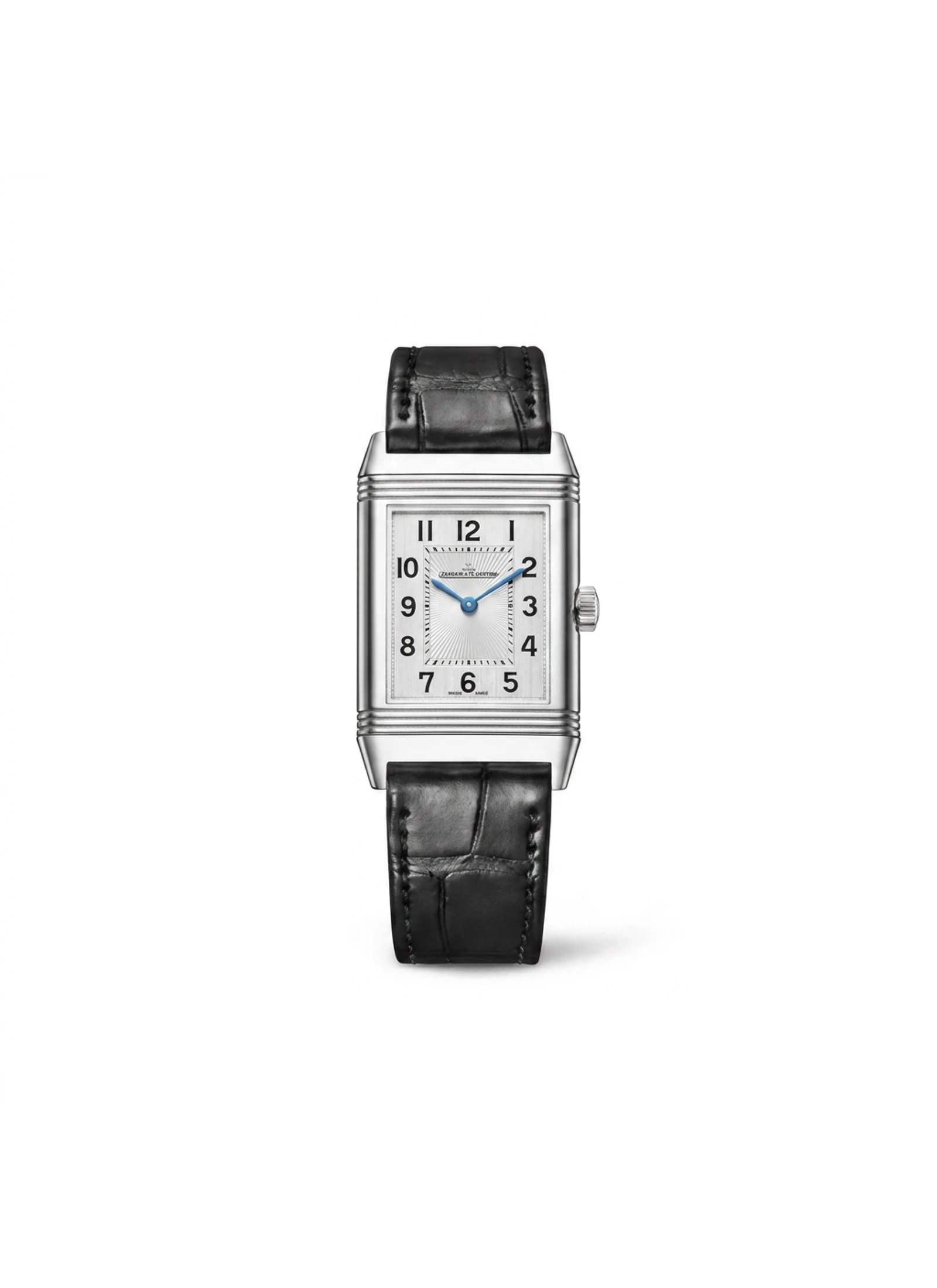
A cleared catalog visual of Reverso Classic Medium Thin anchors this chapter to a specific watch reference.
![Bain News Service,, publisher. Polo Game, T. Roosevelt [between ca. 1910 and ca. 1915] 1 negative : glass ; 5 x 7 in. or smaller. Notes: Title from unverified data provided by the Bain News Service on the negatives or caption cards. Forms part of: George Grantham Bain Collection (Library of Congress). Format: Glass negatives. Rights Info: No known restrictions on publication. Repository: Library of Congress, Prints and Photographs Division, Washington, D.C. 20540 USA, http://hdl.loc.gov/loc.pnp/pp.print General information about the Bain Collection is available at http://hdl.loc.gov/loc.pnp/pp.ggbain Higher resolution image is available (Persistent URL): http://hdl.loc.gov/loc.pnp/ggbain.09267 Call Number: LC-B2- 2204-14](/story-media/jaeger-lecoultre-reverso-history/polo-game-t-roosevelt-loc-2162676577.jpg)