Grand Seiko started as a 1960 bet that Japan could out-Swiss the Swiss. Then it spent decades inventing a design grammar, a quartz it later had to live with, and a seconds hand that refuses to tick.
Suwa Seikosha launched Grand Seiko in 1960 with the hand-wound calibre 3180, rated in-house to the Bureaux Officiels excellence grade of +12 to -3 seconds a day. The 1964 Self-Dater added a quick-set date, 50 metres of water resistance, and the first Zaratsu-polished Grand Seiko case.
Daini Seikosha's first Grand Seiko, the 44GS of 1967, put Taro Tanaka's Grammar of Design into steel: flat planes, a distortion-free bezel, and a semi-recessed crown. The same years brought the 62GS, Grand Seiko's first automatic, with a bezel-less case and the crown tucked at four o'clock.
The 61GS automatic and 45GS manual of 1968 ran at 36,000 vibrations an hour. In 1969 both lines gained V.F.A. versions rated to a minute a month, while skills from the Neuchatel and Geneva observatory trials fed the hi-beat work. Remaining mechanical Grand Seiko production ended in 1975.
The name came back in 1988 on the 95GS, a quartz rated to ten seconds a year, then on the 9F family in 1993, built to drive proper Grand Seiko hands. In 1998 the 9S55 automatic and a tightened Grand Seiko Standard put a mechanical calibre back in the line, and the SBGR001 set the modern Heritage shape.
Grand Seiko's first Spring Drive, calibre 9R65, arrived in 2004. The Snowflake dial followed in 2005 as the SBGA011 and, after the 2017 brand split, as the SBGA211. The 9S85 restored hi-beat mechanics in 2009. Evolution 9 and calibre 9SA5 arrived in 2020, and the White Birch SLGH005 took the GPHG Men's Watch Prize in 2021.
A Japanese luxury watch that began as an exam paper
In 1960 Suwa Seikosha, the inland factory that is now Seiko Epson, launched Grand Seiko as the ideal watch: precise, durable, legible and beautiful enough to lead the world. That is a lot to ask of a 35 mm gold dress watch with a lion on the case back, and for the first few years the answer was mostly a movement. Calibre 3180 was the first Japanese calibre rated in-house to the Bureaux Officiels de Controle excellence grade, +12 to -3 seconds a day, with a 45-hour reserve. The Swiss had written the paper. Suwa marked it itself.
The other half of the house, Daini Seikosha in Tokyo, was competing with Suwa in the useful way siblings do. By 1967 Daini had cut the 44GS, the watch that still tells you a Grand Seiko from across a room, and Suwa had put a rotor in the 62GS. Then both factories wound their balances up to ten beats a second, sent specially prepared movements to Neuchatel, and for a few years looked as if they might win the mechanical argument outright. Quartz, which the same group would put on sale in 1969, made that argument look suddenly antique. Mechanical Grand Seiko production ran down through 1975.
The name came back on quartz, then on a new mechanical family in 1998, then on Spring Drive, whose seconds hand glides instead of ticking. The watch people now mean when they say Grand Seiko is often the Snowflake, a titanium Spring Drive with a dial that looks like windblown snow around the Shinshu studio. In 2017 the Seiko signature came off the dial entirely. Evolution 9 and the White Birch followed. This is that arc, from a lion on a case back to a birch forest on a dial, told through the watches that make each turn visible.
The First wore Chronometer on the dial and a lion on the back
Seiko's brief, as Phillips later quoted it, was to build a watch "as precise, durable, easy to wear and beautiful as humanly possible". Collectors now say First, or 3180 after the calibre, or J14070 after the model number. The team at Suwa took the Crown's large-balance calibre 560 from 1959, added a movable stud, a fine-adjustment regulator, Diashock, hacking seconds and a barrel-hole jewel, and rated the result +12 to -3 seconds a day. It was the first Japanese movement rated, in-house, to the Bureaux Officiels excellence grade of +12 to -3 seconds a day. The Gothic Grand Seiko logo at 12 o'clock was chosen because it looked traditional, a slightly comic ambition for a name that had just been printed.
Around the back sat a lion, the king-of-watches joke. The steel watches were gold-filled; a few cases were platinum. Production ran only from 1960 to 1963. The 1964 Self-Dater, with calibre 5722A, was the practical sequel: a quick-set date, water resistance raised to 50 metres, and the first Grand Seiko case finished by Zaratsu polishing, a distortion-free mirror done against the side of a rotating disc. The name comes from Sallaz, the German machines Seiko had bought. It is a factory term, however much the brochure copy later dressed it up.
In 1966 Grand Seiko published its own accuracy standard, tighter than the Bureaux Officiels chronometer grade, first at +6 to -3 seconds a day and from 1969 at +5 to -3. The Swiss had decided that only watches tested in Switzerland deserved the word Chronometer on the dial. Suwa, unimpressed, printed Grand Seiko instead and kept tightening the numbers.
Taro Tanaka wrote the grammar. The 44GS is the sentence everyone still quotes
Until 1967 every Grand Seiko had come from Suwa. Daini Seikosha's first attempt is the one the brand still looks like. Taro Tanaka, hired in 1959 as Seiko's first properly trained industrial designer, had spent hours at the Wako store in Ginza watching how people reacted to Swiss watches in the window. His conclusion, later quoted as company scripture, was that Grand Seiko needed to sparkle with quality: sharper angles, wider flats, and no distortion in the reflections. By 1962 he had written that down as the Grammar of Design. The 44GS of 1967, reference 4420-9000, is where those rules became a case.
Three principles still sit on the brand's own design page. Surfaces should be flat, with two-dimensional curves and almost no three-dimensional ones. Those flats should be as wide as possible, on the case, the dial and the hands. Every surface should be a distortion-free mirror. From that come the nine elements collectors can recite, from the double-width index at 12 and the semi-recessed crown to the inward-slanted bezel. Zaratsu is what makes the bezel look like still water. The 44GS was a manual five-beat watch, 37 mm, made for only about two years, with an early Diashock dial and a later Daini-logo one. Steel examples still turn up as founding documents. The case still looks like next year's Grand Seiko.
The Grammar was never meant to be a prison. Tanaka's rules also shaped King Seiko, and they leaked into ordinary Seikos of the late 1960s. The 44GS remains the one collectors mean. When Grand Seiko wants you to know a new watch is a Grand Seiko, it still cuts that inward case and that mirrored bezel.
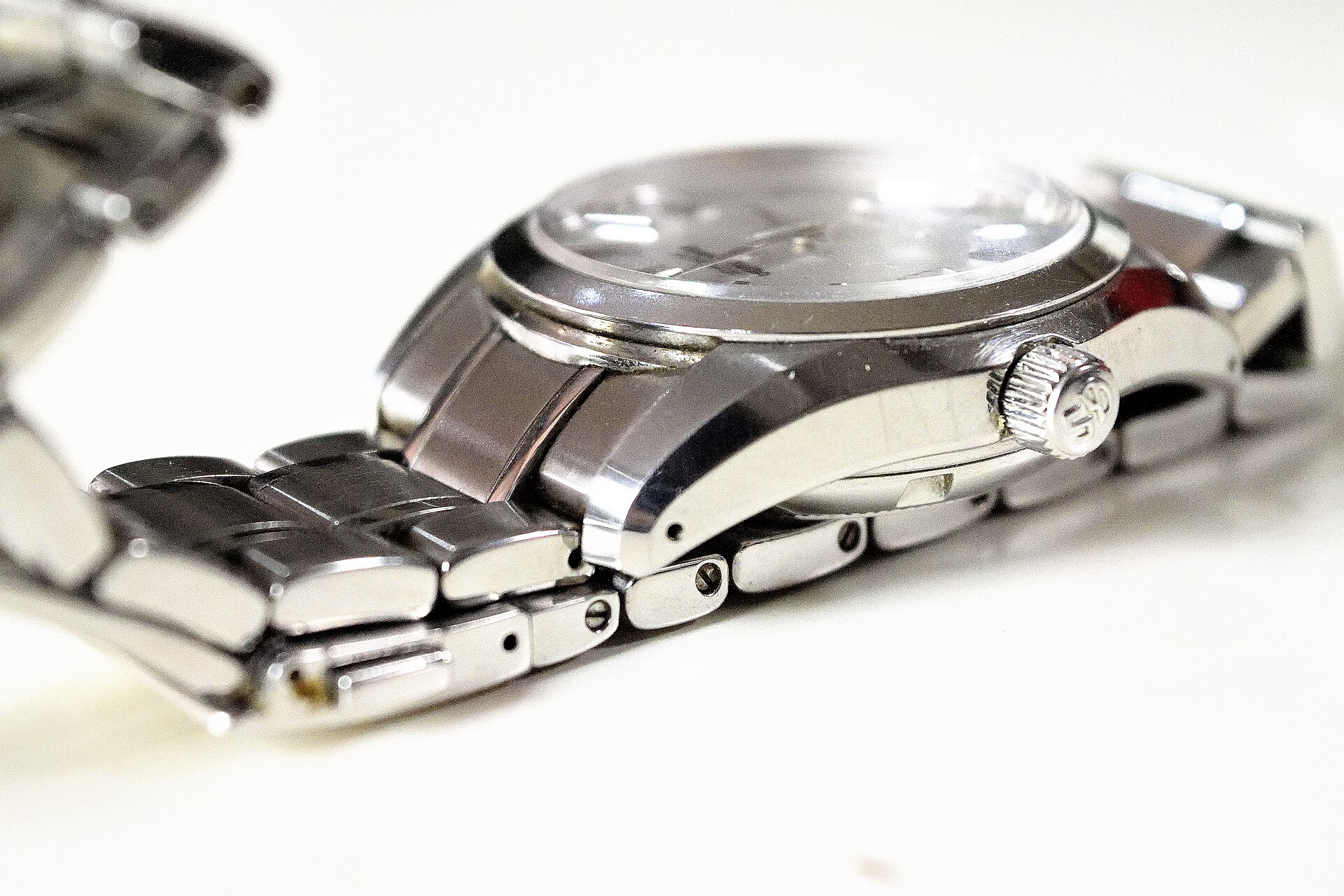
A modern Grand Seiko case in profile: wide flat planes, a bezel that slopes inward, a mirror that shows no distortion. Tanaka wrote the rules in 1962 and the 44GS cut them in steel in 1967. The factory has been cutting them ever since. STSPP / Wikimedia Commons - CC BY-SA 4.0
Ten beats a second, and an observatory that started by failing them
Grand Seiko dates the 62GS, its first automatic, to 1967. Collectors who have followed the Seikomatic 6245 and 6246 paper trail often put the changeover a year earlier, so a 6245-9000 can wear a 1966 date and a 6246-9001 a 1967 one. Either way it is a bezel-less 36-odd millimetre automatic with the crystal set straight into the mid-case, the crown almost hidden at four, and Magic Lever winding. The date 6245 and day-date 6246 were the expensive steel watches of the line, and they look a little more organic than the 44GS, Tanaka's grammar spoken with a rounder accent.
In 1968 Suwa released the 61GS, Japan's first automatic 10-beat, calibre 6145 at 36,000 vibrations an hour. Daini answered with the manual 45GS, thinner than the 44, in time-only 4520 and date 4522 versions, also at ten beats. High frequency was the lesson from the Swiss observatory contests. Suwa and Daini had entered Neuchatel's mechanical wristwatch section in 1964 and finished 144th and 153rd, too low even to pass. By 1967 they took second and third in the company series prize. In 1968, at Geneva, Suwa occupied fourth through tenth, the top mechanical rankings, while Swiss quartz prototypes took the first three. The observatory work was done on specially adjusted movements, not shop watches. The skills went into Grand Seiko and King Seiko afterwards. Daini later cased observatory-certified 45-calibre movements as the Seiko Astronomical Observatory Chronometer, sold as a Seiko rather than a Grand Seiko and one of the oddest cousins in the family.
In 1969 both factories announced V.F.A., Very Fine Adjusted: a minute a month, tested harder than the already strict Grand Seiko Standard, in six positions over a longer run. The 61GS V.F.A. used calibre 6185; the 45GS V.F.A. used 4580. Some early 6185-8020 watches went out with an applied Suwa logo and no V.F.A. print on the dial, the sort of detail that makes vintage collectors extremely happy and everyone else a little tired. A 61GS went into the Osaka Expo time capsule in 1971, not due to be opened until 6970. Someone at Suwa was thinking in millennia. The last new mechanical model of the first period appeared in 1972. Manufacture of the remaining mechanical Grand Seiko watches ended in 1975.
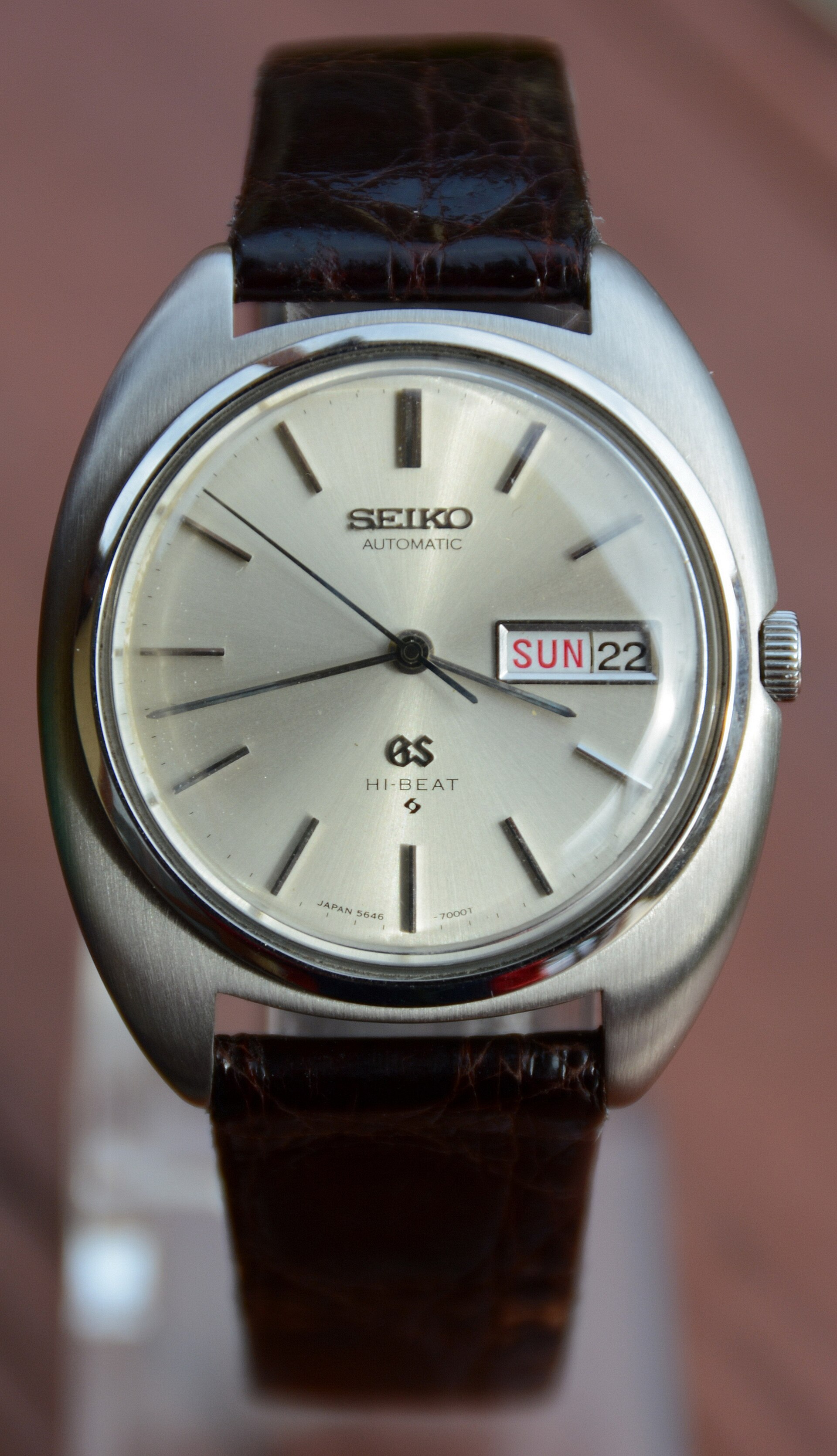
A first-period automatic Grand Seiko Hi-Beat with a day-date window. Ten beats a second was the lesson Suwa and Daini brought home from the observatory trials, and it went straight into the shop watches. Dnalor 01 / Wikimedia Commons - CC BY-SA 3.0 at
They put the name on quartz, then built a mechanical calibre that had to beat itself
The same company that had been chasing observatory points put a quartz wristwatch on sale in 1969. Mechanical Grand Seiko, having just published V.F.A., spent the next few years looking like a very beautiful answer to a question the factory had already moved past. When the name returned in 1988 it was on the 95GS, a quartz rated to ten seconds a year, with specially selected crystals and temperature compensation, and without the broad hands that had been the whole point of the Grammar. In 1993 calibre 9F83 arrived as quartz that could carry those hands: a twin-pulse motor for torque, a backlash auto-adjust so the seconds hand did not shudder, an instant date change, and a shield around the gear train. A current 9F such as the SBGX259 still lives on that idea, a 37 mm dress watch at plus or minus ten seconds a year. The SBGP001 later put 9F85 in a 44GS-style case, the Grammar taught to a battery.
1998 was the mechanical sequel. Calibres 9S55 and 9S51 were the first new Grand Seiko mechanical movements in twenty years, assembled at Shizukuishi to a revised Standard: +5 to -3 seconds a day, six positions, three temperatures, 17 days. The SBGR001, with 9S55, is the watch that made the modern Heritage case: razor hands, a bracelet you could swap, a date font designed to be read. Nobuhiro Kosugi's brief was eternal aesthetic appeal. Twenty-five years later the Heritage case is still the one they cut.
In 2009 calibre 9S85 put hi-beat back on the menu, 36,000 vibrations an hour for the first time in about forty years, with MEMS escape-wheel work and a 55-hour reserve. The SBGH001 was the steel regular-production version, Hi-Beat 36000 printed on the dial in case anyone had missed the point. In 2014 a 44GS GMT on 9S86, the SBGJ005, took the GPHG Petite Aiguille. A later steel 9S86 GMT such as the SBGJ201 kept the extra hand in the line.
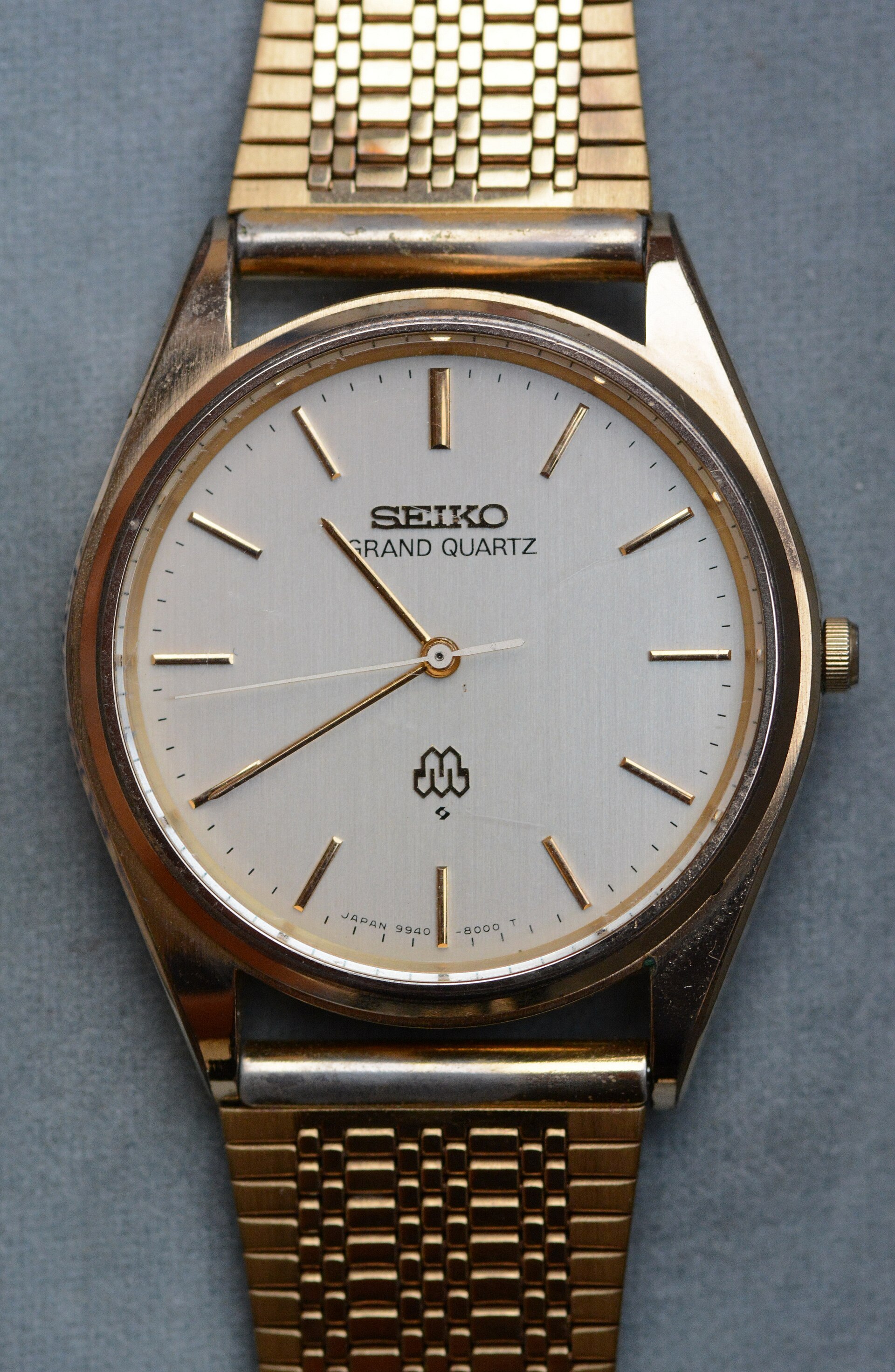
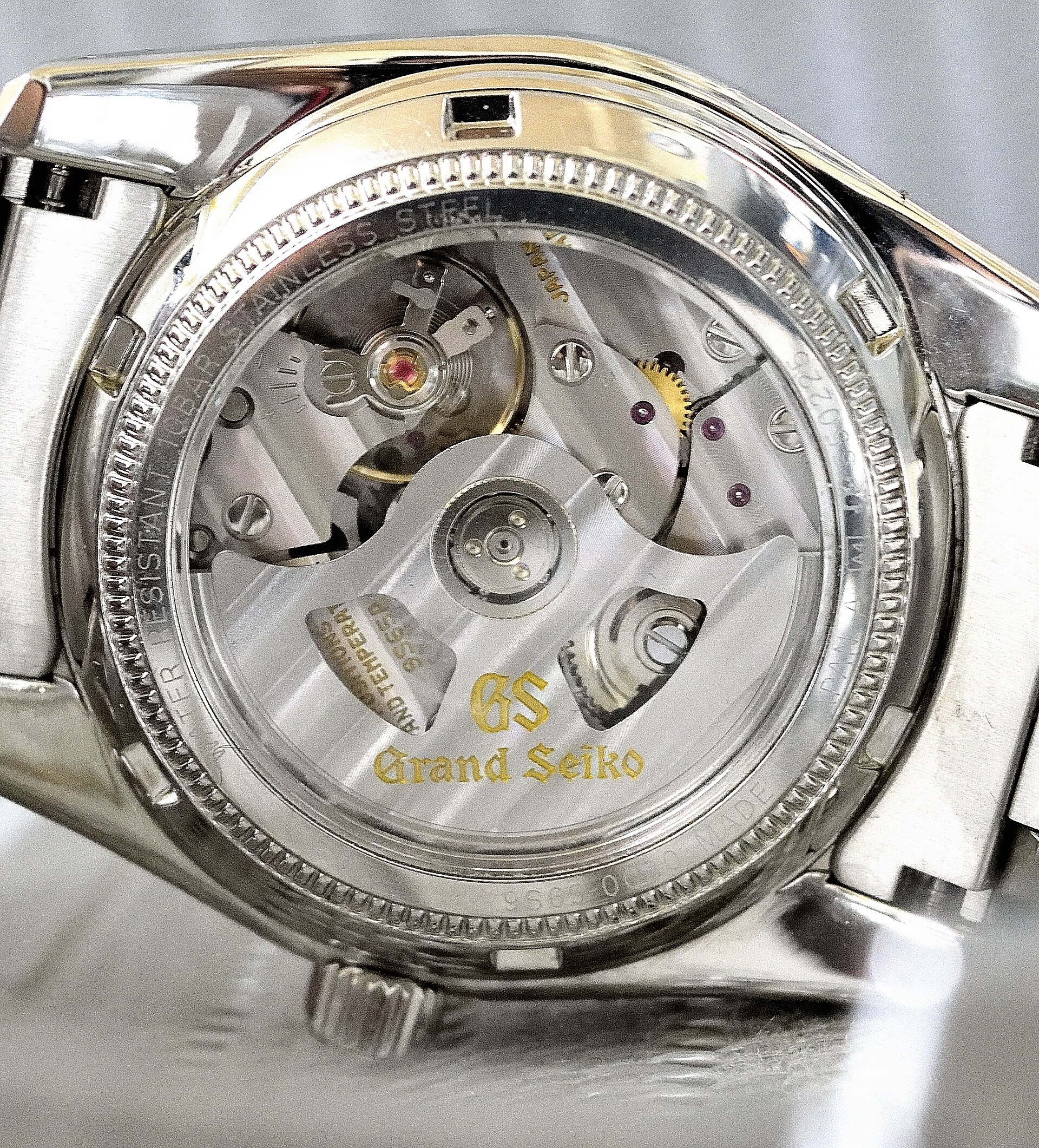
A 1979 Seiko Grand Quartz with the Twin Quartz calibre. This is the gap in the story, the decade when the same factory that had chased observatory points sold thin gold-toned quartz and left the mechanical Grand Seiko in a drawer. Dnalor 01 / Wikimedia Commons - CC BY-SA 3.0Calibre 9S65 through a sapphire back: the mechanical line that returned in 1998 and has been refined ever since. The rotor carries the GS lion in gold, which is the one piece of 1960 ornament the brand never gave up. STSPP / Wikimedia Commons - CC BY-SA 4.0
The seconds hand that glides, and a dial stamped like Shinshu snow
Yoshikazu Akahane started chasing a mainspring-powered watch with quartz stability in the late 1970s. The first commercial Spring Drive watches, still Seiko and Credor, arrived in 1999. Grand Seiko waited until the reserve was three days. Calibre 9R65 of 2004 uses the unwinding mainspring as its only power source and an electromagnetic brake, quartz oscillator and IC as the regulator. Accuracy is quoted as plus or minus 15 seconds a month, or about a second a day. The seconds hand does not tick and does not stutter. It glides. Collectors who grew up on lever escapements still argue about whether that counts as a seconds hand or a magic trick.
In 2005 the Shinshu studio put that calibre under a white textured dial modelled on the windswept snow around the workshop. The original Snowflake is the SBGA011, Seiko at 12 and Grand Seiko at 6, high-intensity titanium, 41 mm, a blue seconds hand and a power-reserve needle. In 2017 it was replaced by the SBGA211, the same object with Grand Seiko alone at 12. That dial is the international turning point. The SBGY002 carries Spring Drive into a thinner elegance case; the SBGA125, a 55th-anniversary 62GS in titanium, put 9R65 in the bezel-less shape of 1967 and limited it to a thousand pieces.
Grand Seiko had been sold internationally since 2010, still wearing both names on the dial, which confused anyone who thought Seiko meant a dive watch and a sensible price. Shinji Hattori, at Baselworld in 2017, presented Grand Seiko as an entirely separate brand. New watches put the Grand Seiko emblem at 12 and dropped the Seiko signature. The company behind it did not change, only the shop window.
They took Seiko off the dial, then grew a birch forest
The 2017 split is a branding story with a case to match. Collectors already had the Grammar of Design; what they got next was Evolution 9, announced in 2020 as a further development of that grammar toward wearability: a lower centre of gravity, a bracelet at least half the case diameter, broader indexes, a more emphatic 12. Calibre 9SA5 arrived the same year, a 36,000-vph automatic with a Dual Impulse Escapement, twin barrels and about 80 hours of reserve. The SLGH005 of 2021, the White Birch, Shirakaba on the Japanese pages, was the first continuous 9SA5 model, its dial stamped with the bark of the birch woods around Studio Shizukuishi in Iwate. It won the GPHG Men's Watch Prize that year. The earlier limited 9SA5 watches, including the yellow-gold SLGH002, had been 60th-anniversary pieces. The Birch was the one you could keep buying.
SLGW003 later put a manual 9SA4, Grand Seiko's first 10-beat hand-wound in about fifty years, into the same Evolution 9 vocabulary. The 44GS, never having gone away, keeps being recut: the SBGH345 is a current hi-beat 44GS in ever-brilliant steel with a red dial, Tanaka's grammar in a louder register. Mechanical 9S work now happens at Grand Seiko Studio Shizukuishi, opened in 2020 in a Kengo Kuma building on the Morioka Seiko site. Spring Drive and 9F remain at Shinshu in Shiojiri. The 1967 case still has to answer.
The First marked its own paper. The Snowflake borrowed a Japanese winter. Sixty years is a long time to spend becoming the thing you said you were in 1960, and the lion on the early case backs would recognise the ambition. The birch bark might take a moment.
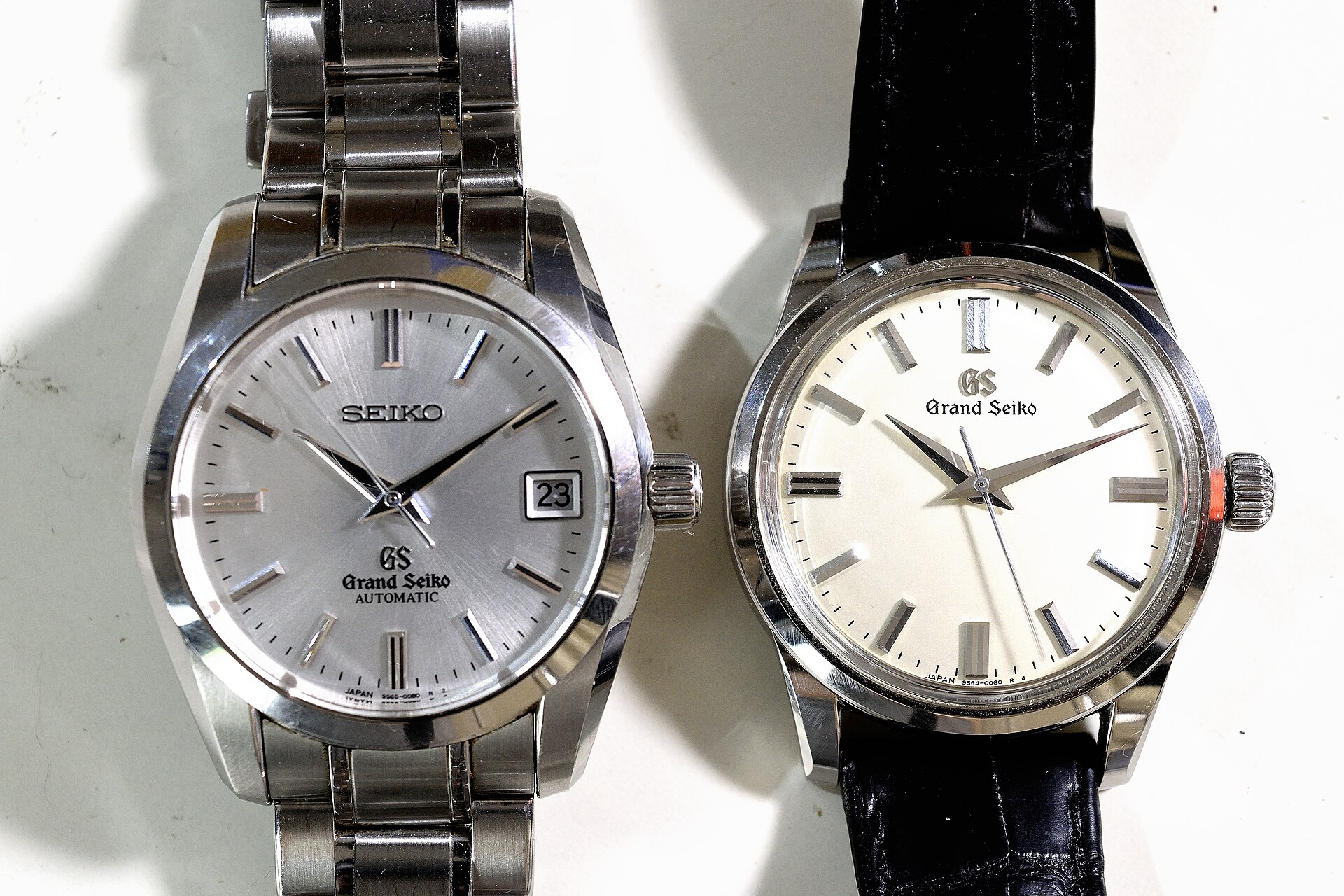
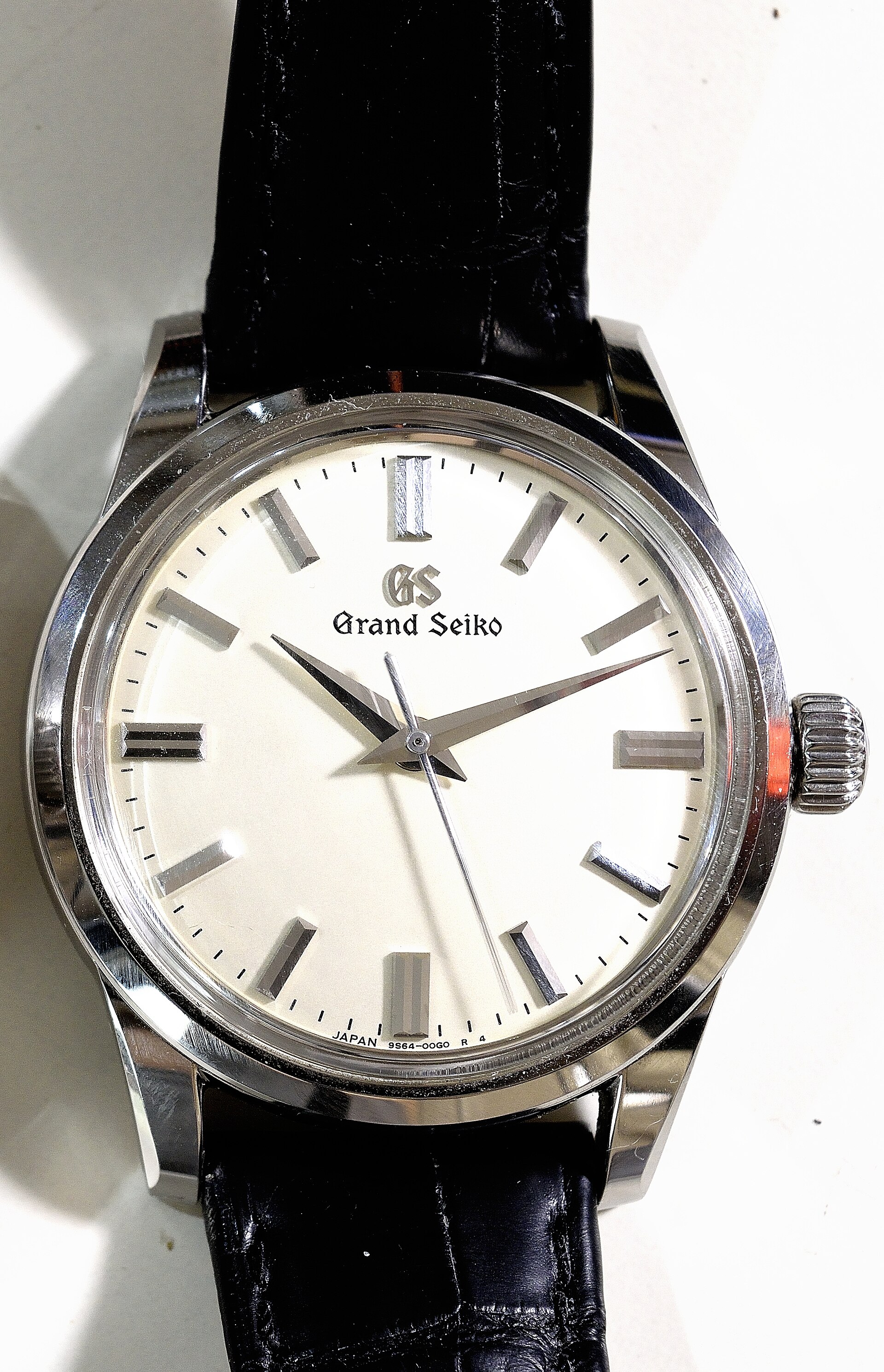
A hand-wound Grand Seiko dress watch with the post-2017 dial: the GS emblem and the name at 12 and nothing else. Collectors argued about the change for about a year, then bought the watches anyway. STSPP / Wikimedia Commons - CC BY-SA 4.0