Kikuo Ibe dropped his father's watch and wrote a brief with three tens. Forty years on, the shapes that survived are a square, a frog, a three-eyed brick and a resin octagon people still call a CasiOak.
Ibe dropped a watch, then spent two years throwing more of them out of a window
Kikuo Ibe was walking to work when a pedestrian bumped him hard enough to snap the strap of the mechanical watch his father had given him. The caseback came off, the hands came off, and the thing was finished. He would not name the maker, only that it was a Japanese three-hander with a date. Ibe was already at Casio, and the brief he wrote for himself was almost comically tidy: survive a 10-metre drop, 10 bar of water, a 10-year battery. He called it Triple 10. The name of the watch that came out of it is gravitational shock, shortened.
He put together Project Team Tough. After a year and more than 100 prototypes they were still stuck. The tests were not elegant. Prototypes went out of a third-floor bathroom window at Casio's research building, which happened to be 10 metres above the pavement. The breakthrough arrived on a day off, when Ibe was in the park next door and watched children playing with a rubber ball. The module needed to float inside the case the way the centre of a ball never quite feels the pavement. Two years and more than 200 prototypes later, that hollow, point-contact structure is still how a G-Shock is built.
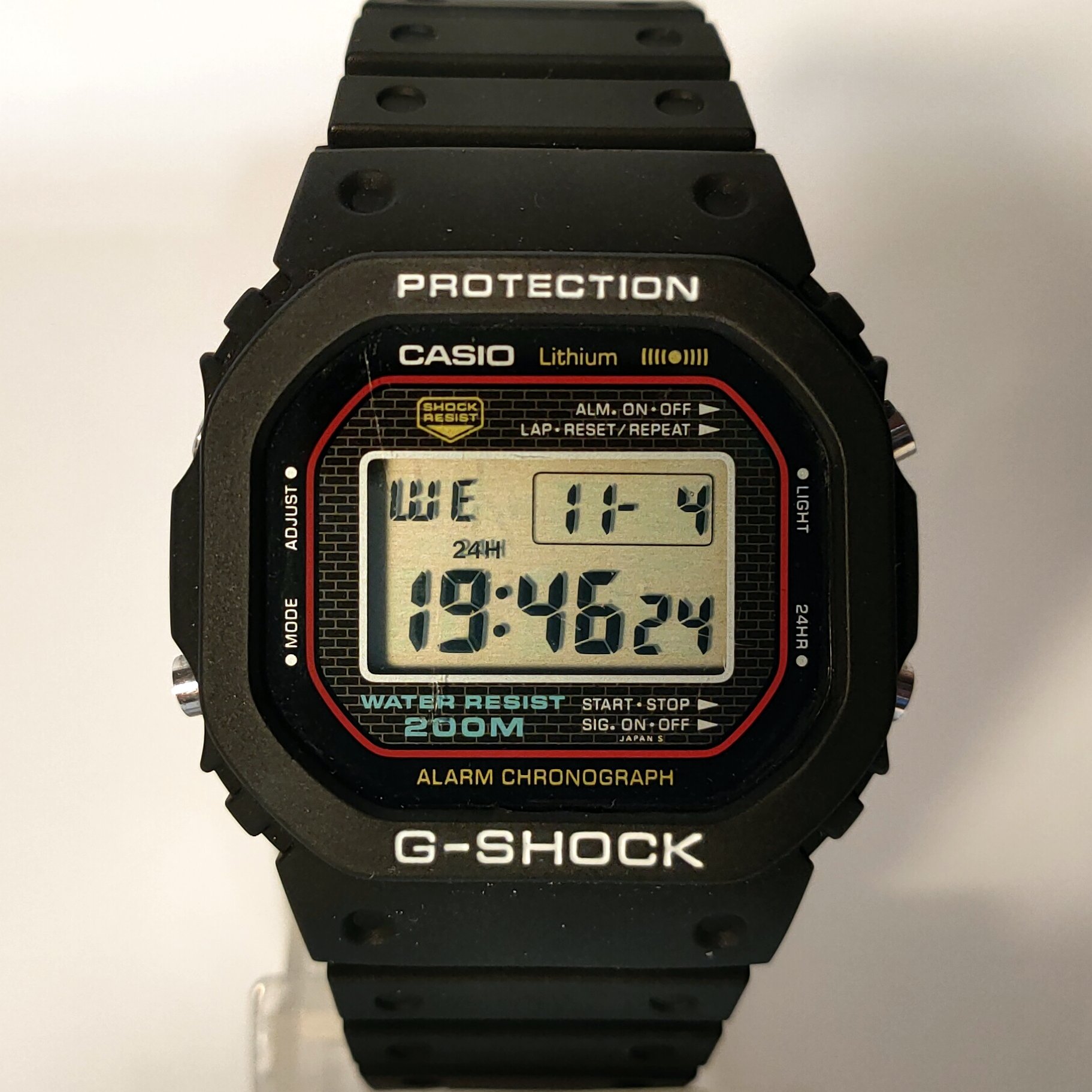
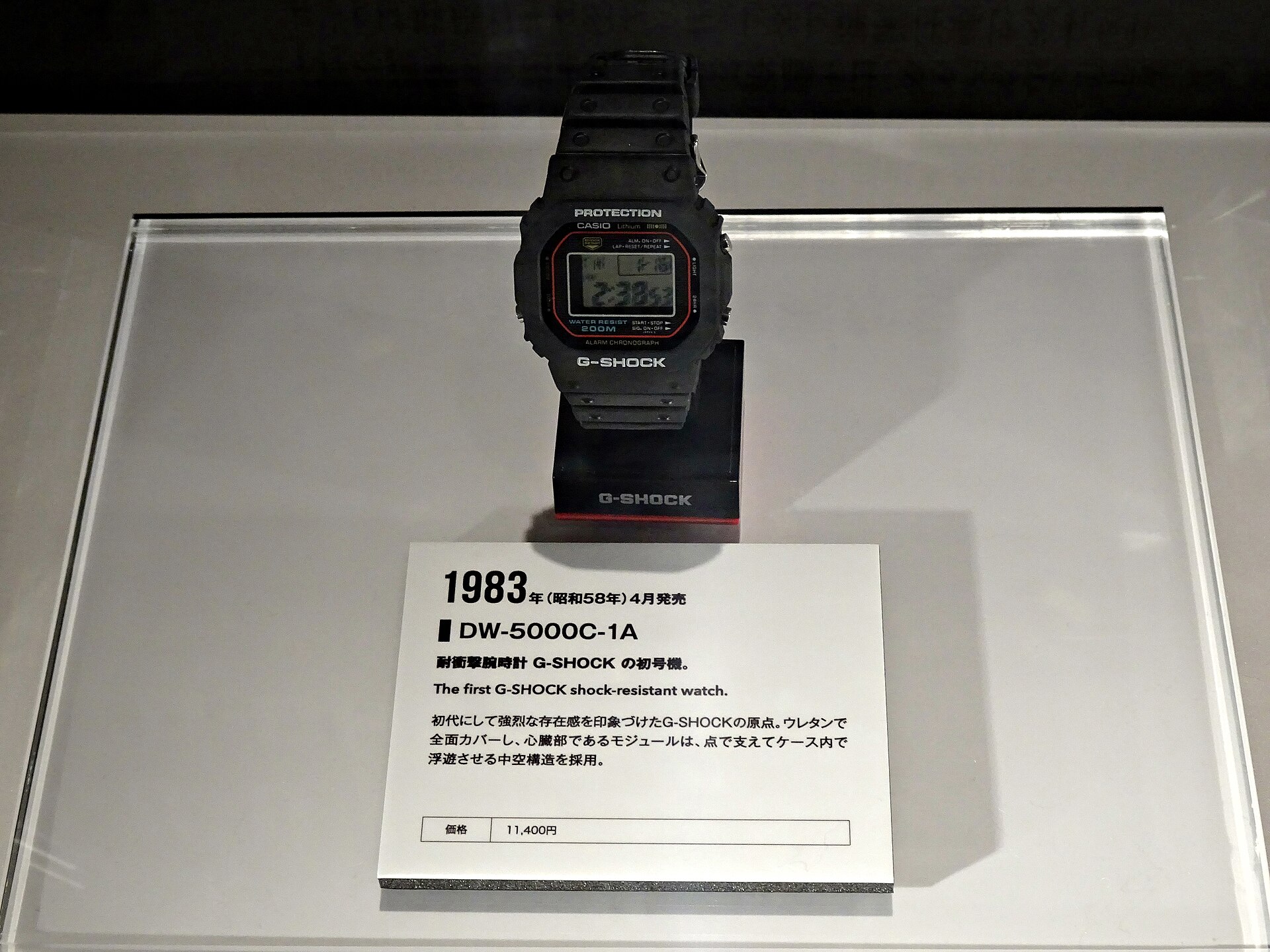
In April 1983 the DW-5000C-1A went on sale for 11,400 yen, black resin with red accents and a matching gold-accented DW-5000C-1B beside it. Japan was still buying thin dress watches, and jewellers were unimpressed by a resin brick that would never come back for repairs. America was easier. Casio's US team filmed a hockey player using a G-Shock as a puck; local television tried the stunt themselves, and the DW-5200C that took the slapshot picked up the nickname Hero. The original square had already beaten two of its own tens: 200 metres of water resistance, double the brief, and a battery Ibe later said managed seven years, short of the original ten.
The DW-5000C-1A on display with its plaque: the first G-Shock, released April 1983 at 11,400 yen, with the hollow structure that lets the module float inside the case the way the centre of a rubber ball never quite feels the pavement. ブルーノ・プラス / Wikimedia Commons - CC BY 4.0
The square that Casio has been reprinting since 1983
Ibe's brief left almost no room for styling. The octagonal bezel exists because it covers the case and the buttons when the watch hits something, and the strap bends downward so a drop hits resin before it hits glass. June 1987 brought the DW-5600C, the successor that kept the silhouette, split the water-resistance print between 20 bar at home and 200 metres for export, and became the square people actually bought. Keanu Reeves wore a DW-5600C in Speed, and the square went worldwide on the back of it. Casio answered in 1996 with the DW-5600E, an electroluminescent reprint that has stayed in the range ever since.
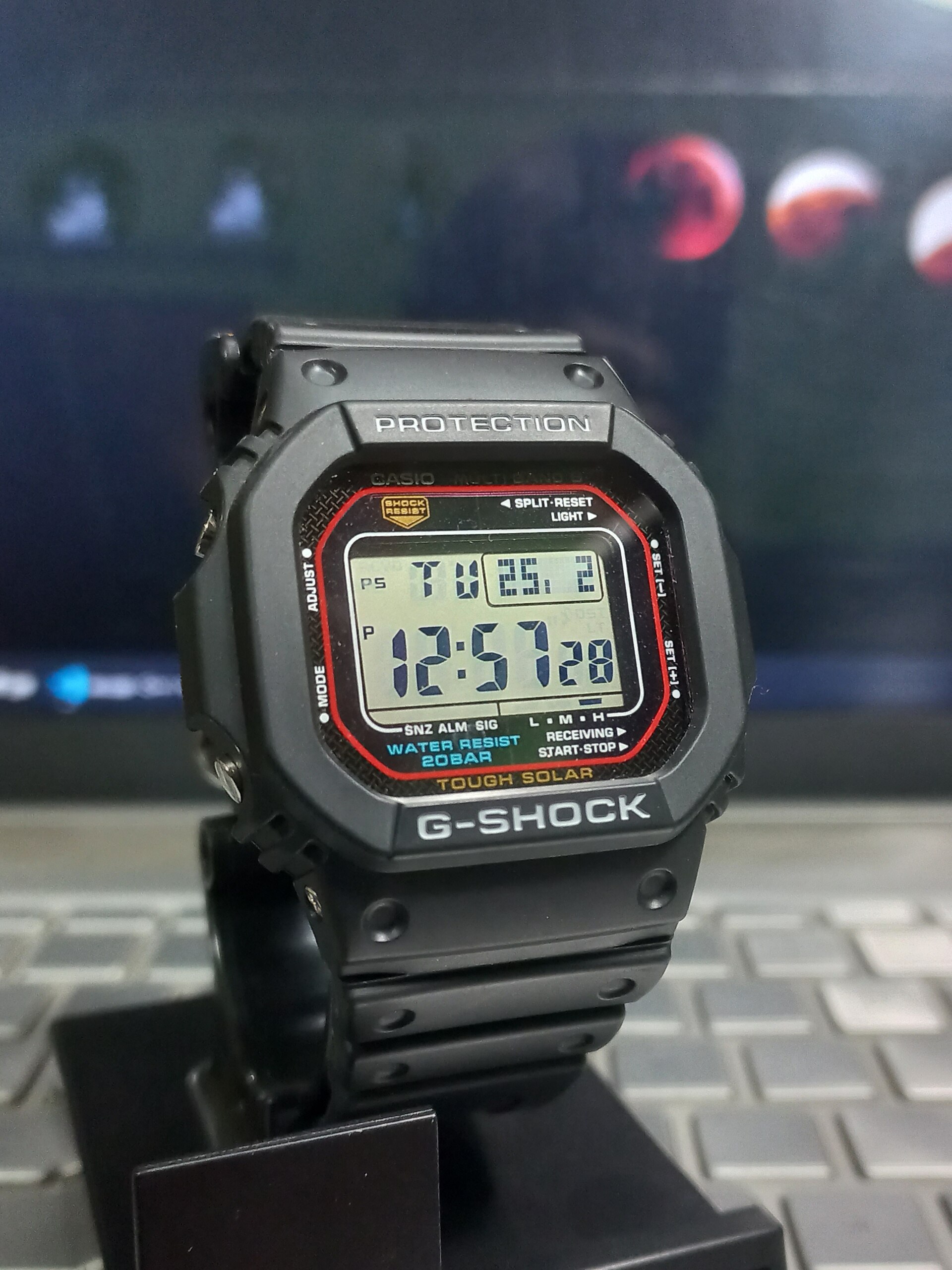
The DW-5600E-1V is the current black version of that reprint: resin, mineral glass, 200 metres, the familiar LCD. The solar and radio version of the same idea is the GW-M5610-1, Tough Solar and Multi-Band 6 in a slightly smaller resin square. If you want the original's face with steel around it, wait until 2018.
For G-Shock's 35th anniversary Casio put the square into stainless steel as the GMW-B5000D-1. Case, bezel, bracelet and a metal inner capsule, with a resin cushion in between because metal transmits shock the way resin never would. Tough Solar, Multi-Band 6, Bluetooth, 167 grams. The screw-lock caseback still says Shock Resistant. Collectors call it the Full Metal Square. The name is right about the case, and a little rude to the MR-G watches that did metal first.
A GW-M5610 on its stand. Same octagonal bezel and downward-bending strap as 1983, now with a solar cell around the display and a radio receiver that sets the time overnight. This is the square most people actually wear. Md. Rifat Hasan Jihan / Wikimedia Commons - CC BY-SA 4.0
Ten years after the square, Casio built a dive watch that actually met ISO 6425. The DW-6300-1A of 1993 is the first Frogman: an asymmetrical resin brick, a screw-in caseback with a frog on it, an ISO 200-metre diver's rating, and the first G-Shock to get a pet name of its own. Casio's own history still calls it the first Master of G. The development code was Frogman from the start, after frogmen, the old nickname for combat divers. Tatsuya Izaki, who planned it, later said they had special-forces wearers in mind. It cost 18,000 yen when a basic G-Shock was 11,000, the buckle was gold from day one, and the office asked if they were sure.
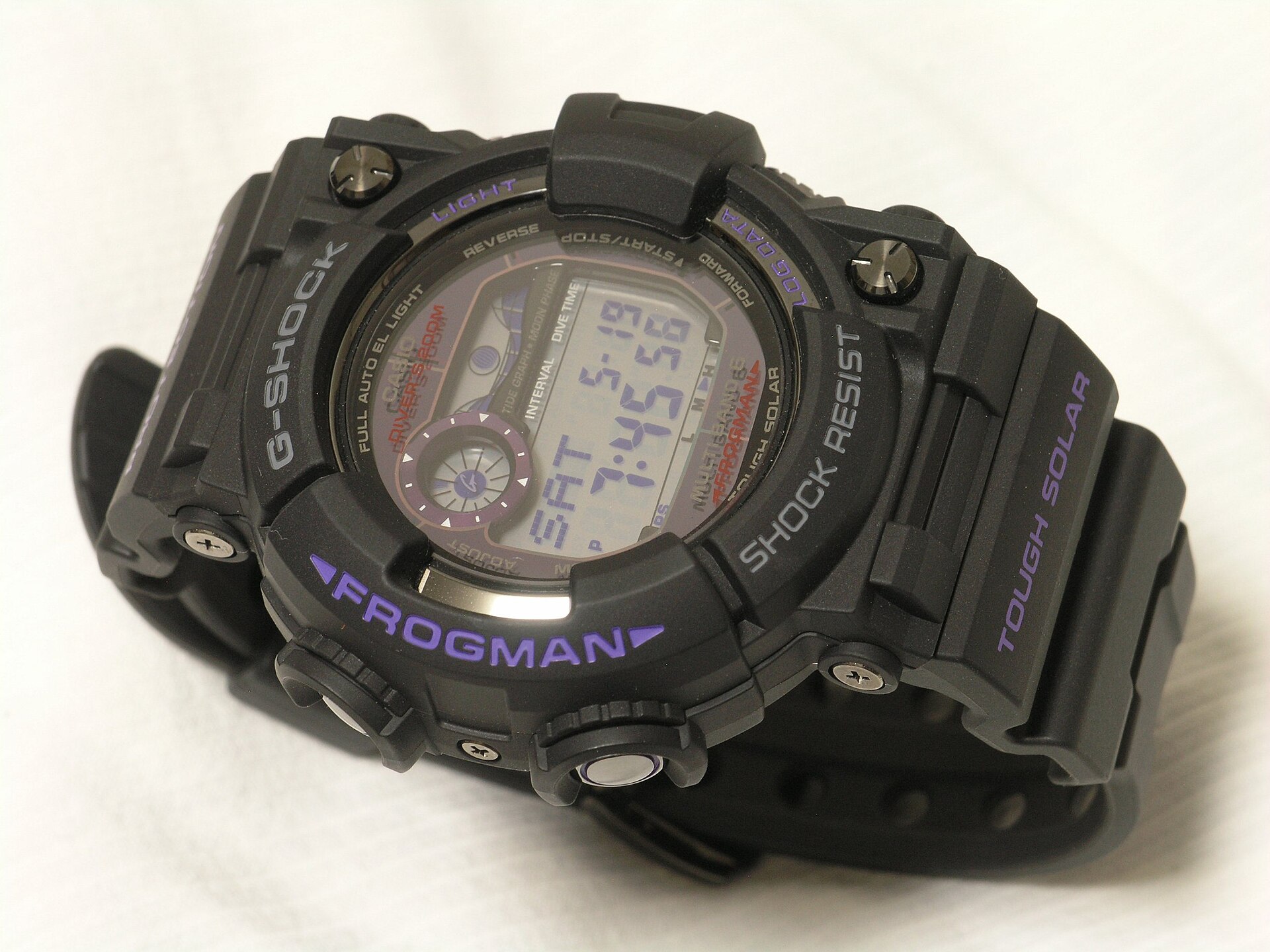
The second generation, the DW-8200-1A of 1995, put a titanium bezel on the same lopsided case. Casio still presents it as the watch that made the titanium obvious. The fifth, the GWF-1000-1 of 2009, added Tough Solar and Multi-Band 6 without abandoning the offset face. Casio still says Frogman is the only G-Shock line built to the ISO dive standard. Every other G-Shock will survive a swimming pool.
A GWF-1000 Frogman in a purple-accent colourway. The case is offset so the display sits where a diver can read it with the wrist turned, and the word FROGMAN has been on the bezel since the second generation. Kansai explorer / Wikimedia Commons - CC BY-SA 3.0
Three eyes, a light button on the front, and the 1990s
The DW-6900 arrived in 1995 as a round G-Shock with a three-section LCD Casio still calls the Triple Graph, and a light button on the front that it had first tried on the DW-6600 a year earlier. Square was the house shape. Round with three eyes was the one that went into hip-hop videos. Alongside the square, it became the brand's most recognisable case. The hip-hop years are when the watch stopped being only a tool. Eminem wore a G-Shock. So did a Beastie Boy. The 6900 is the case those years made famous.
The DW-6900-1V in the range now is the black baseline of that case, still round, still three-eyed, still with the light on the front. What counted as oversized in 1995 now wears as a medium G-Shock. Nobody in baggy jeans would have believed that.
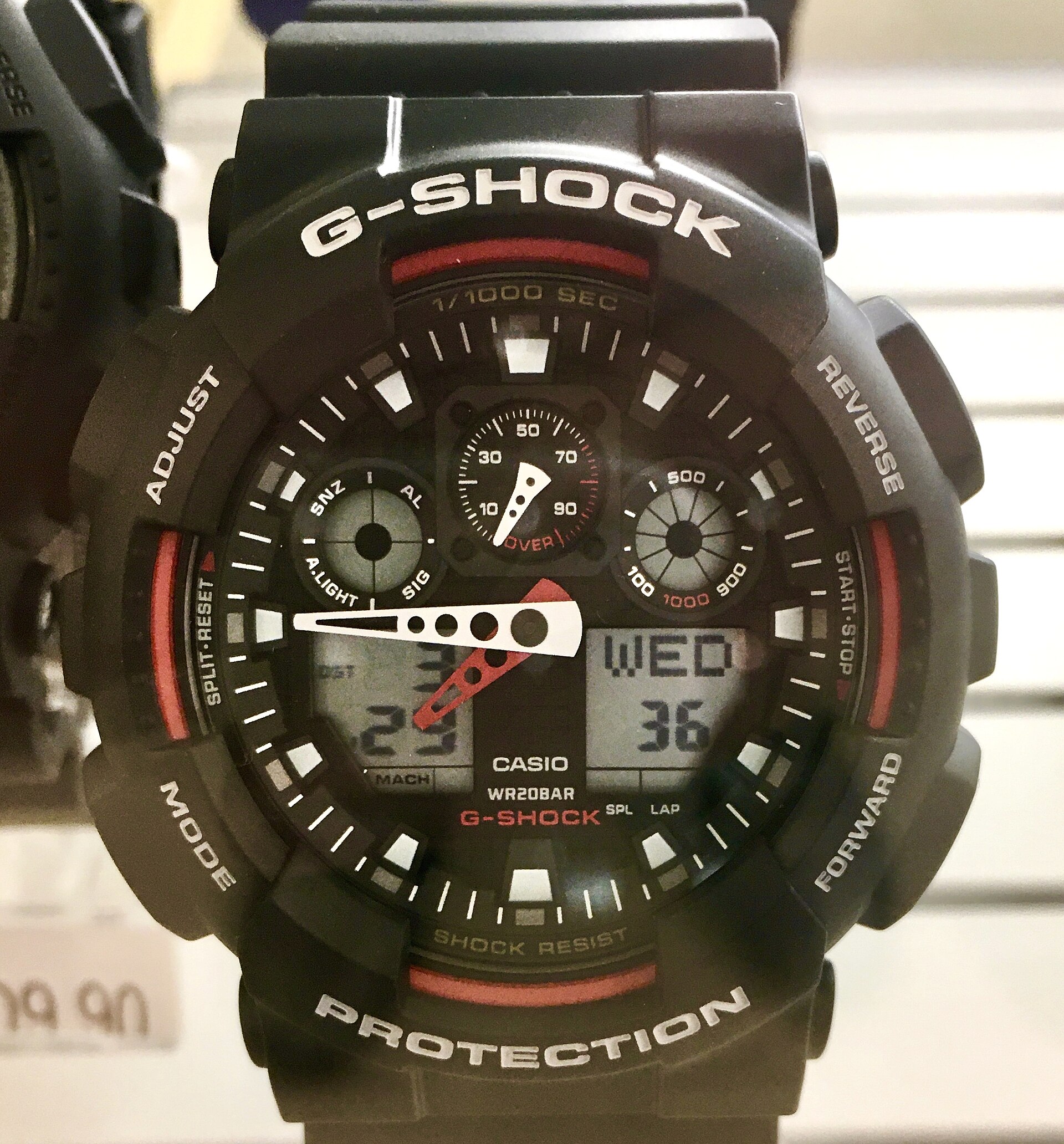
The other brick that ate the 2010s is ana-digi and enormous. The GA-100-1A1 is the January 2010 Black Out colourway of the GA-100: 55 by 51.2 millimetres, negative LCD, LED, the big-case platform that, with the later GA-110 family, pulled analogue G-Shocks back into the middle of the range. The first analogue G-Shock was the AW-500 in 1989. The GA-100 is simply the one people keep putting logos on.
A red-and-black GA-100 in a shop display. Analogue hands over a negative LCD, 55 millimetres across, and the platform that pulled analogue G-Shocks back into the middle of the range and onto every collaboration list. Pittigrilli / Wikimedia Commons - CC BY-SA 4.0
Casio built an analogue square. The internet named it after a Royal Oak.
The GA-2100 arrived in Japan in August 2019 as a thin analogue-digital G-Shock with Carbon Core Guard and an octagonal bezel. Casio's designers have said they were looking at the DW-5000C. The blacked-out GA-2100-1A1 is 48.5 by 45.4 by 11.8 millimetres and 51 grams, the thinnest men's G-Shock at launch. American list price was 99 dollars. Then the nickname arrived.
Collectors called it CasiOak because the octagon looked, from across a room, like a Royal Oak. The name stuck within months of release. The blacked-out 1A1 sold out. Casio has spent the years since adding solar, Bluetooth, metal bezels and smaller cases to the 2100 family. Casio's designers still trace that octagon to 1983.
Land, mud, and a survival brick with three sensors
Master of G is Casio's name for the specialist bricks. Frogman took the sea. The land side grew a family of mud, dust and survival watches, each with a man in the name until the names got longer. The Rangeman GW-9400-1, announced on 11 September 2013, was the first G-Shock with Triple Sensor: compass, altimeter and barometer, thermometer, plus Tough Solar and Multi-Band 6. Casio billed it for survival work. The dedicated sensor button has a metal cover you can find with gloves on. Whether it is officially mud-resistant depends which Casio office you ask. Japan was coy. Europe and America printed it.
The analogue-digital version of that idea is the Mudmaster. The GWG-1000-1A of 2015 put Triple Sensor, Tough Solar and Multi-Band 6 into a 56.2 millimetre resin case with Rangeman-style front screws and button guards, and it made expensive G-Shocks ordinary in the US and Europe. The GG-B100-1A of 2019 is the lighter carbon take: Carbon Core Guard, Bluetooth, a quad sensor with a step counter, no solar. It is still a brick, only a slightly more polite one.
Once the shapes were famous, Casio discovered they were also blanks. The DW-5600 and DW-6900 have spent decades taking other people's colours. In March 2010 A Bathing Ape released a DW-6900 through the BAPE store in Harajuku, with an ape head that only appears when you hit the light. Gorillaz got ana-digis. Bamford got a 6900. Kid Cudi and Pharrell had 6900s set with stones after they left the factory, a long way from a construction-site brief.
The GA-100 and later the 2100 joined the same economy. You can spend a career collecting only collabs and never own a plain black G-Shock, a thought that would have baffled Ibe in 1983 and probably still does. Under the print the watch is still a square or a 6900.
Then they made it in metal, in Yamagata, and charged like they meant it
The MR-G line arrived in 1996, and Casio still points to the MRG-100-1 of November that year as the first metal G-Shock. Ibe's team had been working after hours on an unbreakable metal watch, because the resin ones had started to look young for the people who had grown up in them. No crown, five times the price of a regular model, a bumper bezel with shock-absorbing packing. The same year's MRG-1-1 sat in the new range beside it. Ibe later talked about Yamagata, where takumi still finish MR-G watches in small batches. Majesty and Reality, if you believe the initials. Ibe's own line was simpler: metal is harder to protect than resin, and that was the whole point.
The square eventually got the same treatment at the top. The MRG-B5000B-1 of 2022 is the 5000-shaped MR-G, a digital square built in Japan as a luxury object. Beside it sits the MT-G line, the mid-metal family; the MTG-B3000B-1A of 2022 is the compact steel one, 50.9 millimetres. Full metal for people who wanted the square in steel had already arrived as the GMW-B5000. MR-G is the one that will sit next to a suit and still take the drop test.
Ibe has said his next goal is a watch that can survive outside a spaceship, and he would like to still be working on it in 2035. Until that one exists, the icons are the DW-5000C's grandchildren, still being reprinted in resin, in steel, and, if you insist, in titanium from Yamagata.